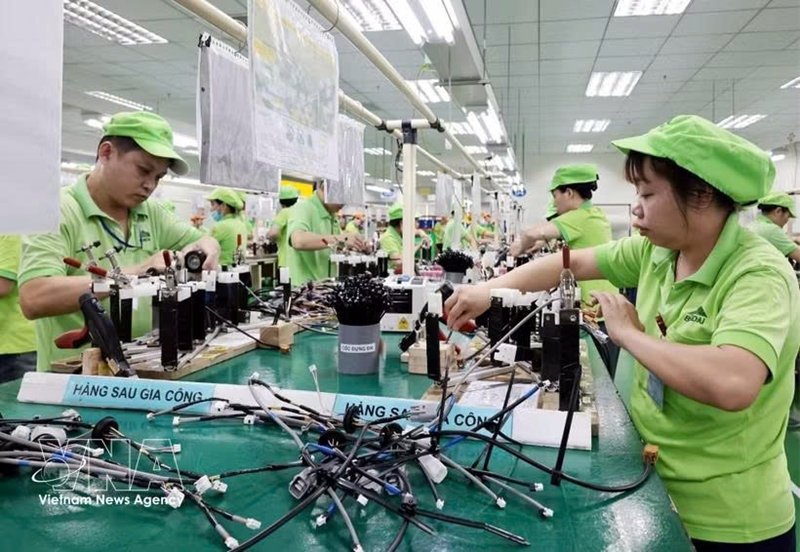
A production line for electrical wire harness assemblies at Bandai Company in Vietnam, as the manufacturing sector remained the country’s key economic growth driver in H1 2026. (VNA)
On October 2, Vietnamese Deputy Prime Minister Nguyễn Văn Thắng signed Decision No. 1919/QD-TTg, amending and supplementing the country’s 2022 foundational framework to achieve an “investment grade” sovereign credit rating by 2030.
The new decree introduces adjustments to Clause 1 of Article 1 on objectives and Clause 2 of Article 1 on main solutions. Some of the specific objectives include securing a credit rating of at least Baa3 (for Moody’s) or BBB- (for S&P and Fitch) or higher by 2030. The framework also targets an average annual gross domestic product (GDP) growth of at least 10% for the 2026-2030 period, aiming to elevate per capita GDP to 8,500 US dollar by 2030. These growth milestones are coupled with strict upper limits for public debt at 60% of GDP and a national budget deficit at 5% of GDP.
Notably, Vietnam pledged to continue refining its legal framework for monetary policy and transparency, as well as enhancing system efficiency by optimsiing inter-institution coordination.
Furthermore the decision calls for the implementation of solutions outlined in Resolution No. 79-NQ/TW regarding the development of the State-owned economic sector. This will be driven through restructuring and integrating science, technology and innovation within State-owned enterprises (SOEs).
Measures on environmental protection are also included, with the government committed to proactively responding to climate change by refining institutional and policy frameworks.
These policy shifts bind the credit rating targets directly to modern economic metrics—like digital transformation, tech innovation and environmental sustainability—rather than just fiscal management.
What does this mean for businesses?
For domestic and foreign enterprises, a higher sovereign rating directly translates to cheaper international capital. As Vietnam lowers its national credit risk, local commercial banks and private corporations will benefit from reduced overseas borrowing costs. Furthermore, the government’s aggressive push into digital infrastructure, environmental, social and government (ESG) compliance and state-enterprise innovation opens massive procurement and partnership tracks for private tech and green-energy firms.
Kala Advisory helps investors turn sovereign rating updates and policy shifts like these into targeted, country-by-country entry plans across Southeast Asia. Visit kala-advisory.com.
About The Author