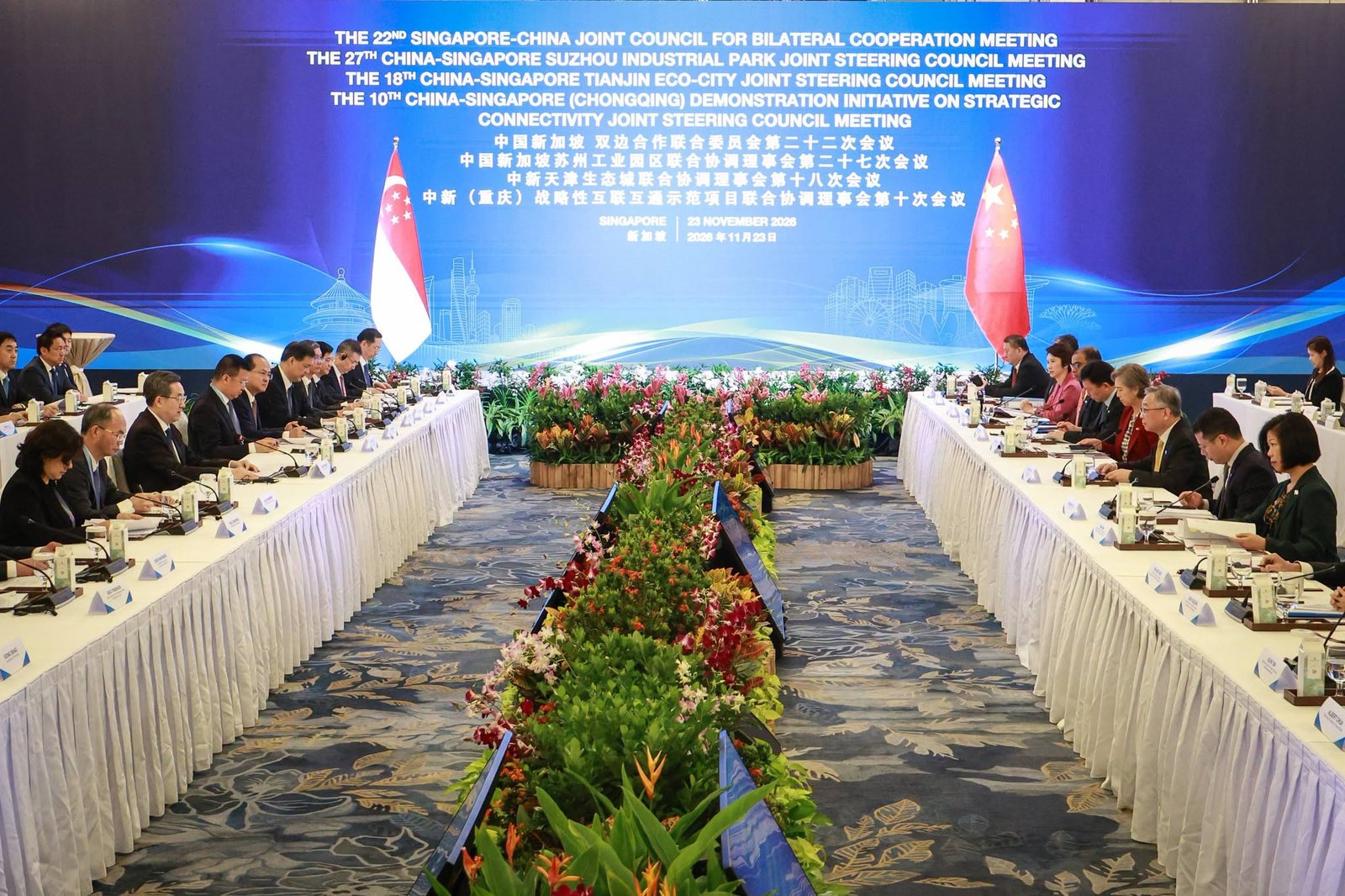
Singapore and China hold bilateral cooperation talks in Singapore announcing 29 agreements to strengthen economic ties on November 23. (Ministry of Digital Development and Information)
On November 23, Singapore and China agreed to 29 Memorandum of Understanding (MOUs) and agreements to expand cooperation in trade, finance, technology, food security and other sectors, as both countries explore to strengthen economic ties.
Singapore Deputy Prime Minister Gan Kim Yong and Chinese Vice Premier Ding Xuexiang co-chaired the 22nd Joint Council for Bilateral Cooperation (JCBC) and related meetings, reviewing progress across their bilateral cooperation projects.
The agreements cover digital trade, innovation, financial connectivity, public health, agricultural science and research. Both countries also agreed to explore stronger payment links and cooperation in financial markets, including measures to support the use of the Chinese renminbi.
Singapore has also approved China’s Hainan Province to export frozen and chilled poultry, pork and poultry eggs. The move is expected to expand Singapore’s food import options and strengthen its food security.
During the meetings, they discussed upgrading the China-Singapore Free Trade Agreement (CSFTA) and expanding cooperation in the green and digital economies, science and technology, and healthcare. Both sides also agreed to deepen cooperation in emerging industries, including embodied AI, through the Suzhou Industrial Park (SIP) partnership.
The Tianjin Eco-City project will broaden its focus beyond infrastructure and urban development to include economic growth, research, innovation and housing. Meanwhile, the China-Singapore (Chongqing) Demonstration Initiative on Strategic Connectivity will advance digital trade, regional supply-chain links and green logistics.
The two leaders reaffirmed their commitment to free trade, multilateralism and a rules-based international order amid an uncertain global environment.
The agreements signal efforts by Singapore and China to strengthen economic ties through practical cooperation, particularly in emerging technologies, digital trade and regional connectivity.
As Singapore prepares to assume the ASEAN chairmanship in 2027, these bilateral initiatives could provide momentum for its broader regional agenda. Their impact will depend on how the commitments are implemented and whether they deliver benefits for businesses and both economies.
About The Author