
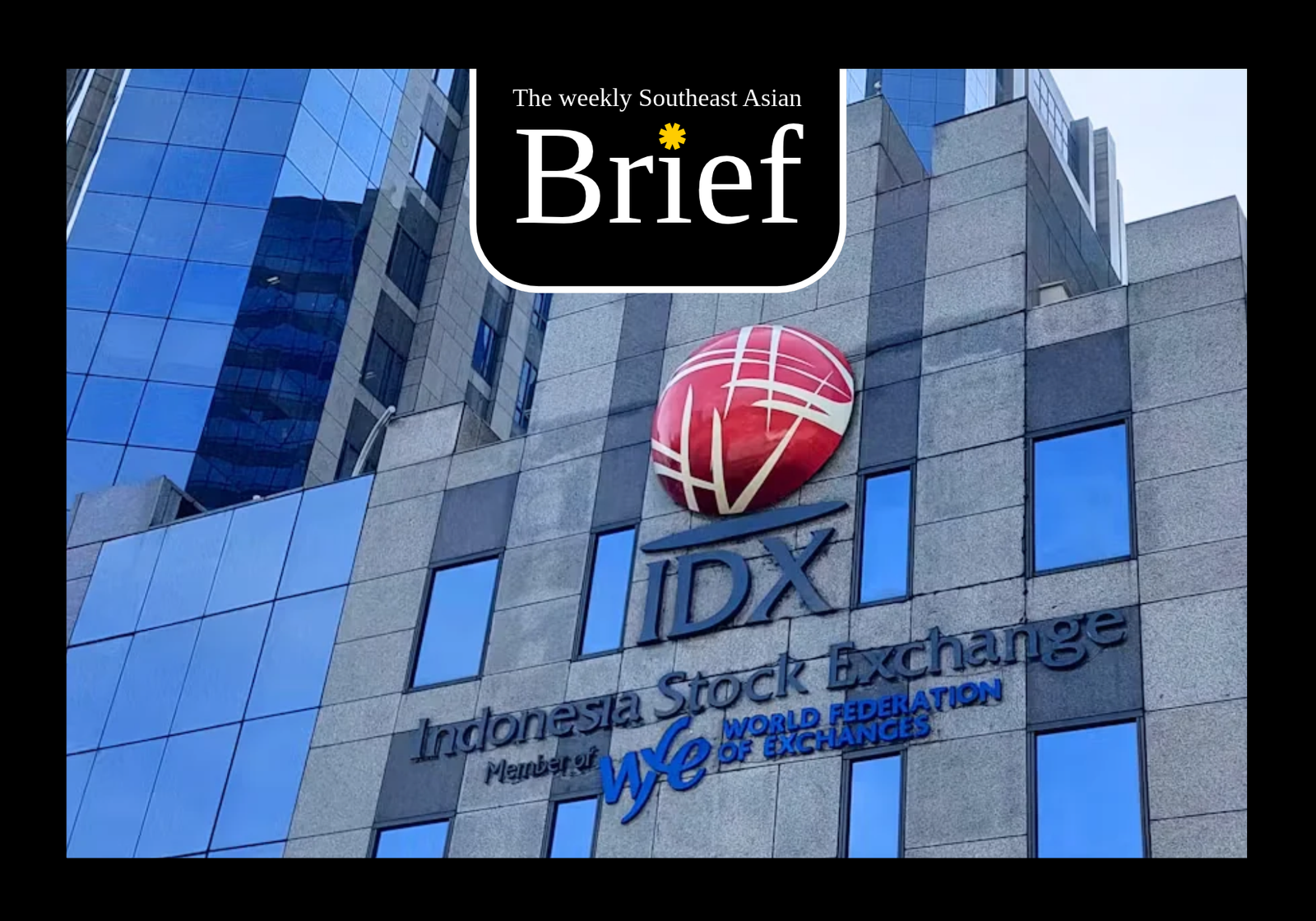
Indonesia’s stock exchange (IDX) building in Jakarta. (Unsplash/Ruben Sukatendel)
Indonesia’s benchmark Jakarta Composite Index (JCI)—dommestically known as IHSG—closed down 41.01 points (0.8%) on October 30, hovering precariously in the red zone at 5,057 level. This adds to a poor year for Southeast Asia’s second biggest stock market, whose market capitalisation fell from Rp16,014 trillion (950 billion US dollar) in January to Rp9,157 trillion (505 billion US dollar) on 16 October.
Of note, earlier before the opening bell, market analysts had anticipated the index would breach the psychological 5,000-point floor threshold. They argued that key technical indicators, namely the widening of Moving Average Converge Divergence (MACD) histogram, coupled with a Death Cross formation in the pivot area, demonstrated lingering selling pressure across the country’s capital market.
Ultimately, Friday’s close capped a predominantly downward trend throughout the week, culminating in a staggering weekly loss of over 7%.
A blip was experienced solely in mid-week when the index climbed 0.31% to reach 5,282. This temporary rebound followed London Stock Exchange Group (LSEG)’s subsidiary, FTSE Russell, decision to maintain the status of Indonesia’s capital market within the Secondary Emerging Market Category, thereby keeping it off the downgrade watchlist.
Conversely, the surrounding days were starkly bearish, with the index plunging nearly 2% from 5,373 on October 26 to 5,266 the following day. Experts attributed this persistent negative sentiment to the previous week’s reclassification proposal by American finance giant MSCI, which triggered aggressive, continuous capital outflow. The resulting shockwaves reverberated through the end of the month. On this final trading day, the index briefly sank to a bottom low of 4,979 points, surpassing the previous support floor of 4,996 recorded on October 19.
Ideally, such turbulence should provoke scrutinisation on how the underlying structural issues are being handled.
For context, the IHSG acts as the primary benchmark index that tracks the price performance of all public companies listed on the Indonesia Stock Exchange (IDX). It represents aggregate investor trust in the country’s economic trajectory. Underpinning it, therefore, is the domestic economic resilience, as well as the global sentiment towards Indonesia.
For foreign capital, the IHSG accounts for a primary consideration in determining whether to allocate assets into the country. Put simply, a growing confidence and optimism will accordingly be exhibited in an upward, bullish trajectory. Conversely, a downward-sloping chart, as seen in this week’s IHSG performance, showcases a weakening market sentiment.
Take, for example (as mentioned previously), MSCI’s recent October 15 announcement regarding a potential downgrade of Indonesia from an “Emerging Market” to a “Standalone Market”. The global index provider cited a lack of transparency, alleged coordinated trading and weak regulatory enforcement. MSCI therefore stated that an Emerging Market status is “no longer appropriate,” and even the one-stage-lower status of a Frontier Market “would not properly recognise the depth of the market problems”.
And although the final decision will only be made next year, MSCI currently imposes a temporary freeze on Indonesian equities, meaning no increase will be permitted for the Foreign Inclusion Factor (FIF) or the Number of Shares (NOS).
This measure consequently curbs investors’ appetite for Indonesian capital, given that it eliminates the upside potential for higher foreign inflows into the Indonesian stocks. This undoubtedly exacerbated the downgrading threat, which ultimately triggered capital outflow. It was vivid precisely on the consecutive day of the announcement, on October 16, when the JCI tumbled by 11,57%—a plunge so severe that it forced a 30-minute trading halt at the market open. It was the steepest one-day drop since the 1998 Asian financial crisis.
The last time the IHSG performed this badly was six years ago, admittedly induced by the external shock of the Covid-19 pandemic. A global health lockdown and economic halt pushed the index’s bottom level down to 3,911 in March 2020, before the market staged a staunch 66.3% rebound within 43 weeks. In fact, by 2022, the index had fully transcended pre-pandemic baselines, climbing comfortably into the 6,000-7,000 point territory.
Analysts attributed that historic comeback to the measures orchestrated by the market regulators, namely the Financial Services Authority (OJK), the central bank (BI) and the IDX. The combination of defensive regulatory interventions and aggressive monetary easing were the main engines.
Drawing from that precedent, a clear conclusion is that domestic economic capability matters most. The current administration, however, seems unsettled—at least in terms of how it will navigate and handle the status demotion threat from MSCI.
Indeed the OJK and the IDX have announced a series of regulatory and structural reforms such as lowering the ownership disclosure threshold from 5% to 1% and, prominently, establishing an independent body, the “High Shareholding Concentrated” committee, to monitor saham gorengan(effective November 2). Saham gorengan, literally “fried stocks”, are thinly traded, usually small-cap Indonesian shares whose prices are pushed sharply up and down by speculators, often with little connection to the company’s fundamentals. But these efforts might be well-outweighed by, for instance, the President’s defiant response towards MSCI claim, in which he accused “foreign entities” of “trying to intimidate” Indonesia.
Furthermore, market monopoly and manipulation have been evidenced in choking the public free float. It was the OJK who, on October 16, disclosed that several trading actors (conglomerates, to be precise) had disguised their identities to acquire a massive chunk of shares in heavyweight companies like Barito Renewables Energy (BREN), Petrindo Jaya Kreasi (CUAN) and Dian Swastika Sentosa (DSSA).
This is not to mention that the heavy capital flight (amounting to a 38% year-to-date crash) is artificially cushioned by domestic forces that have stepped in to buy up the index. A case in point is the state-owned wealth fund, BPI Danantara, which now functions as a systemic shock absorber by purchasing discounted equities primarily from blue-chips, stated-owned enterprises such as Bank Mandiri, Bank Rakyat Indonesia (BRI), Bank Negara Indonesia (BNI) and Telkom Indonesia.
Altogether, these circumstances must serve as a call to action for domestic reform, with the market regulator shepherding it. Without doing so, or by continuing their unsustainable business-as-usual practices, Indonesia risks materliase the worst-case scenario for its capital market: a downgrade to Standalone status, which textbooks have well-documented to result in currency depreciation, inflation and domestic instability.
About The Author


One thought on “After Its Worst Week Since 2020, Can Indonesia’s Stock Market Avoid a Downgrade? ”