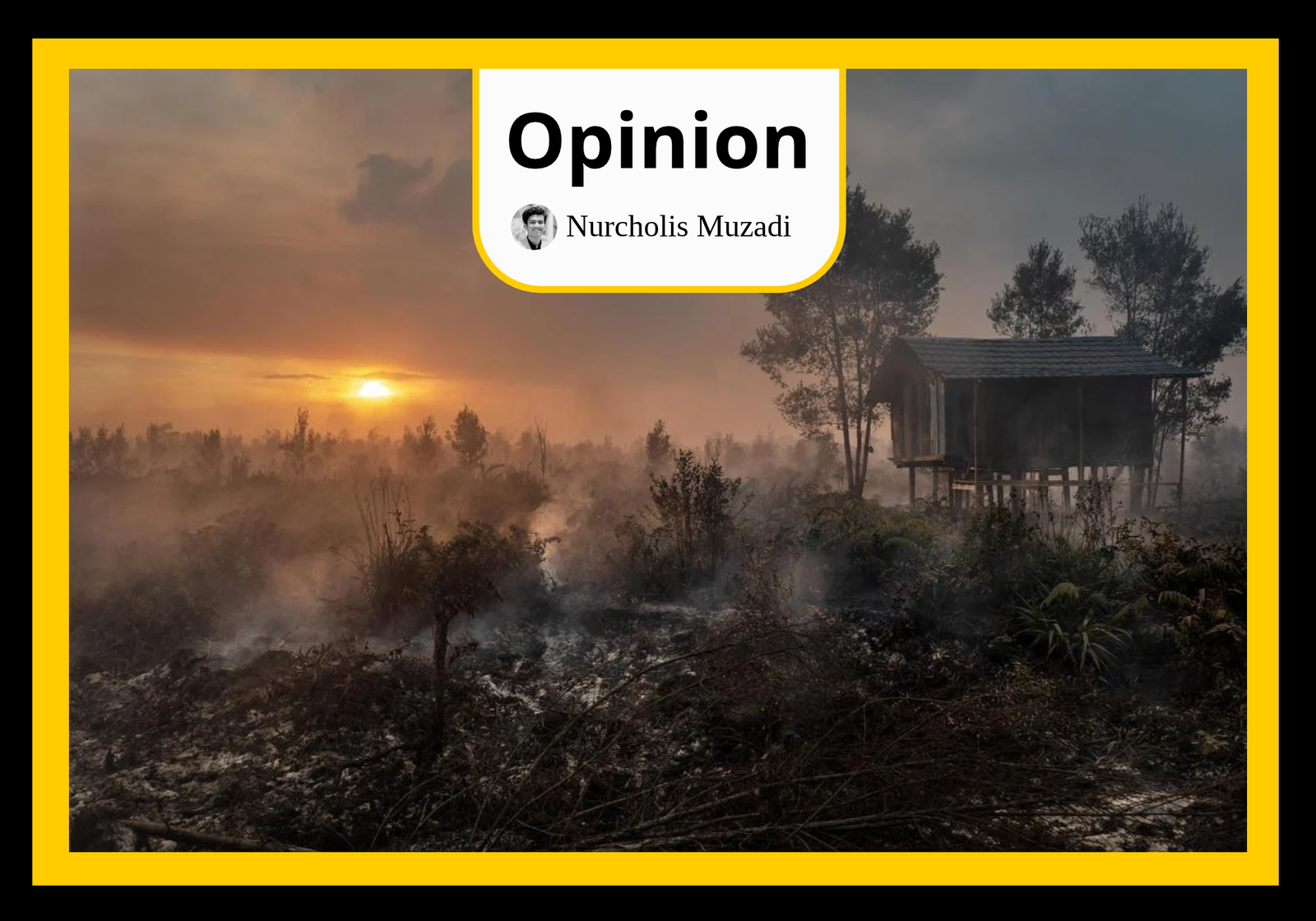
Burnt peatland in Central Kalimantan, Indonesia, following recurring forest and land fires during the 2026 dry season. (Krismes Santo Haloho/Mongabay Indonesia)
Nurcholis Muzadi is a postgraduate student in International Relations at Universitas Gadjah Mada (UGM). The views expressed are the author’s own and do not represent SEA Daily or that of another organisation.
In the annual dry season, Indonesia faces a cyclical crisis: forests and peatlands burn, haze crosses national borders and, ultimately, neighbouring countries brace for the consequences. The recurrence of these fires raises a question that emergency responses alone cannot answer. Worsening air pollution in Singapore and Malaysia that has been peaking since late September again again evidenced that the consequences of Indonesia’s fires extend beyond its borders. Meanwhile, the persistence of fires within Indonesia points to a problem that goes beyond the capacity to extinguish them. When the same crisis returns year after year, the more pressing question is whether the response addresses its root causes or merely manages its consequences.
The distinction matters because haze is not simply a natural disaster that arrives with the dry season and disappears when the rains return. Its recurrence also raises questions about how fire-prone land is managed, how environmental obligations are enforced and whether those responsible are held accountable. It goes without saying that the Indonesian government cannot evade its responsibility to address these problems at home. Yet, when the consequences turned transnational, leaving countermeasures solely to domestic institutions can no longer be justified as a sufficient solution. In this matter, ASEAN must therefore do more than coordinate firefighting and emergency assistance. It must help create the regional pressure needed to make prevention, transparency and accountability harder to postpone.
The Gap Between Evidence and Enforcement
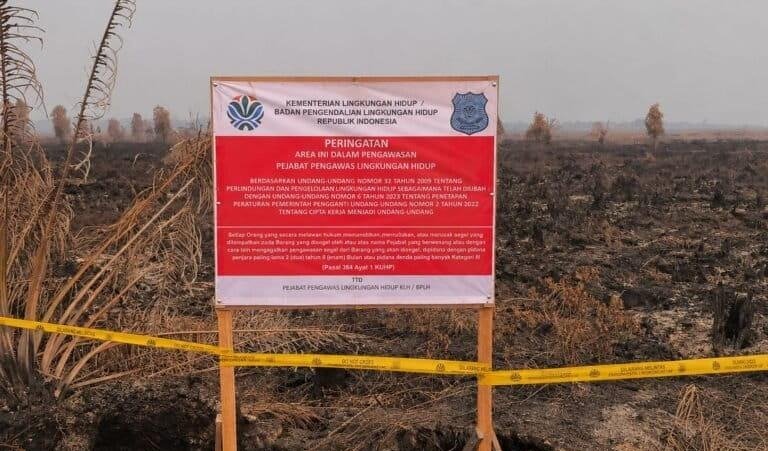
Sealing of a fire-affected area by the Deputy for Law Enforcement of the Ministry of Environment. (Ministry of Environment Public Relations)
The limits of national enforcement become clearer when examining what happens after fires are detected. Identifying fire-affected concessions is only the first step; authorities must move beyond to establish responsibility and ensure that proven violations lead to appropriate sanctions. On September 15, the Indonesian Forum for Environment (WALHI) reported 372 companies it identified as potentially involved in forest and land fires. Later that month, the Ministry of Forestry revoked five forestry business permits, four of which belonged to companies on WALHI’s list. These actions demonstrate that enforcement measures have been taken, but questions remain about their consistency, transparency and deterrent effect.
The number of permits revoked tells only part of the story. Enforcement also depends on whether the evidence behind official decisions can be scrutinised independently. When government assessments of fires in concession areas differ from findings reported by environmental organisations, those discrepancies need to be resolved through transparent investigation rather than left as competing claims. Authorities must establish whether concession holders breached their legal obligations and explain how their findings inform subsequent action. Without publicly accessible findings and clear follow-through, it remains difficult to determine whether enforcement addresses the causes of recurring fires or merely responds to individual incidents.
A case in Riau, Sumatra, illustrates why this distinction matters. In August 2026, Indonesia’s Environment Ministry confirmed indications of fires within the concessions of four companies identified by WALHI, with the affected areas still undergoing field verification. Meanwhile, Riau police had named 40 individual suspects in forest and land fire cases covering 904 hectares, but no company had been named as a suspect by the time Mongabay reported on the cases on August 30. These figures speak to the wider handling of fires in Riau, not solely the four companies. The absence of corporate suspects at that point does not establish corporate guilt, nor prove that investigations had failed. It does, however, raise a broader question: does enforcement go beyond identifying affected areas and individual suspects to establish responsibility wherever the evidence warrants it?
Questions about how fires are handled are also reflected in how their scale is reported. On October 12, President Prabowo Subianto cited 639.23 hectares across six provinces as an indication of progress in tackling the fires. However, as Mongabay reported, the figure referred to areas where firefighting teams were working, not the total area burned or all fires still burning nationwide. On October 14, the National Disaster Mitigation Agency (BNPB) and the Ministry of Forestry clarified the scope of the figure. The distinction is important because the area being handled by firefighting teams does not, on its own, show the full extent of the fires. When the scope of official figures is left unclear, claims of progress risk obscuring the scale of the problem rather than clarifying it.
When Accountability Stops at the Border
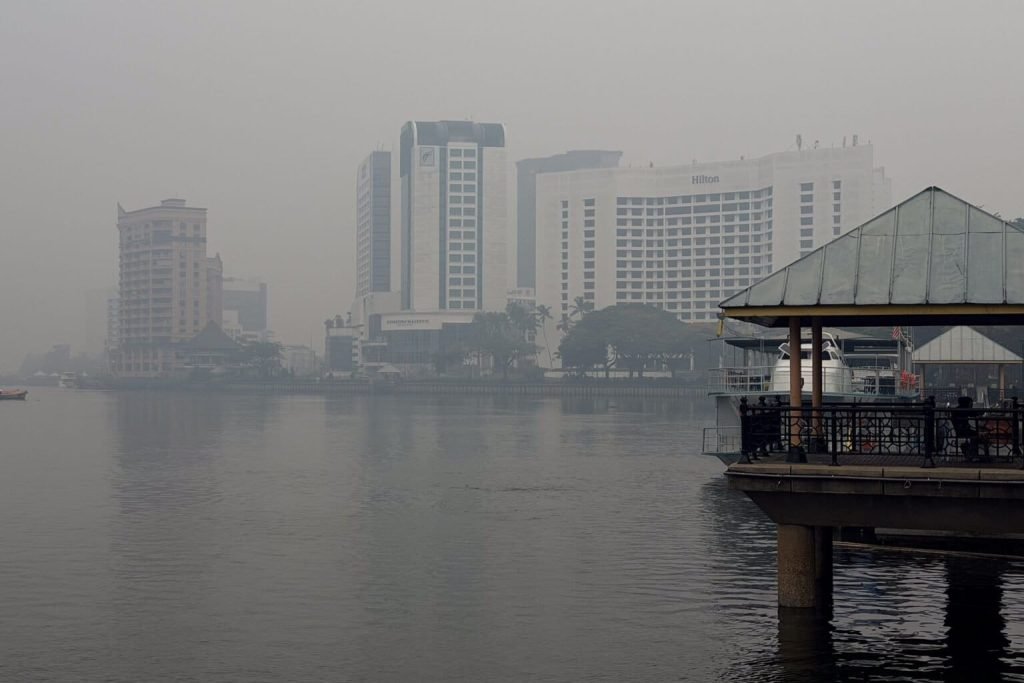
Kuching riverside in the city center is shrouded in thick haze in Kuching, Sarawak state, Malaysia, on Sept. 4, 2026 (Mongabay Indonesia)
The haze crisis exposes a fundamental imbalance in Southeast Asia’s regional response; cross-border consequences that are not met with responsibility for preventing and prosecuting fires, which remains largely within the jurisdiction of individual states. When smoke from Indonesian fires affects neighbouring countries, the resulting health risks and social disruptions are shared across the region. Yet the decisions that shape fire prevention, land management and enforcement remain primarily subject to Indonesia’s domestic institutions. Neighbouring countries therefore bear some of the costs of recurring haze while having limited influence over the domestic decisions that determine whether it can be prevented.
Of note, ASEAN has long recognised the transboundary nature of the haze problem and established a regional framework to address it. The ASEAN Agreement on Transboundary Haze Pollution, adopted in 2002 and ratified by Indonesia in 2014, provides a basis for cooperation on prevention, monitoring, information-sharing and emergency response. Yet the persistence of recurring haze raises a question about whether this framework can do more than facilitate talks. In practice, the agreement does not establish a robust compliance mechanism or specific sanctions for states that fail to fulfil their obligations under it, while disputes are directed towards consultation and negotiation. Admittedly, this approach preserves space for diplomatic engagement, but it leaves implementation heavily dependent on the willingness and capacity of individual governments to act. When national enforcement is inconsistent or its outcomes are difficult to scrutinise, regional cooperation risks becoming merely a response coordinating tool rather than a blueprint for addressing the conditions that allow it to recur.
These limitations cannot be understood solely as a matter of legal design; they are also rooted in ASEAN’s political norms. The principle of non-interference in the domestic affairs of member states has long shaped the organisation’s approach to regional cooperation, encouraging diplomacy and consensus, whilst limiting the scope for external pressure on national governments. In the context of transboundary haze, this creates a difficult tension: neighbouring countries have legitimate reasons to demand stronger action when pollution crosses their borders, yet pressing Indonesia to strengthen enforcement can become a “politically sensitive” issue given that land management and environmental regulation are treated as matters of domestic authority. ASEAN’s limited provisions for independent dispute settlement further leave disagreements over implementation largely dependent on diplomacy.
However, respecting national sovereignty does not mean reducing ASEAN’s role to materialising emergency coordination and diplomatic dialogue. Regional pressure can take forms that reinforce, rather than replace, domestic enforcement, namely through a more systematic sharing of fire and concession data, greater transparency in investigations, as well as regular public reporting on the outcomes of enforcement actions. Such measures would not require ASEAN to determine corporate guilt or override Indonesian courts. Instead, they would make it prohibitively high for governments to leave unresolved questions about fire prevention and accountability out of the regional conversation. The challenge, therefore, is not to abandon non-interference, but to develop forms of regional cooperation that make national commitments more transparent and their implementation more accountable.
Beyond ASEAN’s Non-Interference Principle

ASEAN leaders at the 48th ASEAN Summit in Cebu, the Philippines, on 8 May 2026. . (ASEAN Philippines 2026)
The challenge for ASEAN is not simply to strengthen its regional framework, but to reconsider what meaningful cooperation should entail. Emergency assistance, satellite monitoring and information-sharing remain important, particularly when fires spread rapidly. However, these measures cannot substitute for sustained scrutiny of how member states prevent fires, investigate suspected violations and enforce environmental regulations. If cooperation focuses primarily on managing the immediate effects of haze, the institutional weaknesses that allow fires to recur risk remaining untouched. Prevention and accountability must therefore become central to regional cooperation, rather than matters addressed only by national governments after a crisis has emerged.
One practical step would be to establish a more transparent regional system for reporting fires and tracking enforcement outcomes. Governments could share geospatial data on fire hotspots and concession boundaries, publish updates on investigations involving fire-affected concessions, and report whether administrative, civil or criminal measures have followed. Such a system would not automatically establish corporate liability, since satellite detections alone cannot prove who started a fire or whether a legal violation occurred. However, it would instead allow governments, researchers and the public to compare reported incidents with official investigations and their outcomes. By making this information more accessible and comparable across countries, ASEAN could strengthen regional scrutiny without assuming the role of national law-enforcement agencies.
Such proposals will inevitably raise concerns about national sovereignty and ASEAN’s principle of non-interference. Governments may argue that decisions on land management, environmental enforcement and corporate liability should remain within national jurisdiction, free from external political pressure. Rightfully so, regional scrutiny should not become a means for other states to dictate another state’s domestic policies or prejudge the outcome of legal proceedings. Yet sovereignty should not mean that the regional consequences of domestic decisions are beyond legitimate scrutiny. When fires generate pollution that crosses national borders, transparency and cooperation are not merely internal administrative matters; they are also part of a state’s responsibility to its neighbours. The challenge is therefore to distinguish interference in domestic decision-making from collective efforts to ensure that commitments on transboundary pollution are implemented transparently and consistently.
Ultimately, ASEAN does not need to abandon non-interference to make its haze cooperation more meaningful. It needs to ensure that regional commitments are accompanied by greater transparency and regular scrutiny of their implementation. This could begin with shared reporting standards, public updates on enforcement outcomes and a clearer process for raising concerns when transboundary pollution persists. Such measures would not guarantee an end to Indonesia’s fires, but they would make it more politically “costly” for recurring haze to be treated as an isolated emergency without sustained attention to its causes. Regional pressure should reinforce Indonesia’s domestic responsibilities, making accountability more visible and reform more difficult to postpone.
CONCLUSION

Children receiving respiratory treatment at a smoke-free home in Palangka Raya, Central Kalimantan. (Krismes Santo Haloho/Mongabay Indonesia)
The challenge ahead is not simply to respond to fires immediately when they emerge, but to ensure that the conditions allowing them to recur are no longer left unchallenged. When the consequences repeatedly cross national borders, the issue cannot remain exclusively within the boundaries of domestic governance. ASEAN has a stake in whether national commitments translate into meaningful action, and its cooperation should reflect that responsibility.
All in all, regional pressure will not resolve every weakness in Indonesia’s environmental governance, nor should it become a pretext for external interference in domestic affairs. Its value lies in making accountability more visible by fostering shared information, transparent reporting and sustained scrutiny of enforcement outcomes.
About The Author