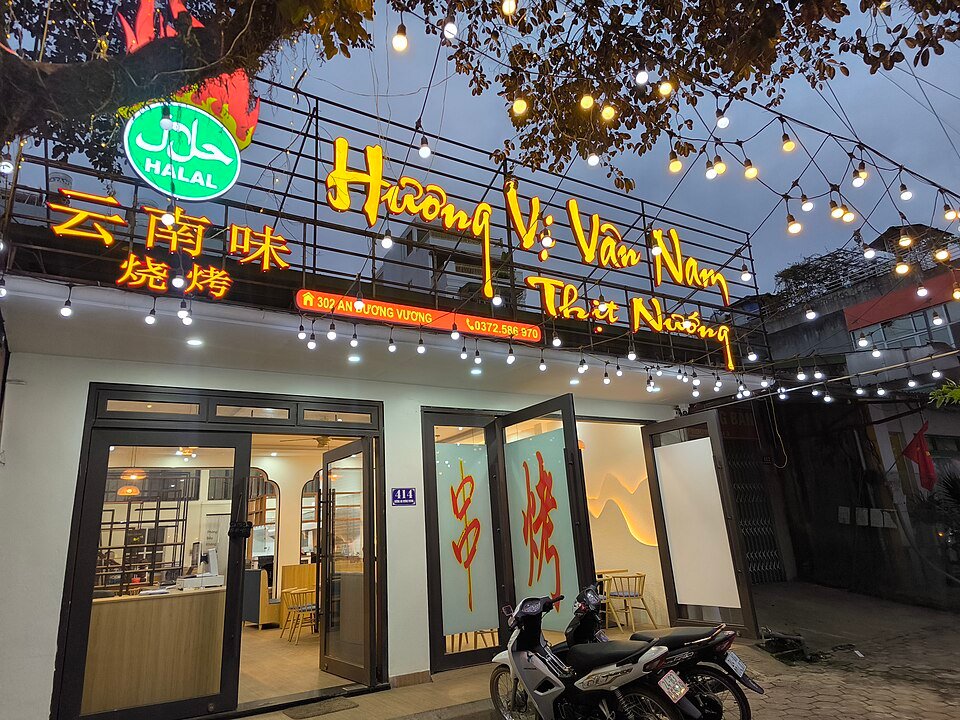
A halal-certified Yunnan BBQ restaurant in Lào Cai City, Vietnam. (Wikimedia/源義信)
Vietnam-Malaysia trade reached 10.8 billion US dollar in the first half of 2026, putting total trade on track to surpass 18 billion US dollar for the year and approach the 20 billion milestone, the Vietnam News Agency reported following the country’s first-half trade performance briefing on September 25.
Vietnamese Trade Counsellor, Phùng Văn Thành, highlighted a significant “hurdle” that simultaneously offers massive market potential and could serve as a growth lever to narrow the trade gap, namely the Halal certification.
Notably, Vietnam is grappling with a widening trade deficit resulting from an excess of imports, a trend reflected in its trade with Malaysia. In the first half of 2026, the bilateral trade that reached 10.8 billion US dollar comprised 3.4 billion US dollar in exports, outstripped by 7.4 billion US dollar in imports. These figures roughly mirror last year’s full-year deficit of 5.67 billion US dollar. The nation’s primary export commodities mainly span machinery, petroleum products and electronic components.
According to Thành, tapping into Malaysia’s Halal market presents a breakthrough opportunity to break Vietnam’s long-standing deficit deadlock. On one hand, Malaysia boasts a domestic Halal food market valued at 50 billion US dollars, ranking as one of the top five Halal food importers among the Organisation of Islamic Cooperation (OIC) members. This sector is expanding rapidly with Kuala Lumpur targeting domestic Halal consumption of 113 billion US dollar by 2030.
On the other hand, Vietnam is well positioned to plug into this supply chain. The country ranks among the top 10 global exporters of key agricultural products, with reportedly more than 80% of its plant-based agricultural outputs inherently meeting basic Halal requirements.
Thành added that if Halal-compliant product streams are properly developed, they could contribute to securing this year’s 20 billion US dollar bilateral trade target, while supporting the longer-term goal of reaching 25 billion US dollar annually.
What does this mean for business?
Navigating strict Halal compliance presents an initial hurdle for Vietnamese firms. However, successfully aligning with these international standards unlocks a massive commercial gateway. By achieving certification, businesses can position themselves to capture a share of a global Halal industry projected to soar to between 5 and 10 trillion US dollar by 2030, surging from its previous baseline of 2 to 3 trillion US dollar.
About The Author