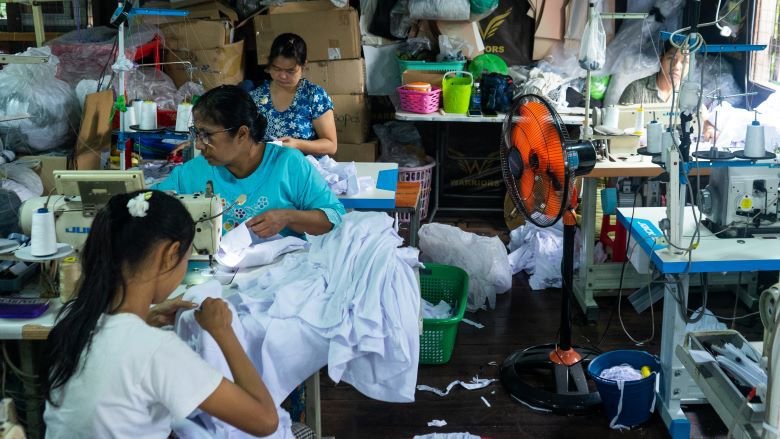
Garment workers in Myanmar. (World Bank/Zaw Win Naing)
For context, the F2 hybrid cotton seed is the second-generation offspring produced by saving and planting the seeds harvested from a first-generation (F1) hybrid cotton crop.
While saving seeds is a common practice for traditional crops, doing so with hybrids causes severe agricultural problems due to genetic laws. These include the re-emergence of weaker traits, causing crops to experience a sharp decline in yield alongside unpredictable fibre quality.
Therefore, the Ministry of Agriculture, Livestock and Irrigation stated that cultivating F2 hybrid cotton seeds significantly reduces both crop yield and quality, failing to produce satisfactory commercial results.
Moreover, under the Seed Law (2015), F2 hybrid cotton seeds fall under the category of unregistered seeds, meaning their distribution and sale are completely illegal.
To advance the cotton sector and offset production costs, the Agricultural Mechanisation Department is stepping in to assist farmers in transitioning to a mechanised farming system. This multifaceted state support includes providing machinery for the entire value chain, namely heavy machinery for systematic land preparation, cotton seed planters, inter-row cultivators, backpack cotton pickers, as well as full-scale cotton harvesters.
What does this mean for business?
Cotton remains a national agenda crop for Myanmar to drive economic self-reliance, especially within low-income rural zones. It holds a strategic position for Naypyidaw’s economy as it serves as a vital national bridge connecting the agricultural sector directly to heavy industrial manufacturing (including textile and garment industrial micro, medium and small enterprises, MSMEs) employment and foreign trade. In recent years, Myanmar has rapidly expanded its cotton cultivation area to over 540,000 acres.
Crucially, the country yields surplus, harvesting more cotton than its domestic market consumes. Now that the state is targeting an output of 700 viss per acre, achieving this surplus is projected to inject an additional 500 million US dollar in foreign exchange earnings directly into the national economy. The recent ban on F2 hybrid cotton is a direct attempt to secure that goal as unpredictable F2 seeds could trigger a domino effect that threatens the entire national strategy.
Kala Advisory helps investors weigh openings like these against the political and compliance risks of frontier markets like Myanmar. Visit kala-advisory.com.
About The Author