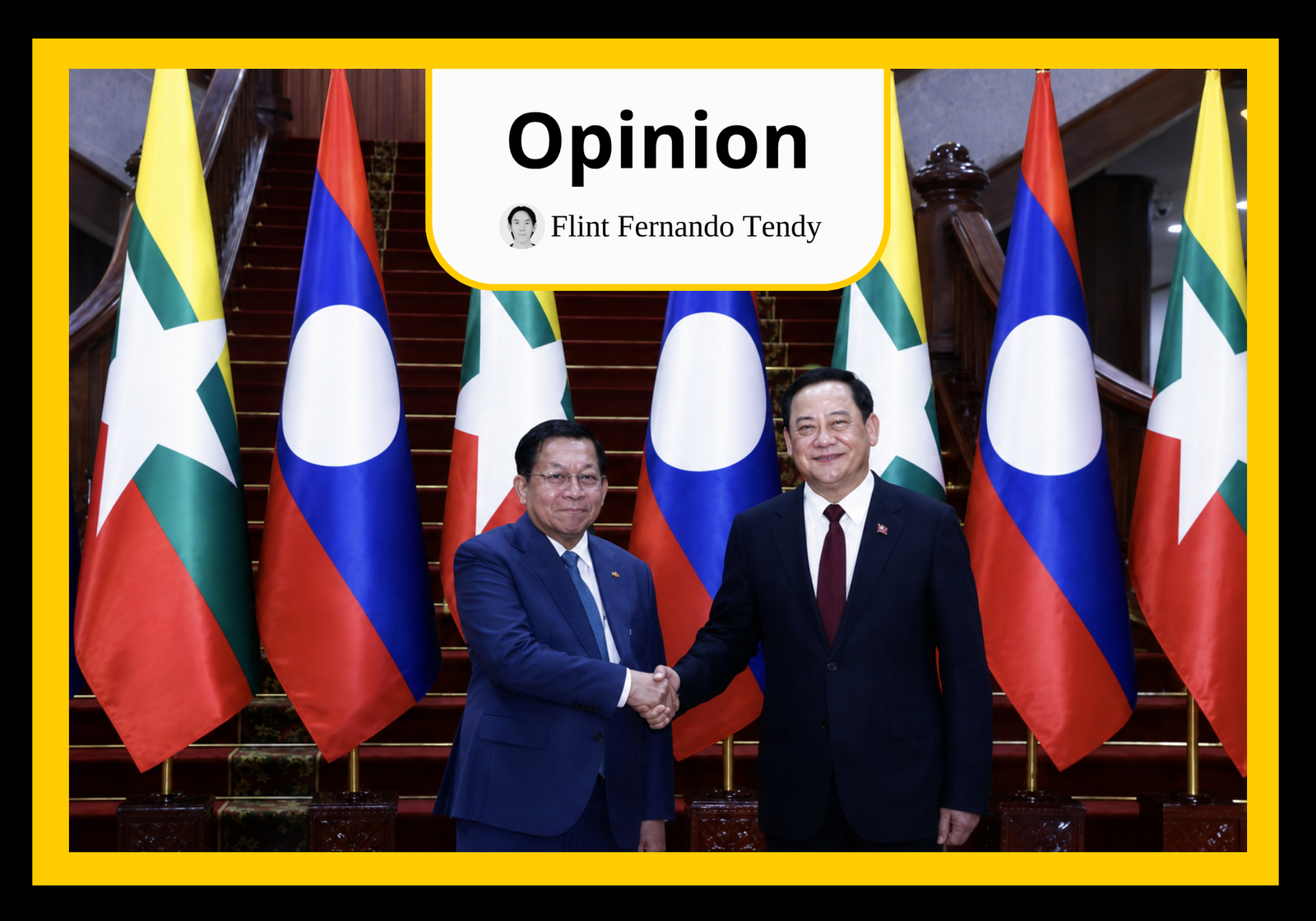
Myanmar Junta Leader Min Aung Hlaing during his state visit to Laos in July 2026 that sparked controversy. (KPL Laos)
Flint Fernando Tendy is an International Relations graduate from Universitas Katolik Parahyangan with expertise in research, stakeholder engagement and cross-cultural communication. The views expressed are his own and do not represent SEA Daily or that of another organisation.
The New Chapter In Myanmar’s Civil War
Myanmar has entered a new chapter in its civil war. Since the military coup in February 2021, Myanmar’s armed forces, or known locally as the Tatmadaw, has faced sustained armed resistance across the country, triggering a civil war that has claimed the lives of over 100,000 people and displaced millions more. Five years on, neither the military’s junta nor ASEAN’s diplomatic efforts have produced a durable political settlement, making this bloody conflict a stain on ASEAN’s conflict management reputation. In response, the regional bloc has largely kept Myanmar’s junta authorities at arm’s length, shunning their participation in high-level political meetings and refusing to recognise the military’s political process as a path towards normalisation.
But that isolation is becoming increasingly difficult to sustain. As the conflict drags on, division among ASEAN members grows more visible as Myanmar’s neighbours like Thailand and Laos are finding reasons to engage with Naypyidaw over border security, humanitarian assistance, trade and regional stability while member states further from the conflict such as Indonesia, Malaysia, and the Philippines have constantly put the pressure on juntas to end the conflict and double down on isolating Myanmar. The Five-Point Consensus (5PC) drafted in April 2021 by ASEAN that demands for cessation of violence, inclusive dialogue, the appointment of a special envoy and the delivery of humanitarian aid through the ASEAN Humanitarian Action (AHA) Centre failed miserably to achieve a political breakthrough ASEAN hoped for.
Meanwhile, Myanmar’s junta has begun to rebuild diplomatic space for itself. In early 2026 they manufactured an election, widely described as neither free nor fair, and elected junta’s Senior General Min Aung Hlaing as the president, the same man who rose to power after a coup d’état in 2021. The reportedly staged meeting between the International Committee of the Red Cross to ensure that the country’s pro-democracy leader Aung San Suu Kyi who has been in a house arrest since 2021 is doing “okay” is also one of the tricks pulled out by the regime to simulate a good faith in resolving the conflict.
In this realm, things have started to progress in accordance with the regime’s favour as in May and June of 2026, Min Aung Hlaing conducted his first two state visits as president to India and China, discussing matters like bilateral cooperation between respective countries as well as border security and trade. Furthermore, regional neighbours Thailand and Laos also welcomed Min Aung Hlaing’s visits, breaking ASEAN’s unwritten rule that has barred senior level Myanmar’s officials from any state-level visit as Thai Prime Minister Anutin Charnvirakul insisted on pragmatism in approaching Myanmar’s situation.
These developments do not show that Myanmar has suddenly escaped international isolation as Western sanctions and political condemnation remain. Rather, they demonstrate that isolation is no longer an effective kind of diplomatic constraint that ASEAN once hoped it would.
That creates a new strategic question for ASEAN: if engagement with Myanmar is becoming inevitable, how can the bloc ensure that engagement produces something more than political legitimacy for the military government?
Leveraging the Situation
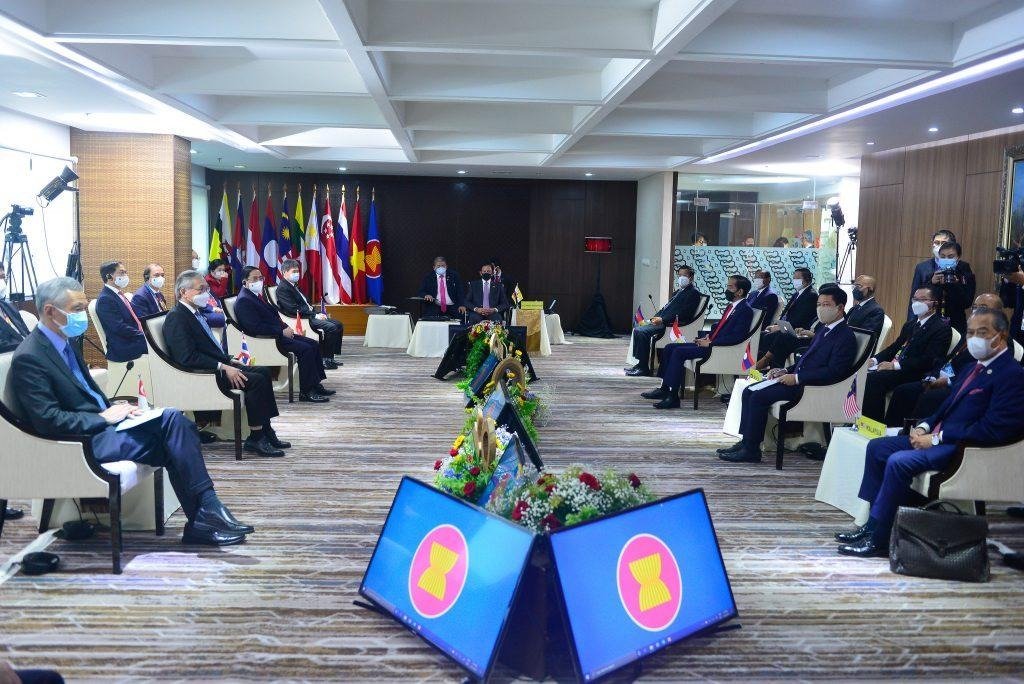
ASEAN leaders during a meeting in Jakarta that produced the infamous Five-Point Consensus on the political situation in Myanmar in 2021. (ASEAN)
Facing this situation, ASEAN is caught in a dilemma between upholding the bloc’s 5PC as its formal framework to address Myanmar and the dynamic change in the country’s political climate since 2021. Abandoning the consensus altogether would risk undermining ASEAN’s credibility and signalling that the bloc’s commitments can be set aside when pragmatic needs arise. However, it also does not mean that ASEAN should avoid engaging Naypyidaw altogether, because it already did. In July this year, ASEAN foreign ministers met Myanmar’s foreign minister in Bangkok, while Thailand promoted what it called a “calibrated re-engagement” approach to gradually bring Myanmar back into regional cooperation. 8E8F95Facing this situation, ASEAN is caught in a dilemma between upholding the bloc’s 5PC as its formal framework to address Myanmar and the dynamic change in the country’s political climate since 2021. Abandoning the consensus altogether would risk undermining ASEAN’s credibility and signalling that the bloc’s commitments can be set aside when pragmatic needs arise. However, it also does not mean that ASEAN should avoid engaging Naypyidaw altogether, because it already did. In July this year, ASEAN foreign ministers met Myanmar’s foreign minister in Bangkok, while Thailand promoted what it called a “calibrated re-engagement” approach to gradually bring Myanmar back into regional cooperation.
The problem is that ASEAN risks shooting in the dark by moving from isolation to engagement without first establishing what it expects to gain from that shift. This is where the bloc’s Myanmar policy has struggled. The 5PC established clear objectives, including an end to violence, dialogue among relevant stakeholders and humanitarian assistance. But its implementation has been weak to say the least, partly because ASEAN has limited tools to compel Myanmar’s military authorities to comply due to its lack of enforcement mechanisms. Meanwhile, ASEAN’s consensus-based decision-making process makes it difficult for the bloc to impose a uniform approach when member states have different interests in Myanmar.
Fortunately, the answer to this conundrum might be there right in the plain sight which is reflected in Thailand’s position on this matter. The term “calibrated re-engagement” was coined by Prime Minister Anutin to slowly push Myanmar to regional cooperation while still demanding real progress in implementing the 5PC. As Myanmar’s direct neighbour, Bangkok has strong incentives to maintain direct communication with Naypyidaw. Border security, refugees, narcotics, online scams, trade and humanitarian assistance spilling down from the conflict cannot be managed effectively through diplomatic distance alone. Thailand has therefore argued that engagement can be used to encourage progress on the 5PC rather than treated as a reward for the military government.
While this proposed new method sounds good on paper and would be hard to reject, ASEAN should approach it with care because if Naypyidaw can secure increasing diplomatic access simply by presenting themselves as a functioning government, ASEAN could gradually lose the leverage that remains. The bloc can offer Myanmar diplomatic and legitimacy recognition within Southeast Asia which will open the door for participation in high-level ASEAN meetings. As a result, Myanmar can enjoy access to ASEAN-led humanitarian and diplomatic channels, something that has been barred from them in recent years. The answer, therefore, should be for ASEAN to make engagement itself a source of leverage. If Myanmar’s junta wants greater participation in ASEAN’s political and economic mechanisms, the bloc can use that desire to seek concrete commitments.
The 5PC, while still remaining the main framework for peace as it is reaffirmed on the July 22nd ASEAN statement, should not be a wall but a ladder in achieving a reconciliation or at least a breakthrough in a dialogue with the junta. ASEAN has an opportunity to redefine what the 5PC means in practice. Instead of treating it as a fixed checklist that Myanmar must fully satisfy before normal relations can resume, the bloc could use it as a framework for gradual engagement. Each concrete step by Naypyidaw could unlock a mutual level of ASEAN engagement, while failure to make progress would limit further political or economic integration. This would allow ASEAN to acknowledge the reality of Myanmar’s diplomatic normalisation without allowing normalisation to become unconditional.
Through this step, ASEAN could embody all points from the 5PC slowly but surely without needing to push for the end of the entire conflict before any chance of engagement, which is not realistic at this moment. ASEAN could ask Myanmar’s junta for measurable progress such as greater humanitarian access, sustained reductions in violence, meaningful dialogue with relevant stakeholders and cooperation with the ASEAN Special Envoy. Such an approach would also help mitigate divisions within ASEAN. Members that need direct engagement would have greater room to pursue it, while those demanding stronger pressure could be assured that engagement remains tied to common regional objectives.
For Myanmar, however, deeper engagement with ASEAN would offer benefits that bilateral relations with individual countries can not fully offer. At a time when Myanmar is increasingly reliant on cooperations and relationships with major powers like China, Russia, and India, closer ties with ASEAN would give Naypyidaw a broader and secure diplomatic base as continued hedging between great powers could risk trading its sovereignty for survival. Greater participation in ASEAN would give Naypyidaw a pathway back into the region’s principal multilateral diplomatic forum, allowing the government to move beyond its current non-political representation and regain diplomatic standing within Southeast Asia. It could also open wider access to ASEAN-led economic cooperation, investment and trade networks, as well as diplomatic channels for addressing border security, humanitarian assistance and other issues that cannot be managed through bilateral relations alone.
ASEAN Cannot Isolate Myanmar But It Can Shape Its Return
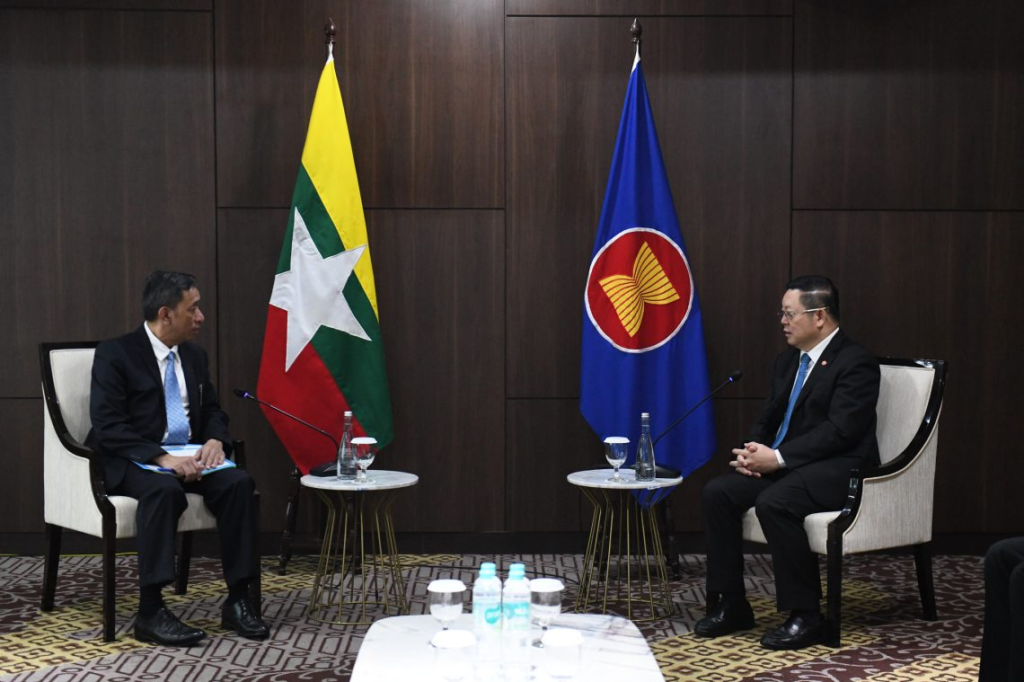
ASEAN Secretary-General Kao Kim Hourn and Permanent Representative of Myanmar to ASEAN Ambassador Aung Myo Myint during a meeting in 2023. (ASEAN Secretariat)
ASEAN should prepare for a Naypyidaw where diplomatic normalisation continues even without a political settlement. Trying to reverse that trend is unlikely to be the most effective use of the bloc’s limited leverage. Instead, ASEAN should make itself the manager of engagement, rather than its opponent. Thailand’s recent push for “calibrated re-engagement” points in the right direction. Bangkok has argued that dialogue with Myanmar should remain open while encouraging concrete progress, while continuing to regard the 5PC as ASEAN’s guiding framework. The challenge is to ensure that “re-engagement” does not become another word for unconditional acceptance.
Moreover, the bloc should identify specific benchmarks and link progress on those benchmarks to greater diplomatic and economic access. Humanitarian access should be the main focus. ASEAN should seek predictable and sustained access for humanitarian organisations, including through cross-border channels where necessary. The second should be a measurable reduction in violence, particularly against civilians. The third should be meaningful political dialogue involving a broader range of Myanmar’s political and ethnic stakeholders. Finally, ASEAN should insist on continued access for its Special Envoy and other mechanisms designed to facilitate dialogue.
Recent trends have shown that drastic changes in Myanmar’s political landscapes are inevitable with or without ASEAN. The choice for the bloc is whether to remain tied to a strategy of isolation that is becoming increasingly difficult to sustain or to adapt and use the reality of normalisation to pursue its original objectives. ASEAN cannot determine who engages with Myanmar, but it can determine what it expects from its own engagement. If diplomatic access is what the junta increasingly seeks, ASEAN should make that access conditional on progress towards peace, humanitarian relief and political dialogue. ASEAN should learn to make peace with that condition and adapt its ways to better suit the current trajectory while also leveraging it to achieve its goal.
About The Author