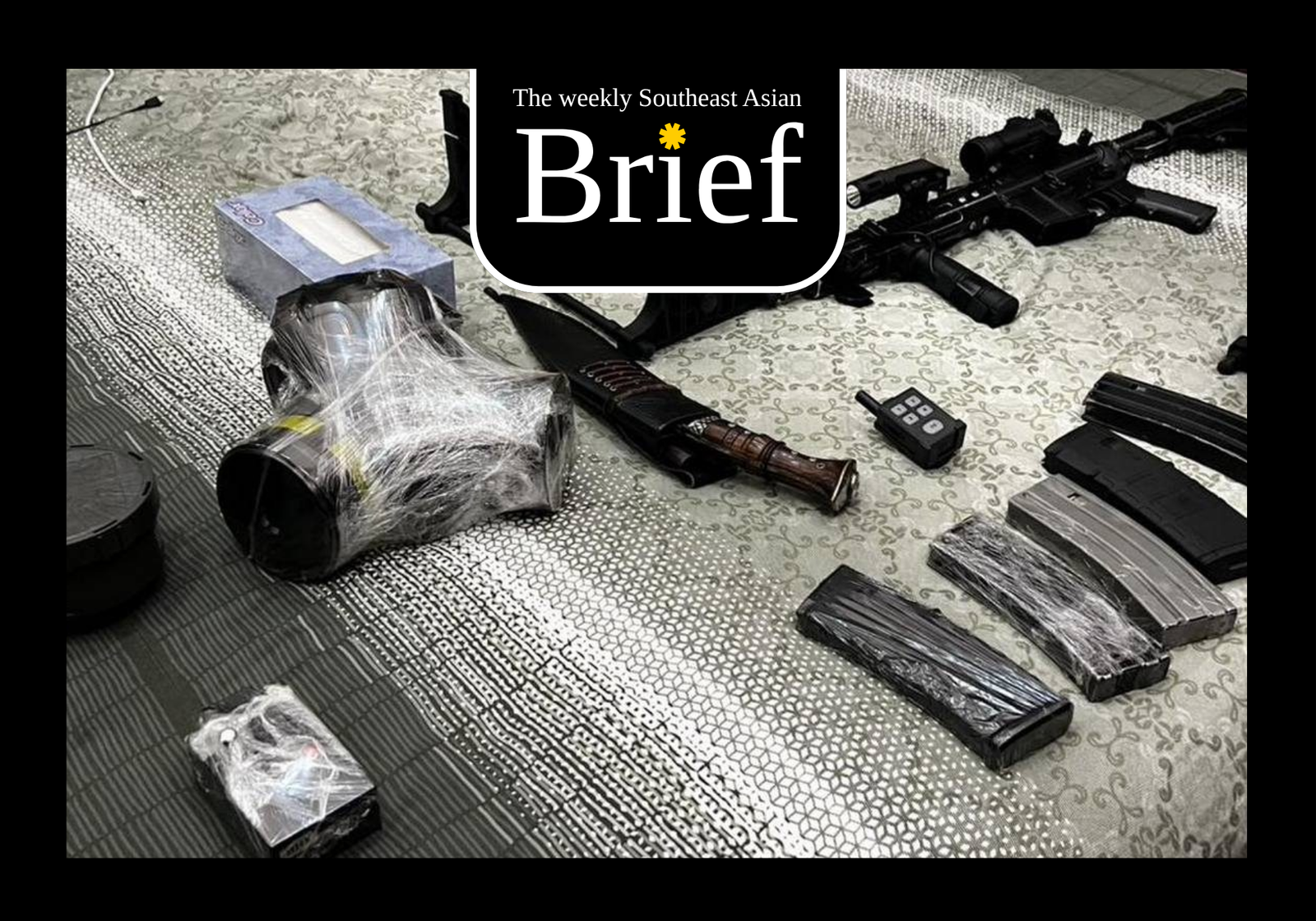
A photo published by Thai police on May 8, 2026, shows weapons found at a home near the beach resort of Pattaya. (Facebook/ThaiPoliceOfficial)
Thai Prime Minister Anutin Charnvirakul has vowed to enact stricter gun laws as Southeast Asia’s highest gun-owning nation mourns one of its deadliest shootings in recent years. Yet, for a country that does not lack firearms legislation, such a response will prove inadequate to address a structural, interlinking societal and institutional crisis.
On August 7, a 14-year-old boy opened fire at Debsirin Nonthaburi School, killing five teachers, staff members and a 12-year-old female student. The seven casualties followed the murder of two initial victims shot earlier; the gunman’s paternal grandparents. A swift investigation commenced by authorities eventually pieced together a puzzle unfolding the harrowing reality of the case.
The perpetrator was certainly not a licensed gun owner, and was later found out that he used a registered 9mm handgun belonging to his grandfather. Reports from the Royal Thai Police further revealed motives behind the rampage that was triggered by layered stressors linked with mental health issues. Corroborative claims from classmates and family indicate the gunman was a quiet, withdrawn individual who turned out to encounter severe academic anxiety fuelled by family pressure and exacerbated by relentless bullying experiences. Furthermore, digital forensics disclosed that the gunman was frequently exposed to overwhelmingly violent social media content.
During the period of mourning on August 9, another gun massacre was committed, this time by a high-profile Member of Parliament (MP) driven by a “personal motive”.
These consecutive cases were no anomalies, if anything, they are the opposite.
According to the latest data from 2018 compiled by the Small Arms Survey, over 10 million of a total 70 million Thai population possess firearms. This breaks down to roughly one gun for every seven people (though it should be noted that this figure denotes total civilian possession and does not map precisely onto the exact number of individual gun owners). The survey found that four out of these ten million weapons are illegal and unregistered.
It is confirmed that the total number of civilian firearms in Thailand alone surpasses the civilian gun holdings of the other ten ASEAN countries combined. Though Thailand places second in Southeast Asia in terms of gun crime, surpassed solely by the Philippines, it is relevant to mention that the two nations are characterised by disparate cultural values and norms.
While the Philippines suffers from targeted, organised gun violence (frequently erupting during high-stakes political events like elections), Thailand has tragically become prone to unpredictable, indiscriminate mass shootings targeting innocent civilians in public spaces. The culture of hiyâ, a Tagalog word for shame, to some great extent restricted Filipinos from committing violence against strangers.
In building an understanding of the issue, contextualising certain shooting cases in recent years adds weight. The recent gun rampage is widely regarded as the most tragic in nearly four years, drawing comparisons to the 2022 child care attack committed by a former policeman which claimed 37 people, with half of whom were toddlers. To note, that historical case is actually classified as a mass murder rather than a “pure” mass shooting, given that the perpetrator primarily inflicted casualties using a knife.
Prior to this was an equally devastating shooting inside a shopping centre carried out by another state actor in 2020, killing 26 and injuring over 50 before the perpetrator was shot dead by security forces. This case prompted the military to tighten safety protocols, including surveillance to prevent soldiers from stealing high-powered weaponry, while shopping malls across Thailand began conducting regular active-shooter and evacuation drills for staff and tenants. Nevertheless, security analysts note that such measures had failed to trigger deep structural gun control reform. And a parallel occurrence in 2023 proves it.
A modified blank gun was unprecedentedly used by a 14-year-old to murder two people at Bangkok’s renowned Siam Paragon shopping mall. The government at that time delivered a copybook response, promising compensation for the victims’ relatives, and of course, pledging a more restrictive gun law.
The way these cases are handled merely on a surface level exposes the value of firearms within Thai society.
As targeted gun homicide is also prominent, this trend can be explained through an accepted axiom that Thais internalised this mindset that a gun is a status symbol, signaling a person’s wealth and societal standing, which ultimately leveraged to yield influence. Meanwhile, high rates of indiscriminate mass shootings are highly argued to stem from overwhelming media narration. Those headlines, in particular those disclosing the perpetrator’s name and background, have been found to project a degree of glorification that inadvertently fosters a dangerous copycat culture.
Additionally, to describe the weak gun law enforcement, with gun permit issuance is said to be swifter than a safety compliance assessment for infants’ milk containers.
On the institutional level, perpetual debates circle the Welfare Gun directive, an exclusive government initiative providing state employees and police officers with access to deeply subsidised, tax-free firearms prices on the pretext of “self-defence”. To put this into perspective, a standard hand gun that costs around 2,500 US dollar on the commercial market can be bought through the welfare programme for just half the price. It was inevitably exploited as an administrative gap “permitted” owners to sell or transfer the weapons after a five-year ownership period. This loophole translated into a lucrative illicit market where the corrupt officials profited handsomely from selling weapons onwards to ordinary citizens or illegal brokers.
In sum, gun violence episodes have always simmered beneath the surface; the threats remain fully potent and manifest cyclically. As time goes by, with the government having demonstrated continual negligence in eradicating the root causes, the cost of inaction is demanding even bigger sacrifices. Globalisation facilitates the seamless entry of illicit firearms into the country, alongside unfettered internet access to violent media, shifting this alarming trend towards the younger generation. It is important to keep in mind that gun-related crime is not an isolated issue; rather, it exists within an intertwined, complex matrix alongside public health, national security, and economic stability. As shown in the recent school shooting case, mental health struggles play a decisive part, while negligent state institutions that fail to apply sufficient preventive measures generate lethal security gaps. Finally, if this status quo persists, it will inevitably erode Thailand’s international reputation, severely compromising tourist confidence and fracturing the country’s vital hospitality industry.
About The Author