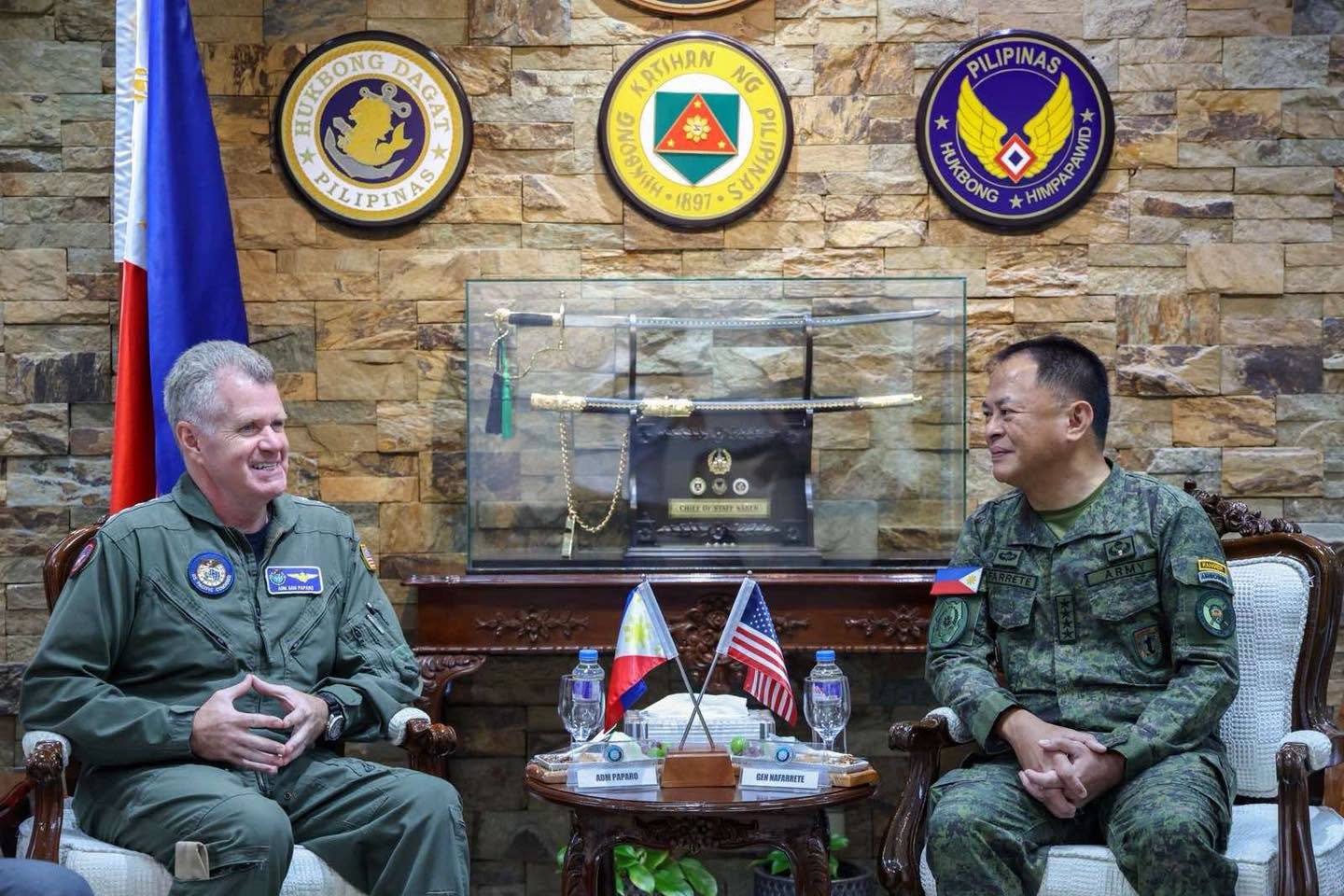
AFP Chief Gen. Antonio Nafarrete meets with US Pacific Command chief Adm. Samuel Paparo Jr. to discuss strengthening Philippine-US defence cooperation. (Armed Forces of the Philippines)
On August 7, the Philippines and the US reaffirmed their longstanding defence partnership after senior military officials signed the 2027 Mutual Defense Board–Security Engagement Board (MDB-SEB) Plan of Activities, outlining expanded bilateral engagements to strengthen military interoperability and address evolving regional security challenges.
Armed Forces of the Philippines (AFP) Chief Gen. Antonio G. Nafarrete and US Pacific Command (USPACOM) Commander Adm. Samuel John Paparo Jr. signed the plan during the MDB-SEB meeting in Quezon City.
The meeting focused on enhancing joint training and exercises, advancing defence capability development, strengthening maritime security cooperation and expanding collaboration in other areas of shared strategic interest. Both officials stressed the importance of sustained military engagement to improve the ability of Philippine and US forces to operate together while responding to emerging security challenges in the Indo-Pacific.
The new plan builds on the Philippines’ wider participation in multinational maritime exercises, such as the recentRim of the Pacific (RIMPAC) Exercise 2026 PHOTOEX on July 22. The guided-missile frigate BRP Miguel Malvar (FFG6) and Philippine Coast Guard vessel BRP Gabriela Silang (OPV8301) participated in a formation involving 28 warships and five submarines.
The developments also coincide with the Philippines’ continued support for ASEAN-led defence mechanisms, including the ASEAN Defence Ministers’ Meeting (ADMM) and ADMM-Plus. The Department of National Defense (DND) has reaffirmed the ASEAN Treaty of Amity and Cooperation as a foundation for peaceful relations and regional security cooperation.
The AFP said details of the 2027 plan were not disclosed for security reasons. However, USPACOM said the programme would include activities ranging from large-scale exercises to subject-matter expert exchanges, building on hundreds of bilateral activities conducted annually.
The 2027 MDB-SEB plan and RIMPAC participation reflect the Philippines’ two-track defence strategy: strengthening deterrence and operational capabilities through its US alliance while maintaining ASEAN-led dialogue and multilateral security cooperation. Strategically, the Philippines is seeking to improve its ability to respond to maritime and regional threats without moving away from ASEAN’s emphasis on diplomacy, consensus and a rules-based regional order.
About The Author