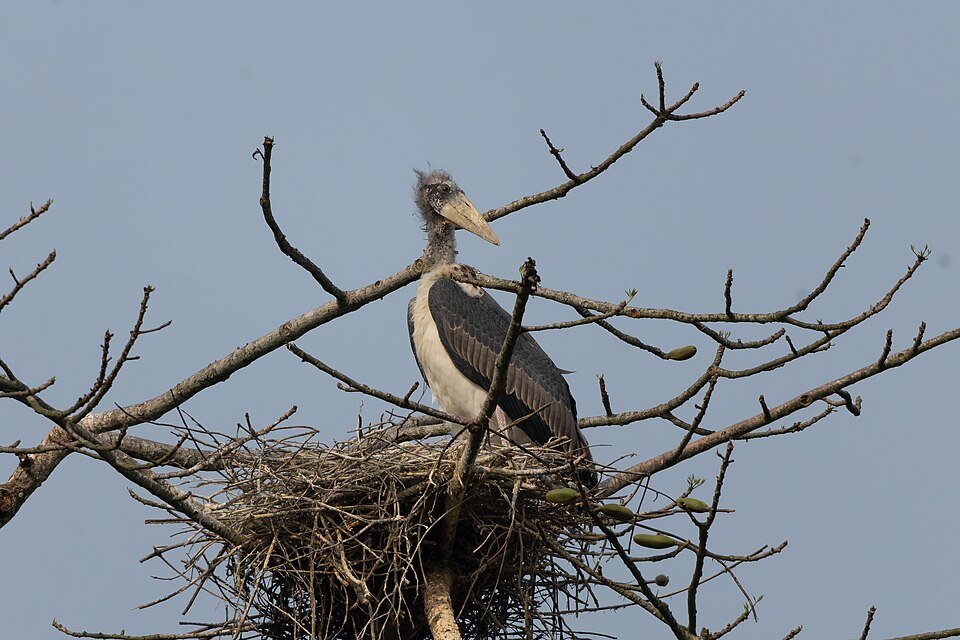
Illustration of The Greater Adjuvant. (Tisha Mukerjee/Wikimedia)
On July 21, the endangered Greater Adjutant stork arrived earlier than expected at Cambodia’s Boeung Prek Lapov Landscape Protected Area, with conservationists describing the sighting as a positive sign for the species’ recovery.
Conservation group NatureLife Cambodia said three Greater Adjutants have so far been recorded at the protected wetland in Takeo province. The birds were first spotted in late May, several weeks ahead of their usual seasonal arrival.
The species normally migrates to Boeung Prek Lapov between June and August, or sometimes as late as September, depending on annual water levels. This year’s earlier appearance suggests the wetland is already providing suitable feeding conditions, although experts say continued monitoring will be needed to determine whether the pattern persists.
Known scientifically as Leptoptilos dubius, the Greater Adjutant is one of the world’s rarest stork species and remains the focus of intensive conservation efforts in Cambodia. The bird was listed as Endangered” on the International Union for Conservation of Nature (IUCN) Red List until 2024, when its conservation status was improved to Near Threatened following encouraging population gains across its range.
Cambodia has played a significant role in that progress. The country is home to Southeast Asia’s largest breeding colony of Greater Adjutants at the Prek Toal Ramsar Site, where long-term habitat protection and species management programmes have helped support population recovery.
Despite the improved classification, conservation authorities stress that the species still requires sustained protection. They warn that continued habitat management and close monitoring are essential if recovery efforts are to remain on track.
Boeung Prek Lapov is the largest wetland sanctuary in Takeo province and supports a wide range of threatened waterbirds. However, the protected area continues to face pressure from illegal land encroachment. In response, Cambodia’s Ministry of Environment, provincial officials and conservation partners are completing zoning plans and installing boundary markers to strengthen management and safeguard the wetland from further disturbance.
About The Author