Climate diplomacy has never lacked ambition.
For years, we’ve seen governments effort to bold their commitment for climate change through Net-zero targets, signed international agreements and pledged billions of dollars for the energy transition. Yet despite those promises, the world continues to grapple, with rising emission, and more fragile geopolitical tension. These urgencies depict that we breathe in a nature that clearly moves like a ticking time bomb and it’s unfolding behind our eyes.
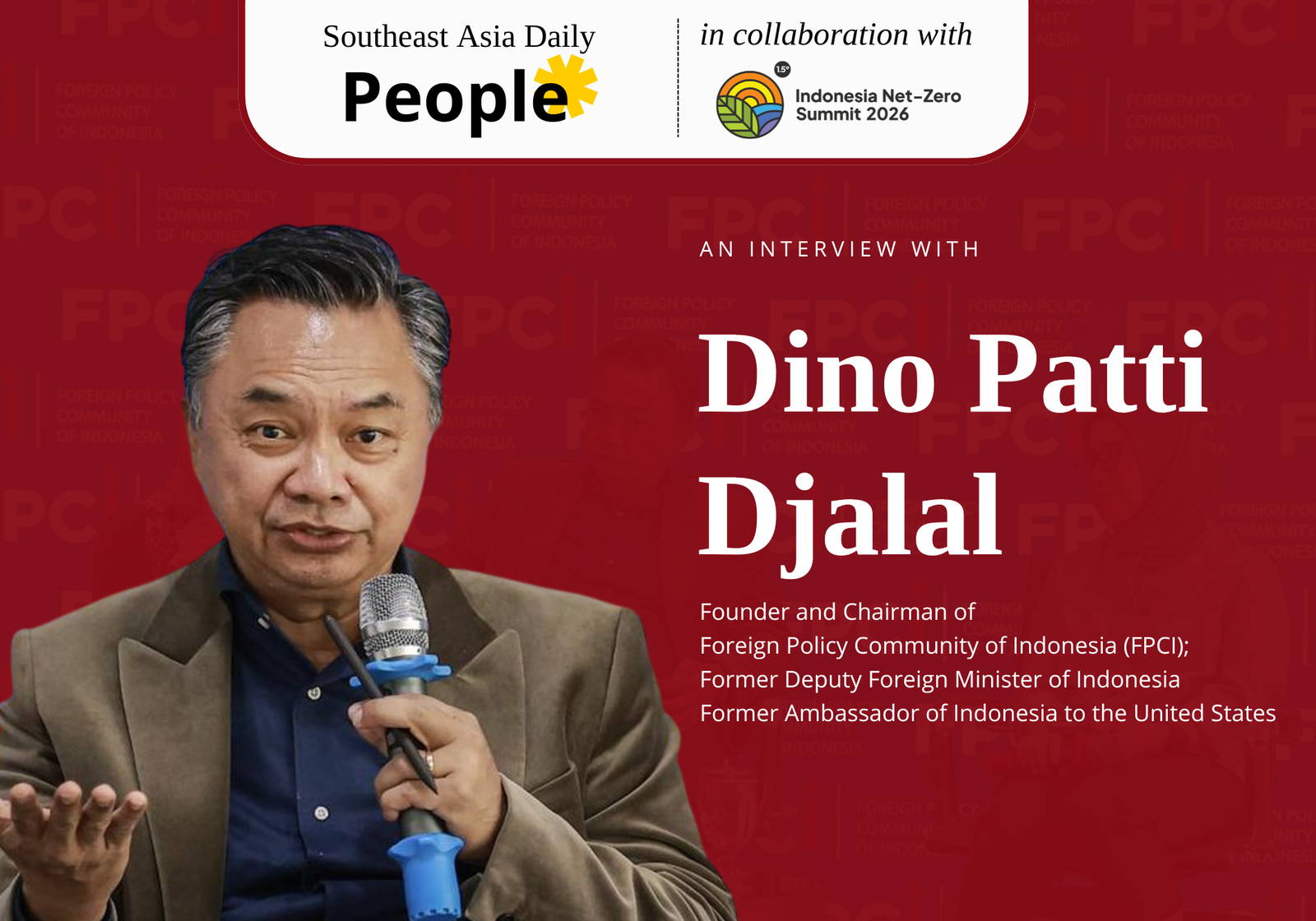
As Jakarta simmered in the afternoon heat and just days before the Indonesia Net Zero Summit (INZS) 2026, SEA Daily had the opportunity to discuss with the Foreign Policy Community of Indonesia’s (FPCI) Founder and former Deputy Foreign Affairs Minister, Dino Pati Djalal, about the urgencies and future ambition of climate commitment. Over three decades in diplomacy, Dino Pati Djalal served in various senior positions within Indonesia’s foreign service, including as Indonesian Ambassador to the US before rising to the ministry’s second-highest office in 2014 and then FPCI in 2015, as he believes foreign policy talks should extend beyond diplomatic circles and closer to the grassroots, where civil society, students and global public could be engaged in an independent platform.
Yet when asked what defines this year’s biggest climate gathering, Dino did bold a single word.
“Delivery.”
That, he believes, is currently the main hurdle to global climate diplomacy.
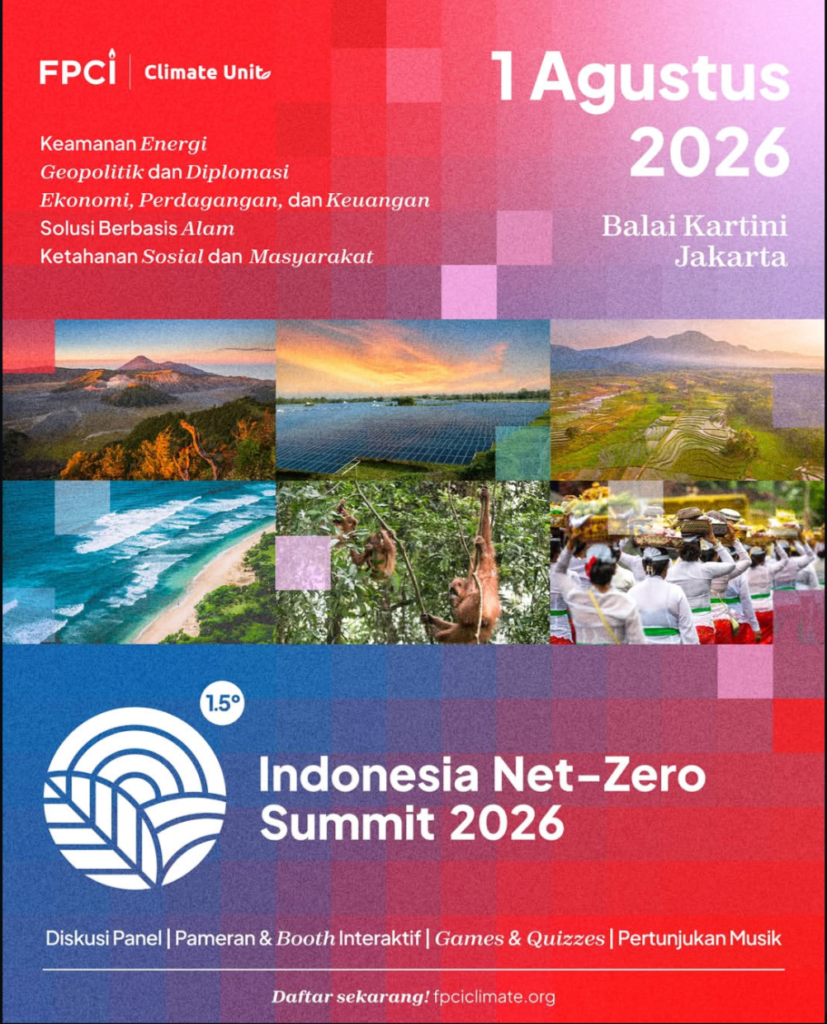
It is the reason this year’s publicly-accessible Indonesia Net-Zero Summit carries the theme “It’s Time to Deliver!” Now in its fifth edition, INZS has grown into the largest independently organised climate forum in Indonesia, and its 2026 programme—running at Balai Kartini in Jakarta on 1 August—moves from Indonesia’s 100 GW solar ambition to ASEAN energy security and the financing gap behind both. At a time when ambitious declarations have become commonplace, he argues that implementation has become the defining challenge of climate action.
A Different World
On the floor of the US Senate, Republican Senator Jim Inhofe displayed a snowball—on 26 February 2015, in winter—as evidence the globe was not warming, in a year that was found to be Earth’s warmest on record at the time. (Wikimedia)
With geopolitical tension and rigid-characteristic policy on the rise,the past decade has been marked with the exits of leading countries with power autonomy from climate change awareness, toward security and their vested interest within the bubble of their geopolitical stance and interest. What can we predict as a risk of rupture in the process is due to how big power countries are not fully contesting to take part of carbon emission as the common problem and responsibility as the developing ones. Fragments come not from the lack of power, but the solidarity to different autonomy within every quarter, and that solidarity, according to Dino himself, is reachable and boundable to the middle power of the world, including Indonesia.
For the veteran diplomat, while major powers are busy with geopolitical waves and economical alignment, climate change progression can be taken as a quantum leap for middle power countries to make impactful movement worldwide—which is usually taken mostly by developed countries.
“So now we see there’s a new chapter and hopefully it can be realised”,
With the upcoming decade potentially seeing uncontrolled climate change, the responsibility cannot be solely relied on a select set of countries, but on all nations within this world.
Why Indonesia Still Matters
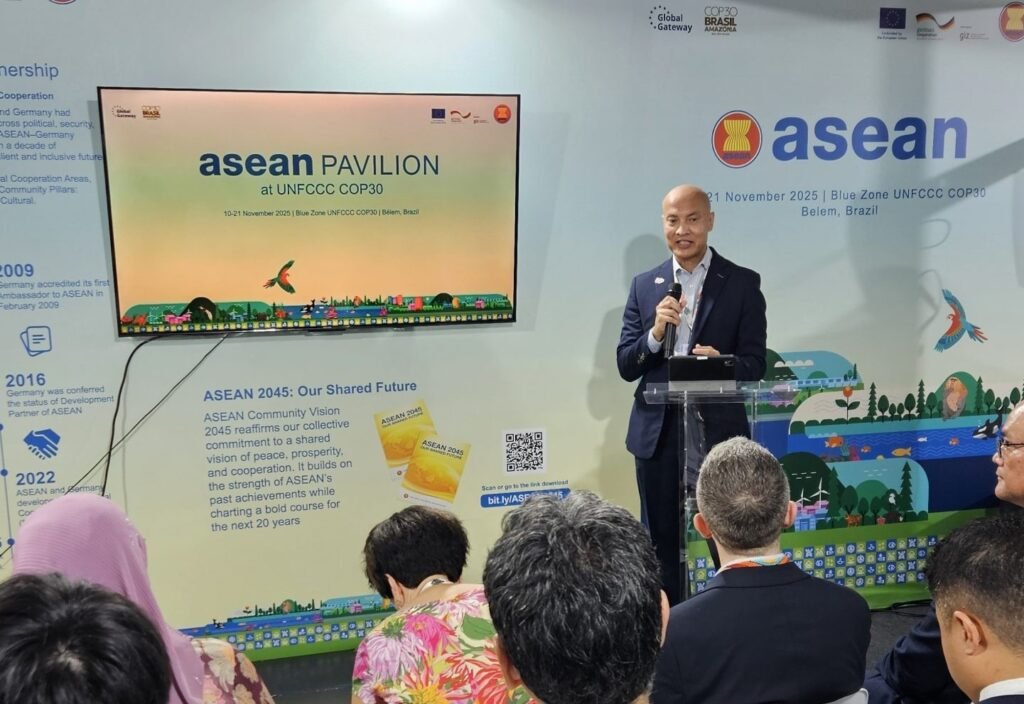
Official inauguration of the ASEAN at the 2025 UN Climate Change Conference (UNFCCC COP30). The regional bloc is where Indonesia can and still have a considerable impact in advocating climate action. (ASEAN Secretariat)
Looking back, Indonesia has been one of the sole leaders between Southeast Asian countries in building climate diplomacy. Maintaining its achievement as the first developing country that states 26% of emission reduction, Indonesia has the capability and has owned a portfolio to start leading and bridging global climate diplomacy throughout not only in its region but also worldwide—both lending hand to the industrial countries and the developing countries.
The most immediate place where Indonesia can have an effect is ASEAN, where net-zero targets are set nationally rather than collectively. Even though it has already been solidified, all of them have different problems, especially on energy security. “Some have done very well on EV, on renewable energy, like Vietnam has done very well. So the whole region has different pace and different problems that they face, different priorities, but we are hoping they can move together now”, said Dino. For him, the most plausible aspect that Indonesia can move and lead immediately in the Southeast Asian bloc is the ASEAN Power Grid, as the association itself recently reached an agreement on the ASEAN Petroleum Reserve.
Not long prior, Jakarta set a target of 100 Gigawatt generated from solar power under the instruction of President Prabowo, indicating a start of transition in regards to climate improvement. This indicates that Indonesia’s entering a phase where they’re adjusting their placement in seeking opportunity to compete with the dynamicity of world development—including industrial infrastructure, which now is turning into renewable energy.
Beyond Government Diplomacy
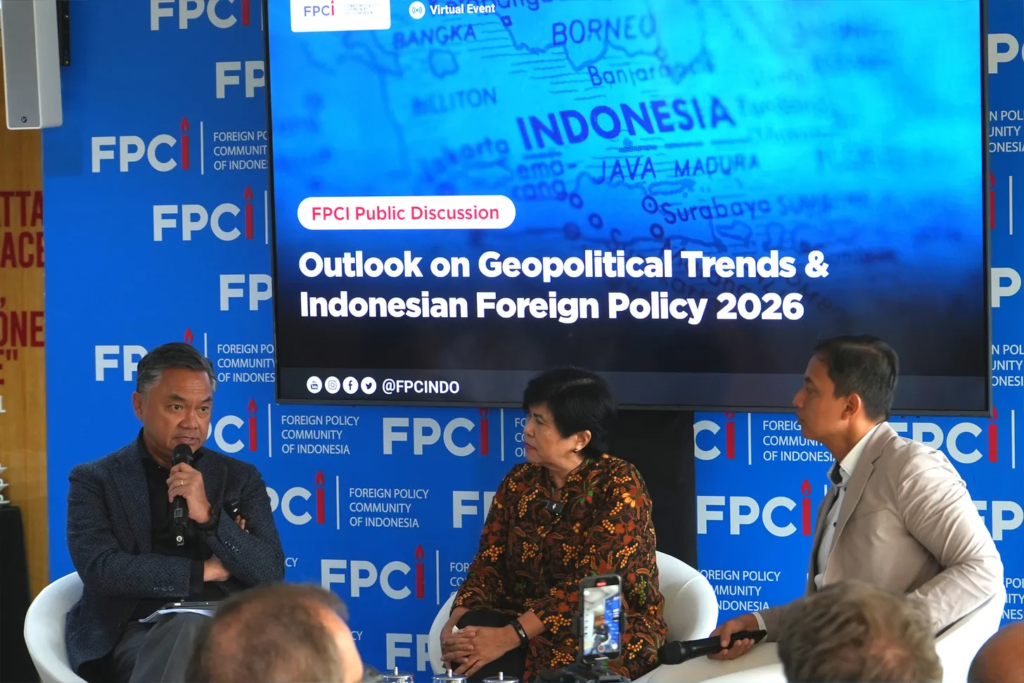
Dino Patti Djalal, Founder and Chairman of the Foreign Policy Community of Indonesia (FPCI), and Professor Dewi Fortuna Anwar, Co-Founder of FPCI and Research Professor at the Research Center for Politics, National Research and Innovation Agency (BRIN), speak at the FPCI Public Discussion on “Outlook on Geopolitical Trends & Indonesian Foreign Policy 2026”. (Foreign Policy Community of Indonesia)
After spending his whole career in the foreign ministry, Dino could have stepped away from diplomacy altogether. Instead, he chose to reimagine it. Devoting himself to bridge and reinforce it through wider public dialogue, Dino argues that foreign policy should belong to everyone. It should no longer be an exclusive topic.
During the interview, we asked Dino’s point of view on how a forum can do that the ministry cannot.
“I think our strength is our ability to engage and embrace the grassroots”.
His argument finally led him to found the biggest independent and non-partisan grassroot foreign policy community in Indonesia, Southeast Asia and Indo-Pacific, the Foreign Policy Community of Indonesia (FPCI). He argues that it is very crucial to invite the grassroots into a deep and wider dialogue, as civil society has the flexibility to create dialogue that extend beyond official negotiations, bringing together students, researchers, business leaders, local community and young people into discussions that were once reserved only for policymakers.
For Dino, public trust and participation is non-negotiable. As mistrust and cynicism mount for the government, he believes that civil society must be perceived as a partner in shaping solutions, rather than threat or suspicion. Their participation matters the same as how the government negotiates through international fora, businesses determine investment strategies, researchers develop new technology, while the grassroots adapt and shape the public expectation, often reality. He added that the government should embrace civil society even when faced with criticism, recognising that independent voices can strengthen policymaking instead of undermining it. Because one, two or more ambitions rely on trust, active participation and are delivered through action.
Climate Is a Shared Responsibility
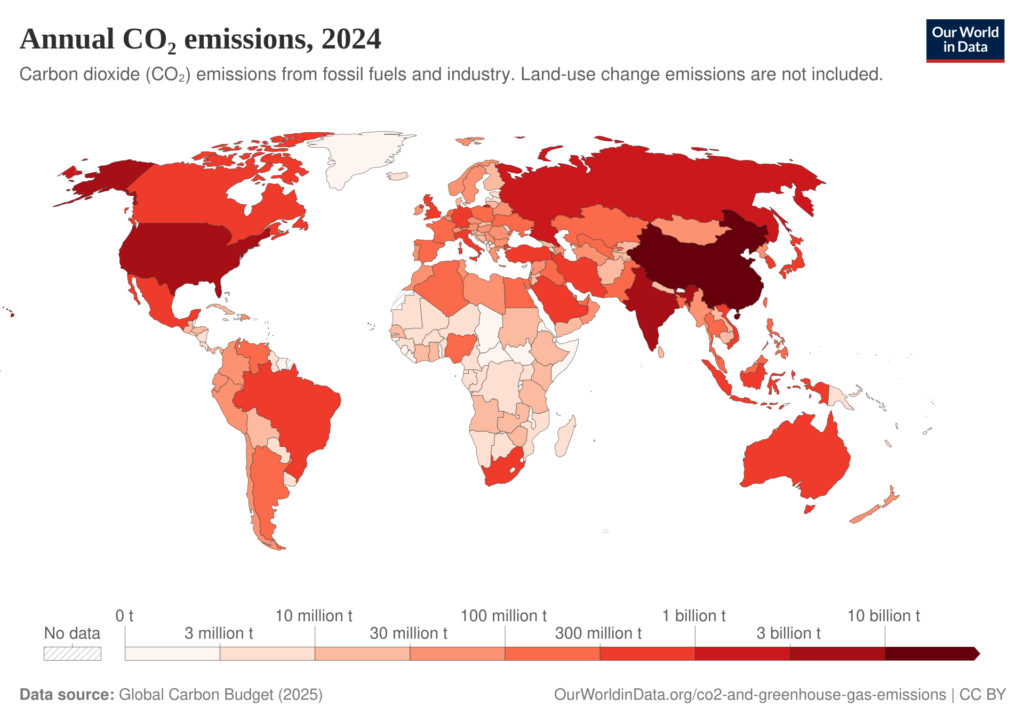
Annual carbon dioxide (CO₂) emissions in 2024, measured in tonnes per year. (Our World in Data)
As the conversation progressed, the discussion shifted away from governments and towards individuals. We wonder why someone outside Indonesia, or even outside Southeast Asia, should care about a climate summit in Jakarta. Dino’s answer is strikingly simple. Climate security, he argued, is ultimately a “mathematical game.”
By that, he meant the atmosphere doesn’t distinguish where emissions come from. What matters is the sum of it. Every country’s policies, every companies’ investments and every individual choice contribute to the same equation. To illustrate this, he provides us with an anecdote. The founder of FPCI told us he just bought two EVs, but he wondered what’s the use of it, if somebody in the US bought two large trucks that use fossil fuel? “What I save, he destroys.”
According to Dino, his experience illustrates shared responsibility. No single government, company, or household could achieve climate security alone. Progress depends on billions of people making choices that collectively move global emissions in the same direction.
In his view, that is why also INZS extends beyond Indonesia. The summit is part of a broader conversation about how countries, institutions and citizens can work together to translate climate commitments into meaningful actions. Because if climate change is a “mathematical game,” then every action, whether taken in Jakarta, Washington or elsewhere, becomes part of the global equation.
As our conversation came to an end, Dino Pati Djalal returned once again to the idea of responsibility. He hopes the conversations it sparks will reach far beyond the conference halls, into boardrooms, classrooms, communities and households. Because for him, climate diplomacy is not measured by the declarations made at a summit, but by what people choose to do once they return home. In a world that has grown accustomed to ambitious climate pledges, Dino believes the next chapter will not be defined by what countries promise, but by what they deliver.
That argument is what the fifth Indonesia Net-Zero Summit has been built to test. Convening on Saturday, 1 August 2026 at Balai Kartini in Jakarta under the theme “It’s Time to Deliver!”, INZS 2026 brings government, business, academia, youth and civil society into sessions on Indonesia’s 100 GW solar ambition, ASEAN energy and climate security, and the financing gap behind both, with keynotes from Coordinating Minister for Economic Affairs Airlangga Hartarto and National Energy Council Secretary General Dadan Kusdiana. Consistent with the case Dino has made since founding FPCI, the summit is open to the public and free to attend, and registration is open at fpciclimate.org/inzs2026.
About The Author