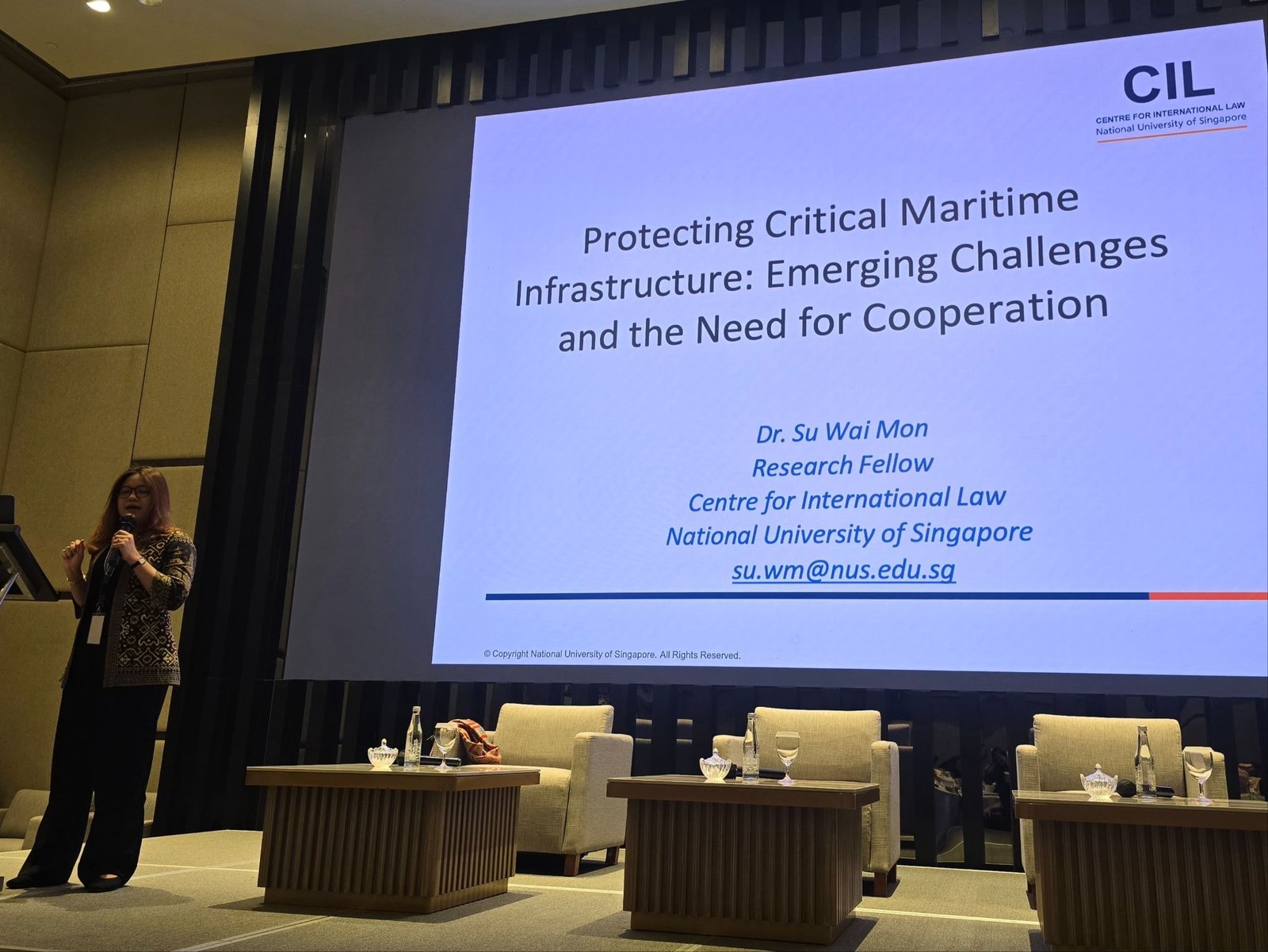
Su Wai Mon of the National University of Singapore presents her research titled “Protecting Critical Maritime Infrastructure: Emerging Challenges and the Need for Cooperation” on July 14 in Jakarta. (SEA Daily/Elisabeth Xaviera)
Around 5.3 trillion US dollar in trade transits the South China Sea each year, a waterway whose legal status remains unsettled. A decade ago, precisely on July 12, 2016, the Arbitral Award issued by the Permanent Court of Arbitration (PCA) in the Hague rejected Beijing’s claims over the sea. However, China’s refusal to recognise it leaves the rules governing one of the world’s busiest trade channels continuously contested. For the region’s economies, that ambiguity is not an abstraction but a durable risk to supply chains, energy flows and food security.
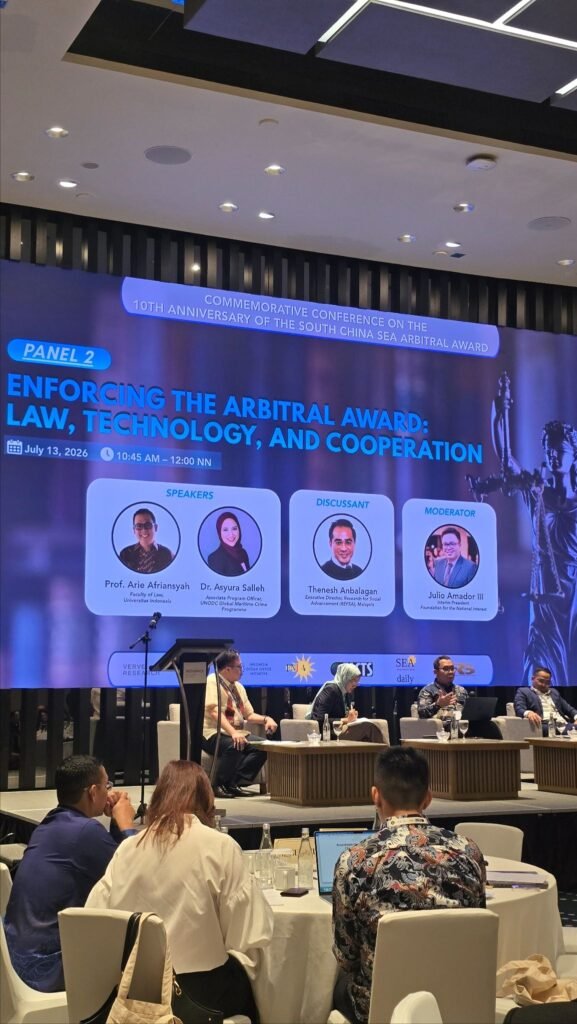
Q&A session of Panel 2, “Enforcing the Arbitral Award: Law, Technology and Cooperation”. (SEA Daily/Elisabeth Xaviera)
“Without stability, there is no prosperity,” Thenesh Anbalagan, executive director of Malaysia’s Research for Social Advancement (REFSA), told the Commemorative Conference on the 10th Anniversary of the SCS Arbitral Award, a two-day FACTS Asia forum in Jakarta that pressed the dispute’s practical costs. His argument was that the award and UNCLOS supply the legal baseline on which predictable commerce depends and that the region already has cooperation templates to build on. He pointed to the Digital Economy Framework Agreement (DEFA) and the ASEAN power grid consortium as models, urging governments to pursue similar government-to-government collaboration at sea.
Much of the economic risk is underwater. Su Wai Mon of the National University of Singapore’s Centre for International Law warned that maritime infrastructure is poorly understood as a risk category. Unlike a land-based refinery, undersea cables and pipelines sit “beyond the public’s imagination”, yet damage to them could ripple through global supply chains. With the region’s chokepoints, from the South China Sea itself to the Strait of Malacca, functioning as arteries for global energy, she argued that investment in operational safety and maritime cybersecurity is now “non-negotiable” for economic resilience.
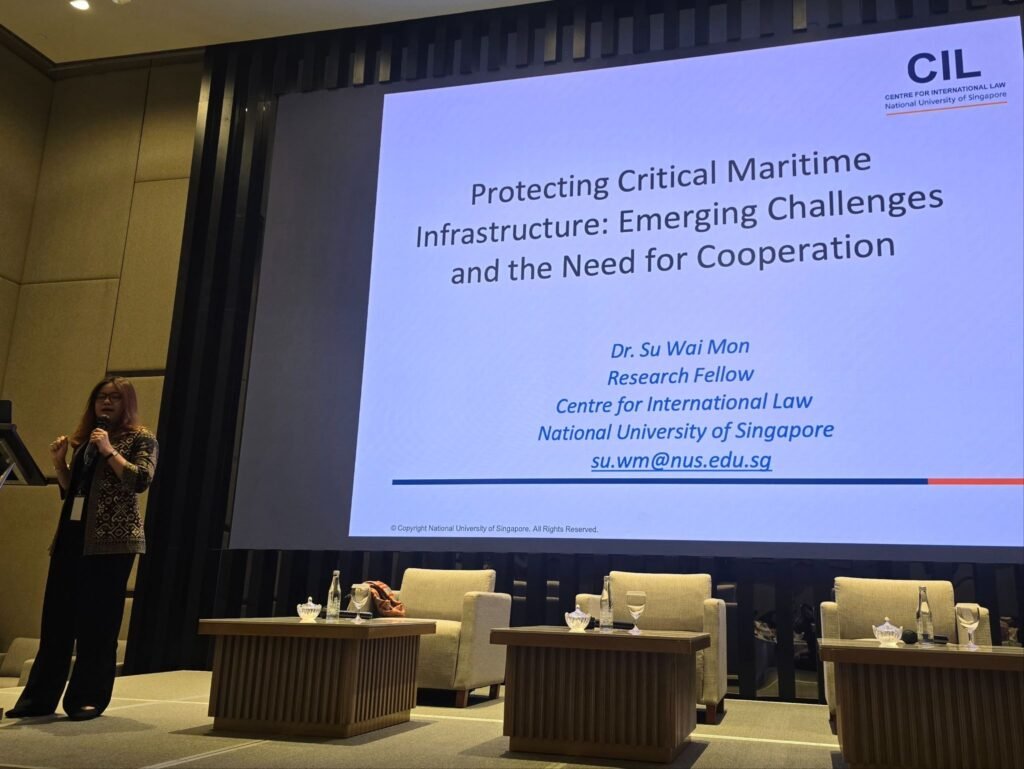
Su Wai Mon, Research Fellow at the Centre for International Law, National University of Singapore, presents her research for Panel 4, “The Award’s Impact on Resource Sovereignty: Energy, Fisheries and Food Security”. (SEA Daily/Elisabeth Xaviera)
Furthermore, Emirza Adi Syailendra of the S. Rajaratnam School of International Studies (RSIS) stressed that the award’s economic value depends on domestic follow-through, warning that the greatest threat to local livelihoods is the failure to translate international law into national legislation that protects them. On fisheries and resource management, he said a dedicated regional fund is “possible and even precedented”, if a difficult instrument to navigate.
Capacity, more than hardware, emerged as the practical leverage. Asyura Salleh of the UN Office on Drugs and Crime’s Global Maritime Crime Programme argued that technology is “the scaffolding” for professionalising maritime law enforcement, but that the region’s first investment should go into trained analysts rather than costly infrastructure. She said that shared Maritime Domain Awareness rests on treating the sea as a “collective source” rather than a pie to be sliced between states, a framing that doubles as an economic case for pooled surveillance and trust-building.
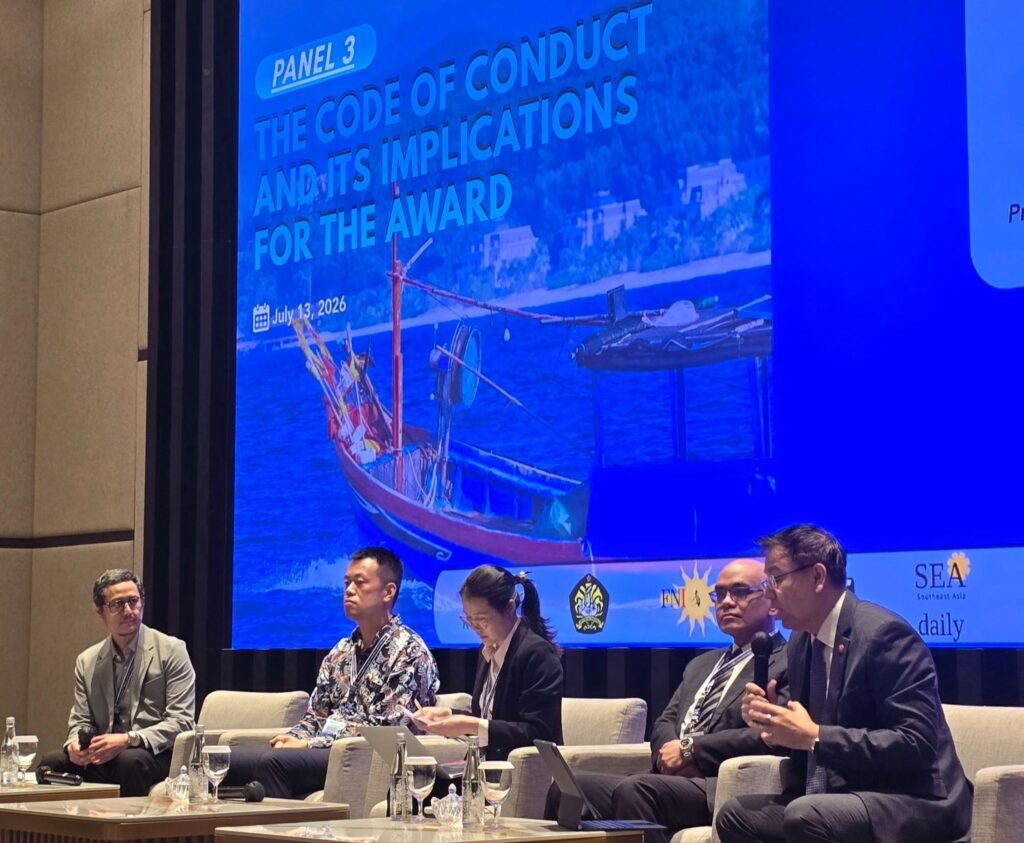
Discussant Kitti Prasirtusk of Thammasat University of Thailand shares his commentary on the presentations of Panel 3, “The Code of Conduct and Its Implications for the Award”. (SEA Daily/Elisabeth Xaviera)
Ten years after the Arbitral Award, the economic logic is clearer than the political path. A concluded Code of Conduct (CoC) grounded in the award would give investors and traders the legal predictability the region’s growth depends on. Without that, the South China Sea remains what several speakers implied it already is, which is a source of prosperity held hostage to unresolved demarcation and a risk that will keep pricing into every calculation made across its waters.
What does this mean for business?
The practical effect of the dispute is a risk premium priced into almost everything that moves through or sits beneath these waters. Shipping and insurance costs track the odds of disruption along lanes that carry trillions of dollars in trade each year, and every grey-zone incident near a contested shoal nudges that premium higher.
The Arbitral Award makes that risk calculable. Offshore energy blocks, fishing grounds and the digital infrastructure underpinning agreements like the DEFA all sit within maritime zones whose entitlements the 2016 ruling clarified under UNCLOS. The clarity offered by such a framework means that companies can plan around a known legal regime. A CoC that reaffirms the award would narrow that gap for investors, whereas a diluted text, or no code at all, leaves the premium where it is.
Kala Advisory helps investors read and navigate risks like these across Southeast Asia’s maritime economy. Visit kala-advisory.com.
About The Author