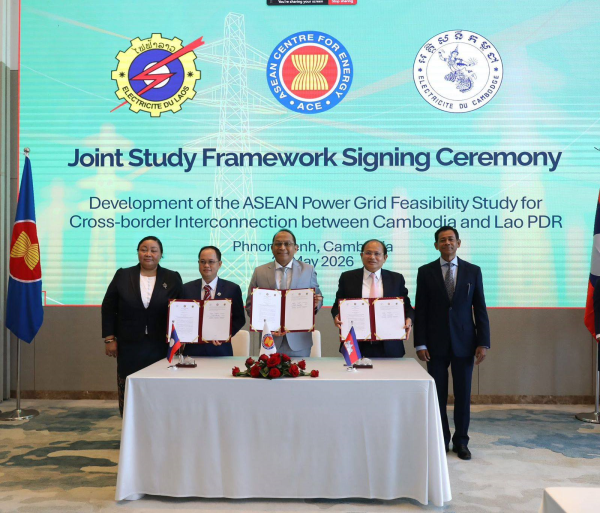
Officials from Lao PDR, Cambodia, and the ASEAN Centre for Energy gather for the signing of a Joint Study Framework to advance Cambodia–Lao PDR power interconnection in Phnom Penh, Cambodia, on May 25, 2026. (Lao News Agency)
The ceremony took place on May 25 in Phnom Penh, attended by senior representatives including Managing Director of Electricité du Cambodge (EDC) Praying Chulasa, Deputy Managing Director of Electricité du Laos (EDL) Viengthong Sackdara as well as Executive Director of ACE Razib Dawood. A World Bank delegation was also in attendance, reflecting the institution’s role as financial backer of the research project.
This joint study framework enables relevant parties (ACE, EDL, EDC and World Bank) to conduct feasibility studies and technical assessments of the grid infrastructure. It also establishes a steering and working Committee to oversee the comprehensive study, with the aim of maximising regional energy potential.
The joint release noted that both countries hold “strategic significance” for the region’s cross border electricity integration. It highlighted Laos’ established role as ASEAN’s de facto energy supplier, alongside Cambodia’s trajectory from import dependency towards domestic resource development and eventual energy self-sufficiency.
This momentum aligns closely with outcomes from the recent ASEAN Summit, where member state leaders formally designated the ASEAN Power Grid as a top regional priority. This project also constitutes a milestone under the ASEAN Plan of Action for Energy Cooperation 2026-2030.
This joint programme is expected to develop integrated high-voltage infrastructure between Cambodia and Laos, expanding capacity for green energy and optimising shared energy resources. In doing so, the project will lay the groundwork for broader electricity network connectivity across ASEAN member states, as the region transitions towards cleaner energy and more resilient energy security. Primary energy sources are reported to include hydropower, solar and biomass.
“This interconnection is not merely a national project. It sits at the heart of the broader ASEAN Power Grid, the region’s collective ambition to link our electricity networks, enhance energy security for 670 million people, and accelerate the transition to clean energy,” said ACE Executive Director Razib Dawood.
What does this mean for businesses?
For businesses operating across Southeast Asia, this framework signals a tangible shift in the region’s energy landscape. Cross-border grid integration points towards a more unified regional electricity market with direct implications for industrial planning, cost forecasting and investment decisions. Manufacturers and energy-intensive industries stand to benefit most, as greater interconnection diversifies supply and opens access to a potentially cheaper energy mix. For renewable energy developers and infrastructure investors, the formal feasibility framework, backed by the World Bank, lowers the risk threshold for cross-border projects.
About The Author