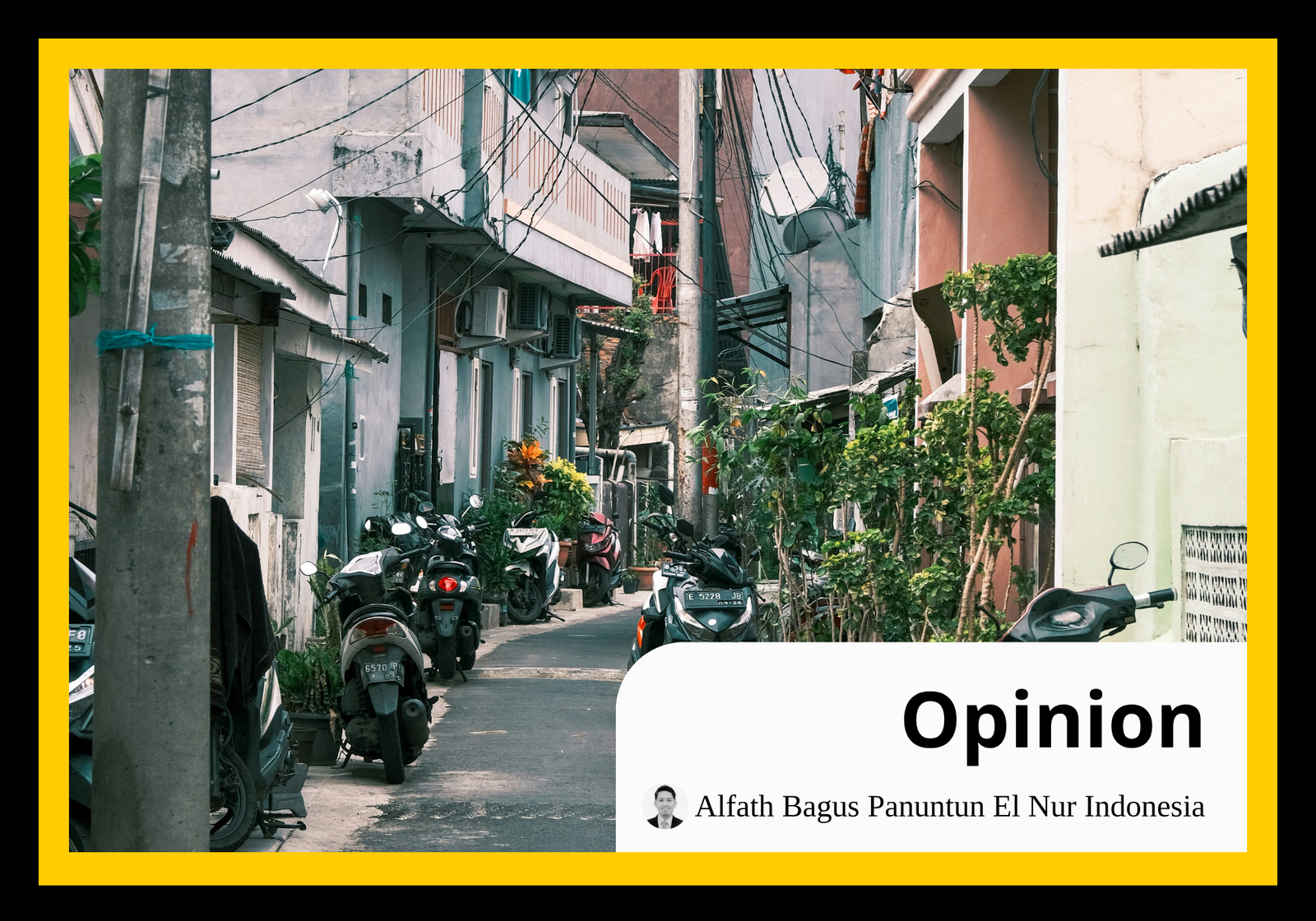
Residential Alley near Gondangdia Station, Jakarta. (Unsplash/Ahmad Hasan Hariri)
Alfath Bagus Panuntun El Nur Indonesia is a lecturer at the Department of Politics and Government, Universitas Gadjah Mada. The views expressed are authors’ own and do not represent SEA Daily or that of another organisation.
Cities Facing Triple Disruption
Walk through any major Indonesian city and the contradictions are hard to unsee. Gleaming co-working spaces sit beside waterlogged ‘kampungs’. Online ride-hailing drivers have become the dominant actors of urban mobility, occupying roads never designed for such intense traffic density. A young professional takes a Zoom call from a café because her rented room has no desk. And after the sun sets, the concrete still radiates. Something structural is underway and it is moving faster than city governments are built to handle.
Call it triple disruption. Digital technology has rewired how Indonesians work, buy and organise. Gen Z and millennials now make up over 53% of the national population, and a growing share are arriving in cities with expectations of connectivity, liveability and basic services that most Indonesian urban governments are unprepared to meet. The pandemic did not merely disrupt; it exposed, with uncomfortable precision, the deferred maintenance that Indonesian cities had been accumulating for decades. The UN projects that 68% of the world’s population will live in cities by 2050. Indonesia is not the exception to this trend; it is one of its central engines.
But here is what almost never makes it into the policy conversation: when Indonesians discuss cities, they almost always refer to the Java island, where around 55% of the populace live in a country of over 14,000 islands. And when they mean Java, they almost always have the capital Jakarta in mind. This selective attention carries a real cost, paid most heavily by those left furthest from the frame. Nowhere is that cost more measurable, or more urgent, than in the heat that Indonesian cities are generating and failing to manage.
Getting Hotter
Start with the structural numbers. Java contributes roughly 57% of Indonesia’s national GDP, a share that has barely shifted across years of growth and disruption. The eastern regions of Maluku and Papua together contribute barely 2.5%. These are not temporary imbalances waiting to self-correct, they are the structural legacy of an economy built, across decades, around a single island.
The deeper irony is that Java’s dominance coexists with stark inequality within it. Jakarta’s smart city index leads the country, but its Gini coefficient sits at 0.41, one of the higher inequality levels in Southeast Asia. Research on Java’s major urban areas finds that surface urban heat island intensity in the Jakarta metropolitan area—now the world’s most populated metropolis, with over 40 million inhabitants—has reached up to 6°C above surrounding non-urban land, a consequence of the city’s built-up area more than doubling since 2000. Less than 10% of Jakarta’s green and open space from 1994 remained by 2017, not because of climate change, but because of planning decisions that opted construction over cooling. The city’s MRT (mass rapid transit) stations and co-working hubs sit minutes from kampung communities without shade, reliable power, or flood protection. Digitally sophisticated, thermally punishing.
This pattern repeats across the archipelago, at increasing intensity. A 29-year study of Makassar in the eastern province of South Sulawesi, a mid-sized city representative of how most Indonesian cities actually develop, found surface urban heat island effects of up to 9.2°C in long-urbanised areas and 6.3°C in informal settlements. Sensor networks across 12 kampungs recorded wet bulb temperatures approaching the upper limits of human survivability. These are not projections. For outdoor workers, vendors, and construction labourers, who make up the majority of the urban poor—they are the daily condition of working life. With roughly 30% of Indonesia’s urban population living in informal settlements, the numbers exposed to this risk are in the millions.
The global picture makes the urgency harder to dismiss. The Lancet Countdown on Health and Climate Change estimates that heat exposure cost the global economy 1.09 trillion US dollar in lost labour productivity in 2024 alone, roughly one per cent of global GDP, before counting health, energy, or infrastructure costs. Heat-related deaths have risen 23% compared to the 1990s baseline. As the Cities Forum’s urban heat strategy makes plain: this is not a weather problem, it is an urban design problem. Dense cities run 1–4°C hotter on average than their surroundings, and up to 10°C hotter at night, because of choices about streets, surfaces and canopy. In Southeast Asia, where heat and humidity combine to generate physiological stress that drier climates do not, that design deficit is costing lives that did not need to be lost.
The cities least equipped to respond are precisely those where digital exclusion compounds heat vulnerability. Internet access stands at 84.7% in Jakarta but only 26.3% in the eastern region of Papua. Heat-vulnerability data barely exists outside Java. The two deficits are not separate problems. They are the same problem in different registers. Meanwhile, 22 districts in the East Java province are still classified as relatively underdeveloped, a reminder that even the island deemed advanced is a patchwork of concentrated advantage and persistent neglect.
The government’s flagship response to regional imbalance has been Nusantara, the new capital being built in East Kalimantan on the island of Borneo. The argument was always as much about equity as about Jakarta’s subsidence and congestion. But a city currently housing just 147,000 people, far short of early projections, cannot by itself rebalance an archipelago of this scale. Built in a tropical forest zone, Nusantara risks replicating the heat island dynamics it was meant to escape. Because the capital’s relocation is more of a speculative development project and a political symbol of former President Joko Widodo’s legacy of power, it might be a new pocket of elite urbanism, surrounded by equally neglected hinterlands.
Changed and Unchanged
The most visible COVID-19 pandemic-era shift, the retreat from the office as the organising centre of urban life, has been real in Jakarta, modest elsewhere in Java, and essentially absent in most outer-island cities. The role of small and medium enterprises’ (SMEs) digital communities in surviving the triple disruption has been well documented in Java: marketplace platforms and community solidarity became survival infrastructure when the formal economy faltered. But the logistics networks, payment systems and reliable internet that enabled this remain absent or unaffordable across much of the archipelago. The digital disruption story, like the heat story, is overwhelmingly Javanese.
On governance, platforms like Jakarta Kini (JAKI), Jabar Digital Service (JDS) and Surabaya Single Window (SSW) represent genuine progress in accessible civil services. The pandemic forced Indonesian bureaucracies to digitise faster than they otherwise would. But the millennial civil servants who drove these reforms cluster in cities with the fiscal capacity to retain them. For a district government in the rural regions of Flores or West Papua, the challenge is not digitising services, it is having enough staff to run them at all.
Three Bets Worth Making
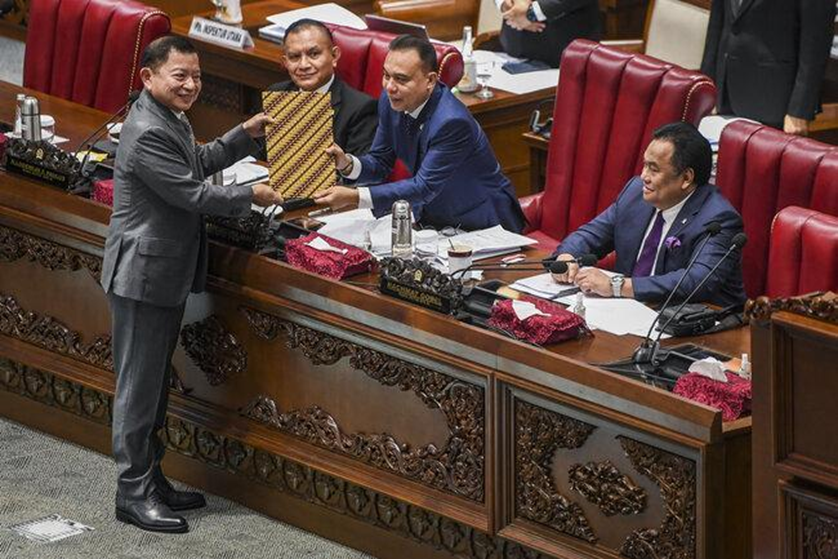
PPN/Bappenas Minister Suharso Monoarfa hands over the IKN document to Deputy Speaker of the House Sufmi Dasco Ahmad during the plenary meeting on approving Law No. 3 of 2022 on the National Capital. (Antara)
A credible urban transformation agenda must take disparity and heat seriously at once. The solutions to both problems point in the same direction. The obstacle is not technical. It is political.
The first bet is on participatory governance, applied differently by geography. In Java’s major cities, the tools exist; what is missing is the will to redirect them toward residents rather than developers. WRI framework for equitable urban transformation argues that civic participation is not a democratic nicety but a practical mechanism for closing the planning gap. In secondary cities and outer islands, the priority is more basic: building the administrative capacity that makes participation meaningful at all. Scaling e-government from Jakarta to Kupang, for example, cannot be done by replicating an app. It requires investment in people, connectivity and institutional trust.
The second bet is on green infrastructure as climate defence and fiscal common sense. Research on Jakarta’s flood losses consistently shows the economic cost of inaction outweighs the upfront investment required. The same logic applies to heat. A 30% urban canopy target, the threshold at which a 93-city European study found one in three heat island deaths could be prevented, is achievable in Indonesian cities that still have land to plant. Jakarta has committed to that target by 2030; closing the gap between ambition and current reality is a governance failure, not a technical one. Medellín’s green corridor programme reduced city temperatures by 2°C in three years by planting 880,000 trees along 30 roads. Ahmedabad’s Heat Action Plan, South Asia’s first, averted an estimated 1,190 deaths a year since 2013. Indonesia has cities where equivalent plans do not yet exist. That is not a resource problem. It is a prioritisation problem.
The third bet, the hardest, is on equity, which means confronting heat and disparity simultaneously. Heat maps almost everywhere overlay the historical map of underinvestment: the neighbourhoods with the least canopy, the oldest buildings, and the fewest ways to escape the heat are almost always the poorest ones. Reforming subsidy targeting using better data and directing investment to those at the bottom requires political commitment beyond warm words. Indonesia needs heat-vulnerability mapping at neighbourhood scale in Makassar, Medan, Pontianak and Jayapura, not only in Jakarta. Whether the new capital Nusantara delivers on its equity promise depends on whether the investments that follow are genuinely redistributive, rather than simply shifting the address of privilege from Central Jakarta to East Kalimantan.
Triple disruption is not a temporary change, but a structural shift that permanently alters the foundations of urban life. Cities with visionary leadership and adaptive governance will be able to use disruption as momentum to build more resilient and equitable cities, while cities that fail to respond will be trapped in an increasingly complex accumulation of crises. For Indonesia, the stakes are high: urbanization can become an engine of shared prosperity or deepen inequality. Ultimately, what will determine it is not just the technology, but the political courage and collective capacity to navigate it equitably and strategically.
About The Author