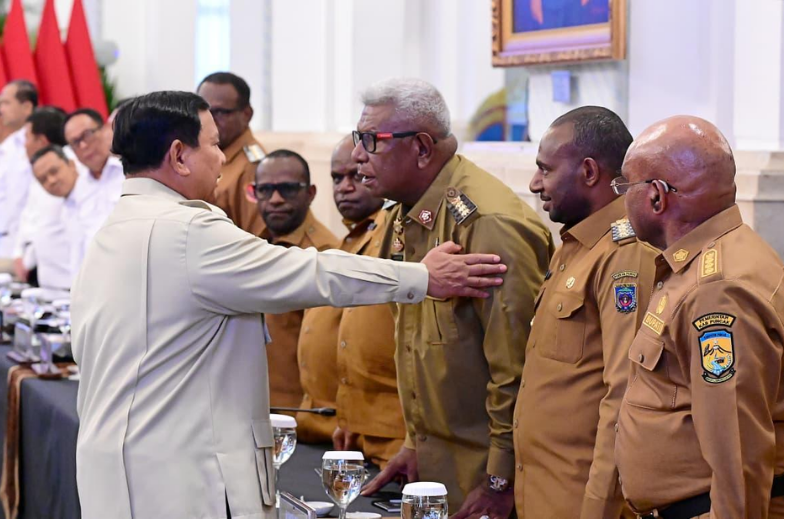
President Prabowo Subianto meets with Papua officials to push food self-sufficiency within three years, focusing on rice field expansion and revitalizing sago. (BPMI Setpres)
Public screenings of the documentary Pesta Babi were forcibly disbanded by the state apparatus in several regions across Indonesia, drawing criticisms from human rights officials and civil society groups.
Directed by Dandhy Dwi Laksono and Cypri Dale, Pesta Babi is a collaborative project by a coalition of Indonesian civil society organisations, environmental activists and independent media, including Watchdoc Indonesia, Jubi Media, Indonesia Baru, Pusaka Bentala Rakyat and Greenpeace Indonesia.
This documentary investigates the indigenous land dispute linked to the Strategic National Projects—including sugarcane, palm oil, and food estate—across South Papua. It also scrutinises the relevant stakeholders in these projects, such as business elites who benefit from these projects and the military, which becomes the sole executor on the ground.
In Tanah Datar, a regency in West Sumatra, the State Intelligence Agency (BIN) reportedly pressured a school headmaster to bar screening at his school. Similarly, a screening at a university in Mataram, West Nusa Tenggara, was forcefully stopped by the rectorate and campus security guards.
Yet, the most controversial case occurred in Ternate, North Maluku, where the Commander of the 1501/Ternate Military District, Lieutenant Colonel Inf Jani Setiadi, stopped the session after a social media backlash over the film’s title, which was considered provocative. Pesta Babi literally translates to Pork Party, a taboo subject in the Muslim-majority country.
The crackdown drew direct commentary from government officials. Natalius Pigai, the Minister of Human Rights, criticised the disbandment, stating, “the ban can only be enforced through a court decision,” and underlined that “the power, initiative and creativity of the Indonesian people must be respected and presented to the public”.
Anis Hidayah, the Chairwoman of the National Commission on Human Rights, added, “it shouldn’t have been necessary to disband it, and the government shouldn’t have been reactive”. She further assessed that the Indonesian National Armed Forces doesn’t have the authority to disband public screenings, calling the government response “reactive”.
Some nongovernmental organisations also sharply criticised this action. Indonesian Legal Aid Foundation (YLBHI) urged the government to “stop all forms of intimidation, excessive surveillance and forced disbandment”, and “to guarantee freedom of expression,” while criticising military involvement as a breach of the Armed Forces Law.
The forced termination of Pesta Babi screenings in public spaces by state actors incited broader concerns over freedom of expression and may affect public trust in security institutions, raising questions about Indonesia’s democratic development.
About The Author