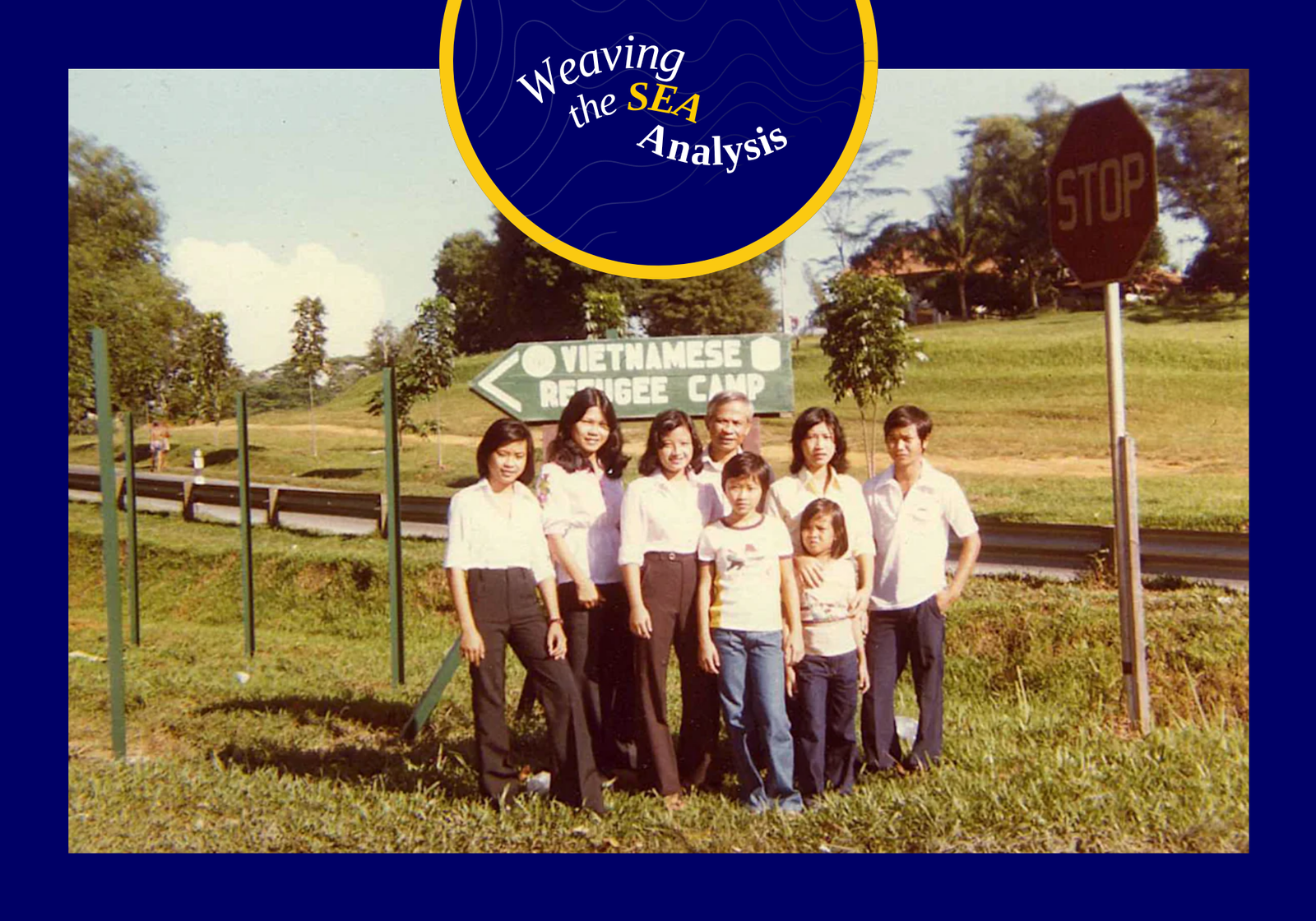
People posing at the former refugee camp at Hawkins Road in Sembawang, Singapore in 1981. (Heather Stenseng)
This is a top 3 entry in the Weaving the SEA Essay Competition 2026, written by Shayla Sakkakhanaune. Her essay traces the Vietnamese refugee history of Singapore’s Hawkins Road camp into the present day, reading the joss sticks and shrines in Vietnamese eateries as a quiet, adapted marker of diasporic religious identity.
A Road that Led to Many Paths
In the Woodlands region of Singapore, the consistent flashes of bright safety vests, steady clanging of tools and prevalence of “Works Ahead” signs almost distracts passersby from a road that deviates from the traffic of Admiralty Road West and leads into an unmarked expanse of greenery. Sidewalks do not accompany the path, and a traffic barrier prevents cars from accessing the area. Further access into the area, however, is not needed to bear witness to a piece of history. Simply stepping towards the barrier allowed me to step onto a path that once led into Singapore’s first and only refugee camp: the Hawkins Road Refugee Camp.
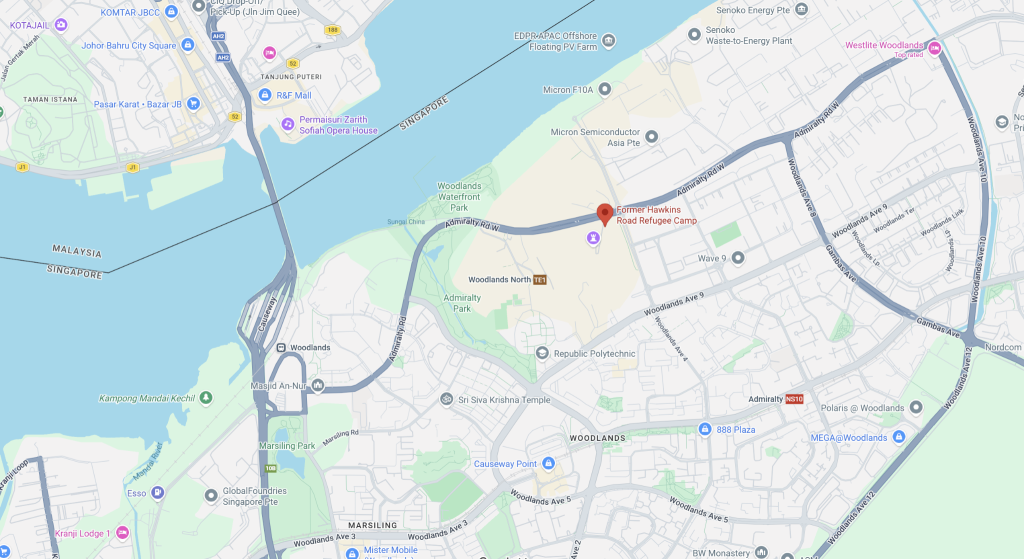
The location of the former Hawkins Road Refugee Camp in Singapore’s Woodlands area (Google Maps)
On 27 June 1996, the Hawkins Road Refugee Camp bid farewell to its last cohort of Vietnamese refugees. Now, over thirty years later, Hawkins Road hardly looks like a historical site, nor is it treated like one. The sign pointing towards the street no longer bears the name of “Hawkins Road” and is labeled instead as “View Road,” fallen limbs of a tree rest unattended on the pavement and the only structure onsite is an abandoned hospital. Although the area has remained vacant since the camp’s closure and many Vietnamese refugees moved back to Vietnam or resettled in the US, Europe or Australia, the Vietnamese community in Singapore has since established itself on the island.
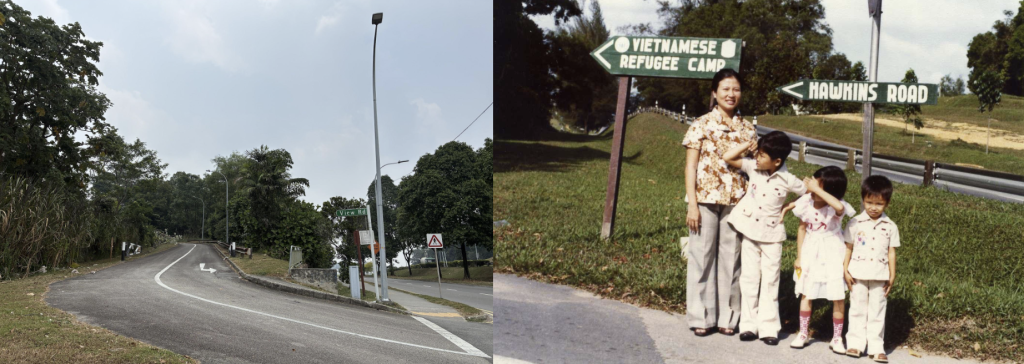
The author’s photo of the entrance to “View Road” compared to a photo of the former entrance to Hawkins Road. (Shayla Sakkakhanaune & Long Nguyen)
Joo Chiat is known for housing several Vietnamese restaurants and coffee shops, but I was particularly curious about the extent of the Vietnamese community near the former refugee camp. Today, the Vietnamese community in Singapore is largely composed of food service workers and students, so I searched for relevant eateries on Google Maps. A hawker stall called My Saigon Pho is the closest Vietnamese eatery to Hawkins Road, but I found myself at a bakery called Tam Tam Viet Nam Bakery in Yishun.
Nestled amongst several Housing and Development Board (HDB) blocks, the Tam Tam Viet Nam Bakery offers a menu of bánh mì, Vietnamese noodle dishes, and drinks, as well as a display of grab-and-go foods. It sits adjacent to the Vietnam Mini Mart and has a cozy seating area for customers. When I happened upon the stall, there were several patrons and workers occupying the space, casually eating and chatting in Vietnamese together. The atmosphere was lively as I ordered a pork bánh mì. After paying, I asked the worker who took my order if he was from Vietnam since I noticed him speaking in Vietnamese. He nodded with a smile, and that is when I told him about how I was trying to find Vietnamese spots in the area; I asked if he knew of any temples that I could visit, but the conversation came to a halt as another customer entered the stall.
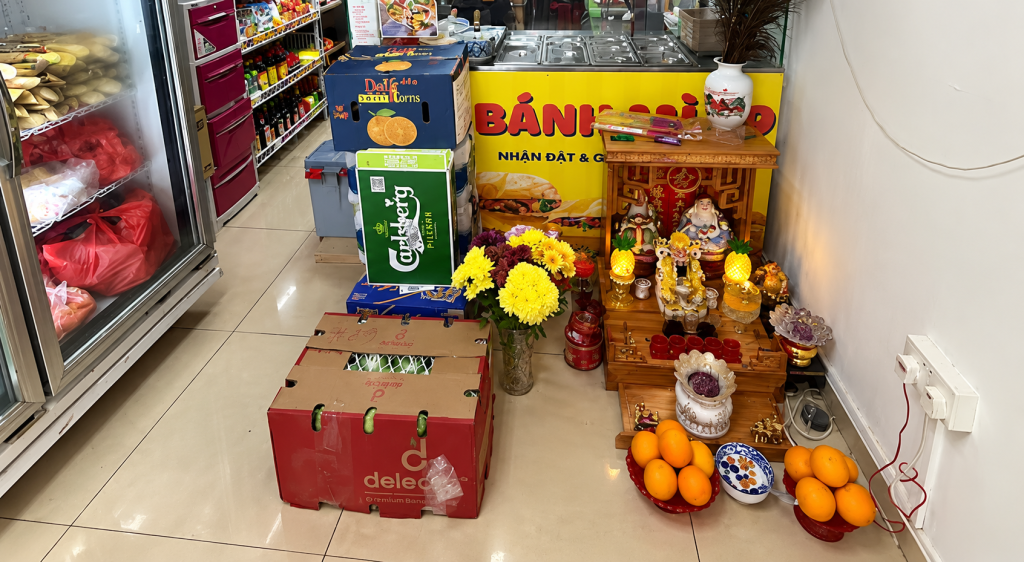
The conversation did not continue because my food arrived at my table soon after and the worker who originally took my order was no longer in the stall once I began eating. I did not mind, however, as the question that lingered in the humid air was answered by the shrine tucked into the corner of Tam Tam.
I chose to ask about a religious space like a temple because such spaces are where minority communities can gather and gatherings need not be religious in nature. I have witnessed this firsthand as the child of Lao and Thai parents through new year’s celebrations at local temples: the temple was as social of a space as it was religious and I learned to view religion as an aspect of our cultural identity. At the same time, I learned that religious practices can be separate from cultural practices, though the line of distinction is quite thin at times. For the Vietnamese community in Singapore, I find that this distinction is similarly thin at Vietnamese eateries where shrines are housed and the appearance of such shrines seem to have been adapted for the Singaporean landscape. What, then, does it mean to be Vietnamese in Singapore and is religion woven into this diasporic Vietnamese identity?
A “Sticky” Adaptation to Surroundings
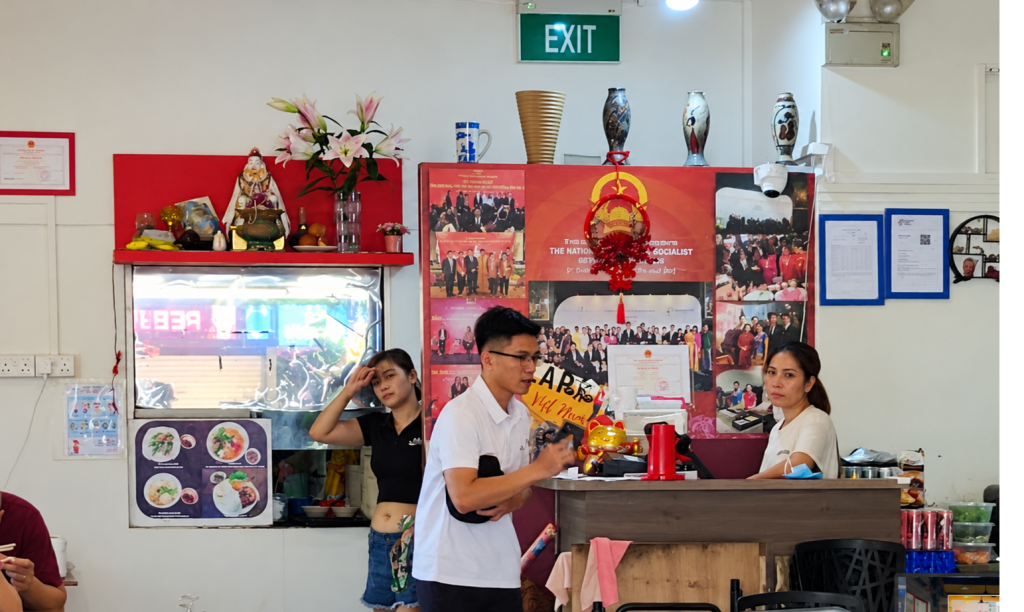
A Vietnamese worship altar on top of a window at the Lập – Phở Thố Đá Restaurant in Singapore. (Google Maps/Philip Cheong)
If cultural identity is to be examined through a religious lens, then it is worth noting the religious demographics of Singapore and Vietnam. In 2023, the Pew Research Center reported that there has been a decline in Singaporeans identifying as Buddhist or as followers of traditional Chinese religions and 26% of adults in Singapore identified as Buddhist overall. In the following year, the Pew Research Center reported that 38% of adults in Vietnam identified as Buddhist and 0% identified as Taoist. I specifically note the percentage of Taoists in Vietnam because 7.3% of residents in Singapore’s 2025 General Household Survey identified as Taoist.
Bearing Singapore’s largely multicultural society in mind, it is understandable how it was reported that less adults in Singapore identify as Buddhist than in Vietnam. At the same time, however, there are more adults in Singapore that identify as Taoist than in Vietnam; Taoism is a religious tradition rooted in Chinese social history, and the Chinese population in Singapore makes up the state’s ethnic majority, so this difference is also understandable. So, it is no surprise that the two temples closest to the former Hawkins Road Refugee Camp are both Chinese in nature; as of writing, Hong Sun Tan Temple (combined with Fei Loong Gong) is under renovation, and Hong Tho Bilw Temple is open during normal hours.
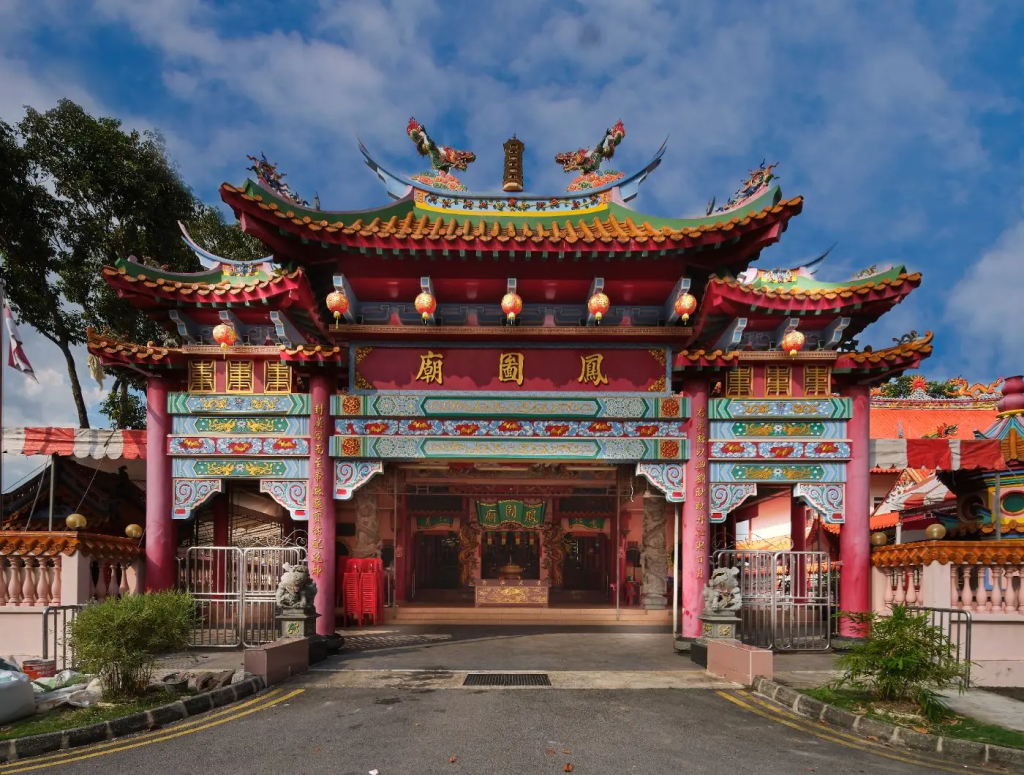
Hong Tho Bilw Temple, one of the Buddhist temples in Woodlands, is Chinese in nature. (Singapore National Heritage Board)
Searching “Vietnamese temples in Singapore” on Google Maps returns results of Buddhist temples in general, none of which are explicitly Vietnamese. With so few places of worship in Singapore to cater to the Vietnamese practice of Buddhism, the presence of shrines in Vietnamese stalls and shops becomes a symbol of cultural adaptation rather than an expression of cultural identity alone.
It is worth mentioning that there is an overlap in the practices of Vietnamese Buddhism, Chinese Buddhism and Taoism, particularly through the use of red joss sticks. When I visited the Hong Tho Bilw Temple, for instance, the man onsite provided me with a bundle of red joss sticks to perform the prayer rituals at each designated area. I was reminded of this abundance of joss sticks when I noticed how the shrine at Tam Tam held a bowl full of red, burnt joss sticks. Several Vietnamese restaurants in Joo Chiat also feature shrines with bowls of red joss sticks, as seen on Google Maps photos of Bánh Mì 29, Long Phung, and Lập – Phở Thố Đá Restaurant. Since these sticks are so accessible in Singapore with numerous shops dedicated to selling them, it is once again understandable how eatery shrines have become a notable marker of Vietnamese religious identity in Singapore.
A Vietnamese worship altar in front of a stall in Bánh Mì 29 in Singapore (Google Maps/Staz Chen)
When the Vietnamese fled the aftermath of war in their home country and initially arrived at the Hawkins Road Refugee Camp, religion was most present in the form of missionaries volunteering at the camp. The religious practices that normally would have been done in Vietnam were understandably limited in Singapore, which was a foreign land to these refugees. Coping with the aftermath of war took the shape of survival, as the refugees at the Hawkins Road were told that they were allowed to stay in Singapore for only three months; they were to be concerned with their present lives, rather than the afterlives of those they had lost in the war. Now, in 2026, the Vietnamese in Singapore can afford to consider and incorporate religion into their daily lives through something as simple as the use of joss sticks.
A Syncretic Singapore
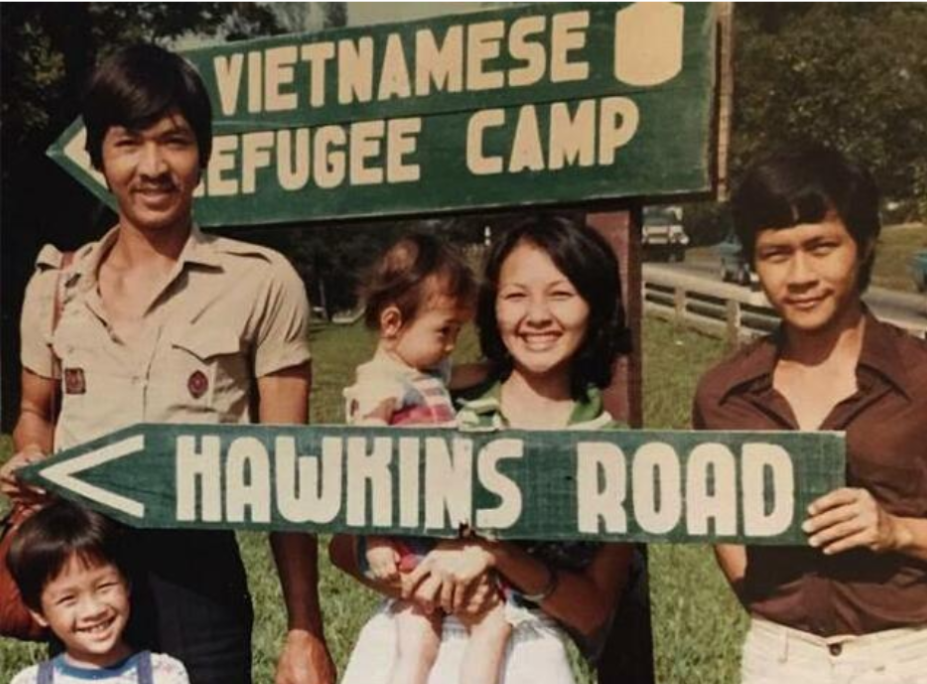
People posing in front of the Vietnamese Refugee Camp sign in Singapore’s Hawkins Road. (Vietnamese Heritage Museum)
The multicultural landscape of Singapore has given rise to a mixing, or syncretism, of various religious beliefs and traditions. As previously mentioned, the overlap between Chinese Buddhism and Taoism is quite evident from the observation of Chinese temples alone, but the syncretism between different cultural perspectives of the same religion have been observed as well. The journey of the Vietnamese to Singapore, as traced from their widespread arrival at the Hawkins Road Refugee Camp to their scattered presence in today’s Singapore, is particularly reflective of Singapore’s diverse and syncretic nature. Something as simple as the presence of joss sticks in a Vietnamese bakery in Yishun is both unassuming yet insightful: many eateries practice the same use of joss sticks throughout Singapore, but the dedication of prayers born from such sticks is what remains unique. To be Vietnamese in Singapore means to adapt to the landscape and make use of the space available; religion may not be tightly woven into this diasporic Vietnamese identity, but it is certainly lingering through the scent of joss sticks.
About The Author