
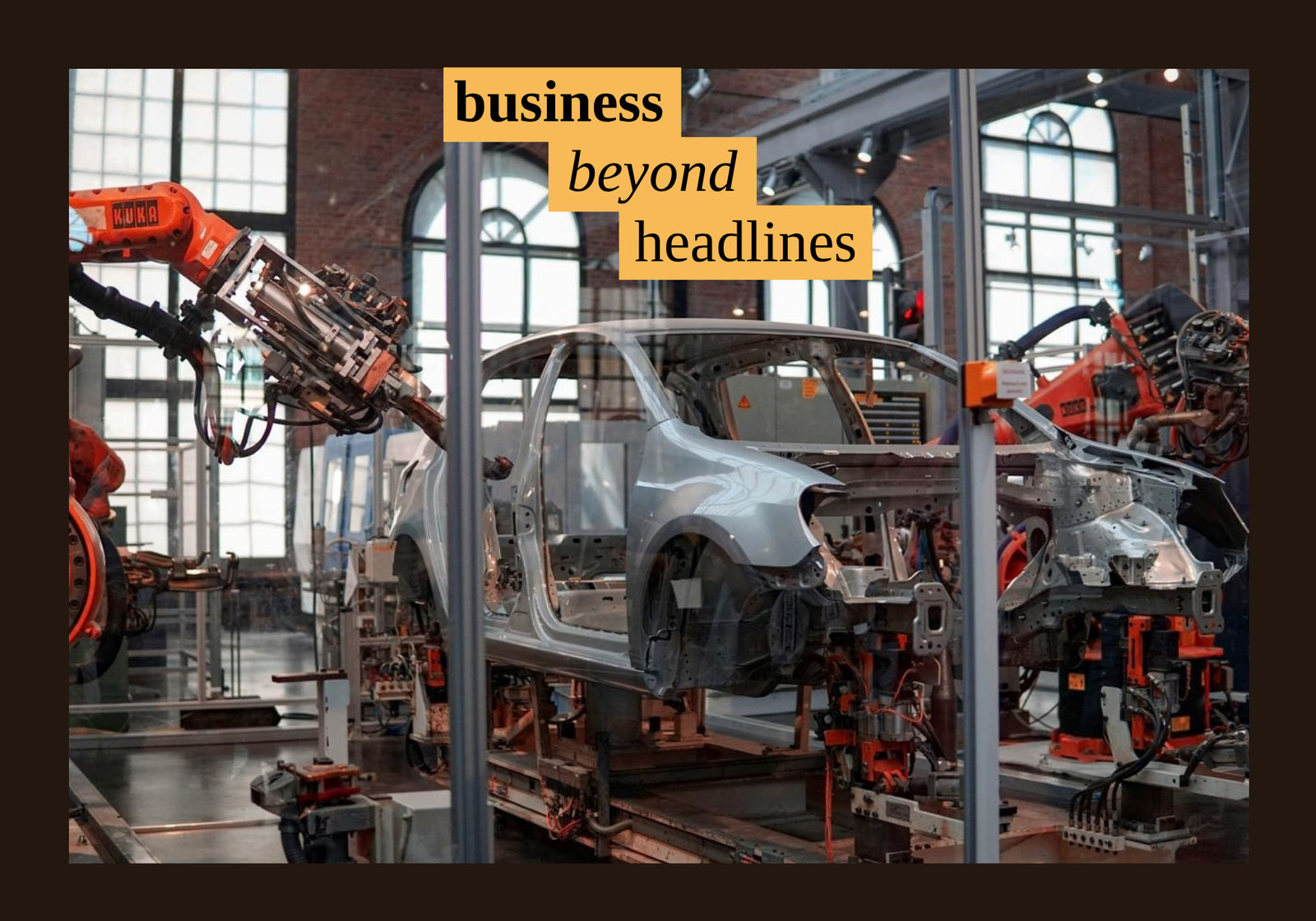
Thailand’s automotive transition is increasingly being shaped by two industrial models: a fast-growing battery-EV segment and a deeply established hybrid and conventional supplier ecosystem (Unsplash/Lenny Kuhne)
August Changed the Story
On 4 August, Indonesia’s Finance Minister Purbaya Yudhi Sadewa publicly invited Japan’s automotive giant Toyota to shift its main manufacturing operations from Thailand to Indonesia. The offer came with a revealing condition, that Toyota should bring its suppliers with it.
The remark mattered because it identified what is increasingly at stake in Southeast Asia’s automotive competition. The prize is no longer simply an assembly plant. It is the industrial ecosystem surrounding it.
Within days, senior Toyota Motor Thailand executive Supakorn Ratanawaraha warned publicly that Thailand was losing competitiveness. Thailand’s Industry Minister acknowledged Indonesia as a serious competitor. Toyota subsequently confirmed that it had no intention of leaving the country.
Then came a powerful counter-signal.
On 21 August, Thailand’s Board of Investment confirmed roughly 38.4 billion Thai baht (1.15 billion US dollar) in fresh Japanese commitments: 16 billion Thai baht (480.9 million US dollar) from Mitsubishi Motors for hybrid expansion, more than 15 billion Thai baht (450.8 million US dollar) from Isuzu for automation, cleaner-energy production and Euro 6 pickups, and more than 7.4 billion Thai baht (222.4 million US dollar) for Mazda’s AutoAlliance operation in Rayong.
Four days later, vehicle-production figures also improved. Thailand produced 117,383 vehicles in July, up 6.12% year-on-year and reversing June’s decline.
Thailand’s automotive industry is therefore not simply being displaced by the electric-vehicle transition. Something more complicated is happening. The country is increasingly supporting two automotive futures at once.
The emerging divide is unusually clear in vehicle-registration data.
Figures compiled by Japan External Trade Organisation (JETRO) from Thailand’s Department of Land Transport show that Chinese manufacturers accounted for 90% of passenger battery-electric vehicle registrations in the first half of 2026.
Japanese manufacturers, meanwhile, accounted for 97.8% of passenger hybrid registrations over the same period.
That split matters because the two segments are supported by very different industrial structures.
Chinese automakers have rapidly established themselves in Thailand’s battery electric vehicle (BEV) market. Manufacturers such as BYD and Changan have invested in local production, helping Thailand maintain its position as one of Southeast Asia’s most important automotive manufacturing bases even as technology changes.
Yet localisation remains incomplete.
JETRO field research found that approximately 60% of procurement by Chinese EV manufacturers operating in Thailand is still imported from China.
Japanese automakers occupy almost the opposite position. Their strongest positions increasingly sit in hybrids, pickups and established platforms—the same segments supported by decades of Thai Tier-1, Tier-2 and Tier-3 supplier development.
Thailand’s transition is therefore becoming more than a contest between combustion engines and battery-electric vehicles.
It is becoming a contest between two models of industrial integration: one expanding rapidly but still relatively dependent on imported supply chains, and another more deeply embedded in Thailand’s existing supplier ecosystem while adapting gradually toward electrification.
The Industrial Depth Question
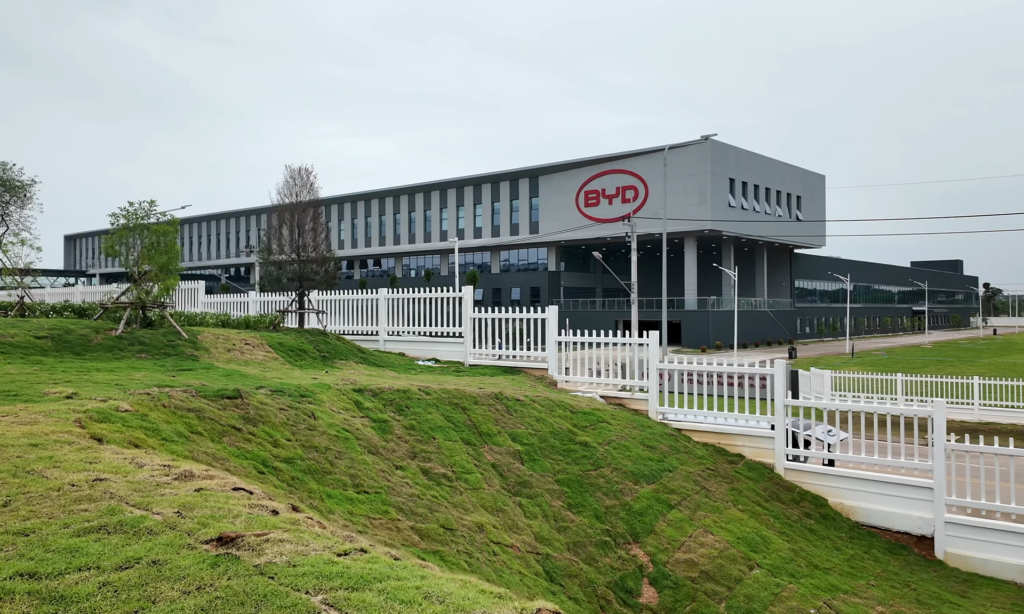
China’s BYD Auto (Thailand) Co., Ltd. manufacturing plant in Rayong, Thailand in 2024. (Wikimedia/iMoD Official)
Thailand’s electric vehicle (EV) incentives have succeeded in attracting manufacturers.
The harder question is how much industrial capability has travelled with them.
In August, Senior Executive Vice President of Toyota Motor Thailand Supakorn Ratanawaraha publicly questioned whether Thailand’s incentive structure was creating deep domestic EV capability or encouraging relatively shallow final assembly. He asked, in essence, whether the country was promoting electric cars or building an electric-vehicle industry.
JETRO’s procurement data gives that concern measurable form.
If around 60% of Chinese EV manufacturers’ procurement remains imported, local assembly does not yet translate automatically into a deep domestic supply chain.
Cost adds another complication.
Ten Thai automotive industry associations have estimated that manufacturing vehicles locally can cost 30–40% more than importing them from China. But JETRO’s field research among Chinese manufacturers already operating in Thailand puts the difference closer to 20%, in part because those companies still import a substantial share of their components from China.
The two figures measure somewhat different things, but together they point toward the same structural challenge.
Local manufacturing remains comparatively expensive partly because the local supply chain is not yet deep enough.
At the same time, existing Thai suppliers may struggle to enter the new EV ecosystem because incoming manufacturers already have established supplier relationships.
The Federation of Thai Industries has described this as a “zero-coin model that leaves no share of the local supply chain,” arguing that some Chinese original equipment manufacturers (OEMs) are bringing their existing suppliers with them rather than drawing extensively from Thailand’s traditional automotive small and medium enterprise (SME) base.
That does not mean localisation is absent. Chinese manufacturers are themselves increasing local production and sourcing.
But it does mean that attracting factories and building a domestic industrial ecosystem are not the same achievement.
Thailand’s response is now emerging through a second policy track.
Rather than treating full battery-electric vehicles as the only route toward electrification, policymakers have created a dedicated excise structure for mild-hybrid electric vehicles.
Under the framework, MHEVs emitting less than 100 grams of CO₂ per kilometre can qualify for a 10% excise rate, with a 12% rate for vehicles emitting between 101 and 120 grams. The regime runs through 2032 and carries investment and localisation conditions, including at least 5 billion Thai baht (150.3 million US dollar) in investment, locally produced batteries from 2026 and designated locally sourced propulsion components from 2028.
The industrial logic is important. A 48-volt mild hybrid keeps much of the conventional vehicle architecture: the engine, transmission, exhaust and fuel system remain, supplemented by a starter-generator and smaller battery system.
For Thailand’s existing supplier base, this creates a transition path very different from the leap directly into BEVs.
It allows electrification to advance while preserving demand for many capabilities accumulated over the past four decades.
The investment announcements of 21 August reinforce this interpretation.
Mitsubishi is expanding hybrids. Mazda’s AutoAlliance investment includes mild-hybrid production. Isuzu is investing in automation and cleaner pickup technology.
In effect, Thailand appears to be using hybrids not simply as a consumer product category, but as industrial policy designed to keep existing supplier capability economically relevant while the market electrifies.
That makes the hybrid strategy more than a technological compromise.
It may be a bridge.
The unanswered question is where that bridge ultimately leads.
For Thai suppliers, the strategic choice is therefore no longer simply whether to “move into EVs.”
There are several possible paths.
Some companies may try to enter the Chinese-led BEV ecosystem.
Others may find stronger near-term opportunities in Japanese-led hybrid and pickup supply chains.
Others still are diversifying away from automotive altogether.
Thai auto-parts suppliers have already begun applying machining and manufacturing capabilities to sectors including medical filtration, packaging and aviation as traditional automotive orders weaken.
Meanwhile, the latest Japanese investment cycle creates another opportunity.
More than 400 Japanese-owned companies have filed projects worth over 55 billion Thai baht (1.65 billion US dollar) under Thailand’s Smart and Sustainable Industry programme since 2023. Planned spending includes machinery replacement, automation, energy efficiency and digital transformation.
Government efforts to close that gap are beginning to produce measurable results. Thailand’s Board of Investment says 18 ‘Sourcing Day’ programmes have connected more than 800 qualified Thai parts manufacturers with multinational automakers, generating more than 1,200 business matches and an estimated 1.79 billion US dollar in domestic procurement value. The figures suggest that supplier integration is not absent; the harder question is whether these programmes can move local firms into higher-value parts of the emerging EV supply chain at sufficient scale.
That creates demand beyond vehicle components themselves.
Thai companies capable of supplying precision tooling, controls, automation, industrial software, maintenance, energy-efficiency equipment and engineering services may be able to participate in the transition without becoming EV-component specialists overnight.
For local firms, the strategic question is becoming increasingly specific:
Which automotive future are they equipped to serve?
And where existing capabilities no longer fit either one, which adjacent industries value what they already know how to do?
What This Means for Suppliers and Investors

Representative of Great Wall Motor (GWM) signing a Memorandum of Understanding (MOU) with the Thai Ministry of Consumption Tax, formalising Thailand government’s approval for the EV 3.5 policy for the Chinese carmaker. (Great Wall Motor)
For companies operating in or supplying Thailand’s automotive sector, three priorities stand out.
First, decide which automotive ecosystem to serve rather than treating the choice as combustion versus electric. The two segments now run on different industrial structures: Chinese manufacturers accounted for 90% of passenger battery-electric registrations in the first half of 2026, while Japanese manufacturers held 97.8% of passenger hybrid registrations. For established Thai suppliers, the stronger near-term continuity sits in the Japanese-led hybrid and pickup supply chains, where the 21 August commitments from Mitsubishi, Mazda’s AutoAlliance and Isuzu are flowing. The Chinese-led BEV ecosystem is expanding faster but offers less room, since incoming OEMs still import roughly 60% of their procurement from China and, in the Federation of Thai Industries’ description, often bring their existing suppliers with them.
Second, compete on horizontal industrial capabilities and adjacent sectors, not only vehicle components. Firms able to supply precision tooling, controls, automation, industrial software, maintenance, energy-efficiency equipment and engineering services can participate in the transition without becoming EV-component specialists. The demand is already visible: more than 400 Japanese-owned companies have filed projects worth over 55 billion Thai baht (1.65 billion US dollar) under Thailand’s Smart and Sustainable Industry programme since 2023, and the Board of Investment’s Sourcing Day programmes have generated more than 1,200 business matches and an estimated 1.79 billion US dollar in domestic procurement. Where existing capabilities fit neither automotive future, some suppliers are already redirecting machining and manufacturing skills into medical filtration, packaging and aviation.
Third, address the financing gap before upgrading, and time investment to the incoming policy. Industrial upgrading requires capital at the moment smaller firms have the least room for it: large operators can borrow at around 3%, while SMEs face 12-18 per cent and micro-enterprises can be pushed toward informal rates of 36-50 per cent. SME lending has been negative for thirteen consecutive quarters, and the first quarter of 2026 recorded more factory closures than openings for the first time in ten quarters. The Finance Ministry’s excise restructuring, due to be completed in September 2026 and implemented before year-end, is expected to reward domestic production, sourcing and exports more strongly than reliance on imports, which makes aligning capital expenditure with Board of Investment matching and the new tax structure a central planning question.
Consequently, there are three factors worth tracking over the next twelve months. The first one is whether the September 2026 excise restructuring, once implemented, rewards domestic sourcing strongly enough to shift OEM procurement behaviour. The second aspect is whether the mild-hybrid localisation conditions hold as they tighten, with locally produced batteries required from 2026 and designated locally sourced propulsion components from 2028. Lastly, whether SME closures reverse after the first quarter of 2026 broke a ten-quarter trend, and Sourcing Day matches begin moving local firms into higher-value EV parts at scale.
About The Author

One thought on “Thailand’s EV Transition: One Market, Two Automotive Futures”