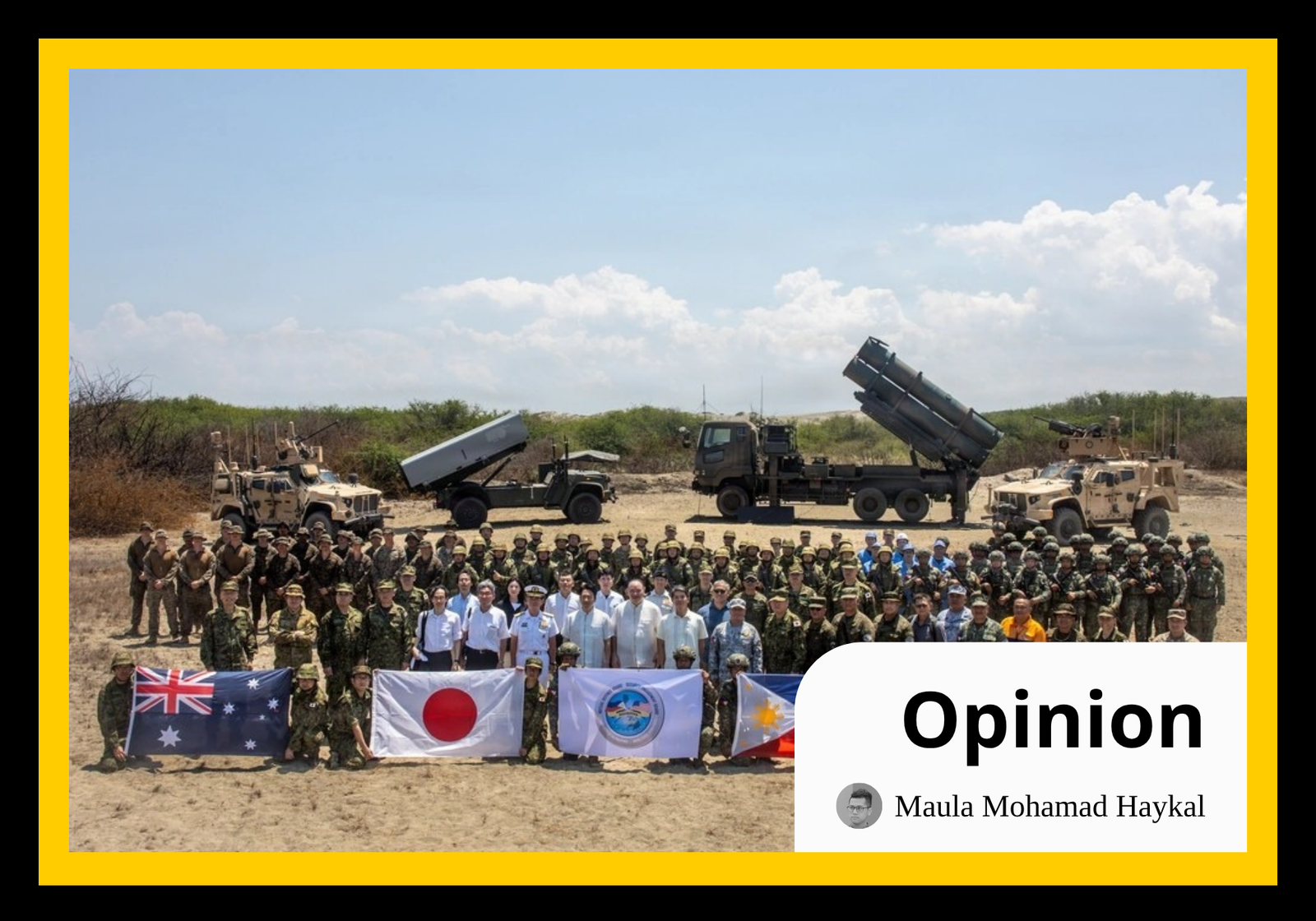
Australian, Japanese, Philippines, and US troops following a joint task force maritime strike event during Exercise Balikatan 2026. (US Marine/Sgt. Jonathan Beauchamp)
Maula Mohamad Haykal is a graduate student in International Relations in Universitas Indonesia, specialising in geopolitics and defence. The views expressed are his own and do not represent SEA Daily or that of another organisation.
Near Simultaneous Military Exercises
On April 20, 2026, the annual Balikatan exercise between the US and the Philippines commenced and will last until May 8. The 41st iteration of the largest annual bilateral exercise conducted by the two countries is attended by various partners such as Australia, Japan, Canada, France and New Zealand, with other countries such as Czechia, Lithuania, the Netherlands, Poland and the United Kingdom serving as observers. Balikatan 2026 covers a range of scenarios, from conventional warfare to disaster response, while also enhancing planning, command and control systems, logistics, and communication through realistic simulations and war-gaming.
Notable deployments in this year’s exercise include the deployment of the NMESIS anti-ship missile system by the US Marine Corps and US Army’s Typhon missile system in the Philippines, participation of the Philippine Marine Corps’ BrahMos anti-ship missiles. Furthermore, Balikatan 2026 also marked the first-ever deployment of Japan’s Type 88 anti-ship missiles to the Philippines along with the deployment of around 1,400 military personnel and several warships, including the helicopter carrier JS Ise.
Further to the south, on April 23, Indonesia held a large-scale combat exercise that included live-fire drills and a sinking exercise (SINKEX) in the Java Sea involving naval and aviation assets. In this first SINKEX since May 2024, the landing ship tank (LST) KRI Teluk Hading was sunk by a French-made Exocet MM40 Block 3 anti-ship missile launched from the SIGMA 10514-class frigate KRI I Gusti Ngurah Rai. Meanwhile, the fast attack craft (FAC) KRI Sampari (628) launched a Chinese-made C-705 missile against a land target on Pulau Gundul (Bald Island). An aerial warfare component was also included, featuring the launch of surface-to-air missiles against aerial targets and F-16s dropping free-fall bombs on maritime targets. Additionally, the exercise also involved the navy’s brand new Multipurpose Combat Ships from Italy.
Then, on April 24, China held a naval drill in the waters east of the Philippine island of Luzon, in an apparent response to the Balikatan exercise. According to the PLA Navy, the drill focused on live-fire exercises, air-sea coordination, rapid maneuvering, and replenishment, with the aim of testing integrated joint combat capabilities. While there are few details on the ships involved, PLA Navy sources stated that the Type 055 destroyer Zunyi led the drill. Additionally, there is an unverified claim that a Type 055 destroyer launched a YJ-20 hypersonic anti-ship ballistic missile near the Philippines in the drill.
At around the same time as the drill east of Luzon, images circulated showing a PLA Navy fleet, including the aircraft carrier Liaoning, heading to the South China Sea for drills after transiting the Taiwan Strait. A move that was likely a response towards Japan’s recent transit of the strait.
A More Militarily Capable and Crowded Southeast Asia
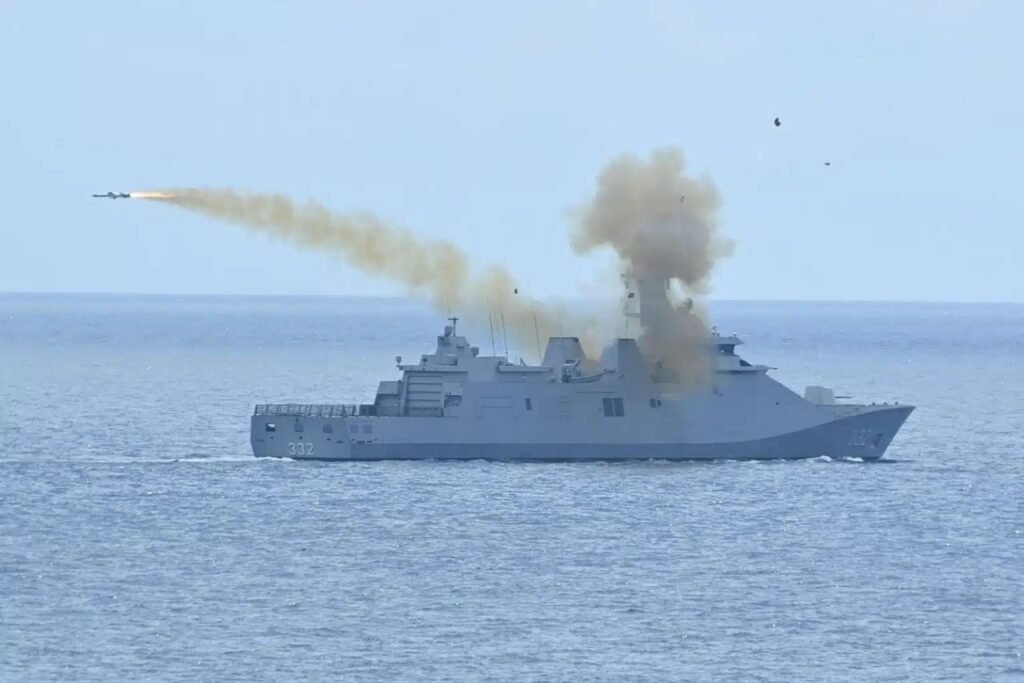
Indonesia’s KRI I Gusti Ngurah Rai (332) firing an Exocet MM40 Block 3 missile during a sinking exercise (SINKEX) in the Java Sea. (Indonesian Navy)
Looking at the timing, scale, and types of drills conducted, these exercises clearly suggest strategic signaling actions. While the Chinese drills are evidently a response to the recent passage of a Japanese destroyer through the Taiwan Strait and the Balikatan exercise, they also indicate China’s growing capability to conduct simultaneous operations both within the First Island Chain and near the Second Island Chain.
Moreover, the alleged launch of a YJ-20 hypersonic anti-ship missile, with a range of around 1,500 kilometres, near the Philippines Sea if proven true, would signal China’s ability to hold US or allied warships at risk in areas around the Second Island Chain, including Guam. The importance of these drills cannot be understated, given their contribution to the development of China’s ability to conduct simultaneous operations in both regions—an important component for possible future military action against Taiwan.
Meanwhile, beyond the usual pattern of a deepening Philippines–US alliance and increasing interoperability, Balikatan 2026 signals several key developments. First, the first-ever live-fire test of the Typhon missile system—conducted, according to the Balikatan official spokesperson, to assess accuracy—signals the US ability to carry out ground-based tactical precision strikes against Chinese-held islands in the South China Sea or even mainland China itself. Such capability is crucial for deterring China from establishing control over the First Island Chain, while also placing Taiwan under the US tactical ground-based missile umbrella.
Second, the Philippines’ growing capability to impose deterrence—primarily in the South China Sea—independently of the United States, as demonstrated by the inclusion of BrahMos missiles in the exercise. While there are no live-fire tests, the simulation firing of the 290 kilometers BrahMos missile suggests that the Philippines is actively striving to master its operation of the missile under real-world conditions.
Finally, while the exercise reflects Japan’s deepening commitment to the Japan–Philippines Reciprocal Access Agreement and its broader strategic commitment towards the Indo-Pacific, the deployment and first-ever launch of the Type 88 anti-ship missile system in the Philippines along with the participation of JS Ise and thousand of personnels signal Japan’s changing military posture vis-à-vis China and its ability to actively safeguard critical sea lines of communication beyond the Japanese archipelago.
For Indonesia, while its exercise in the Java Sea did not show any explicit reference to a particular adversary, it still signals Jakarta’s ability to defend its maritime domain amid a worsening international security environment and recent incident involving the discovery of foreign sea drones in its waters. Moreover, the joint air and sea operations, the firing of modern precision-strike missiles, and the participation of brand-new state-of-the-art warships highlight the increasing sophistication of Indonesia’s military in regards to battlefield interoperability and the progress of its ongoing modernisation efforts.
Taken together, these near-simultaneous exercises reflect a region increasingly characterised by strategic competition through reciprocal signaling and capability demonstration. What is emerging is not merely a series of isolated military activities, but a layered interaction in which states are testing deterrence, interoperability, and operational reach under real-world conditions. Such activities point to a more contested and militarily capable Indo-Pacific, including in Southeast Asia.
As these trends continue, the risk is not only heightened tension but also a more complex strategic environment in which miscalculation becomes easier and more likely. Hence, stronger regional confidence-building measures are becoming increasingly critical. ASEAN, with its commitment to inclusive diplomacy and its central role in the regional security architecture, is well positioned to take the initiative in advocating such measures—provided that its core members are willing to unite and advance them.
About The Author