
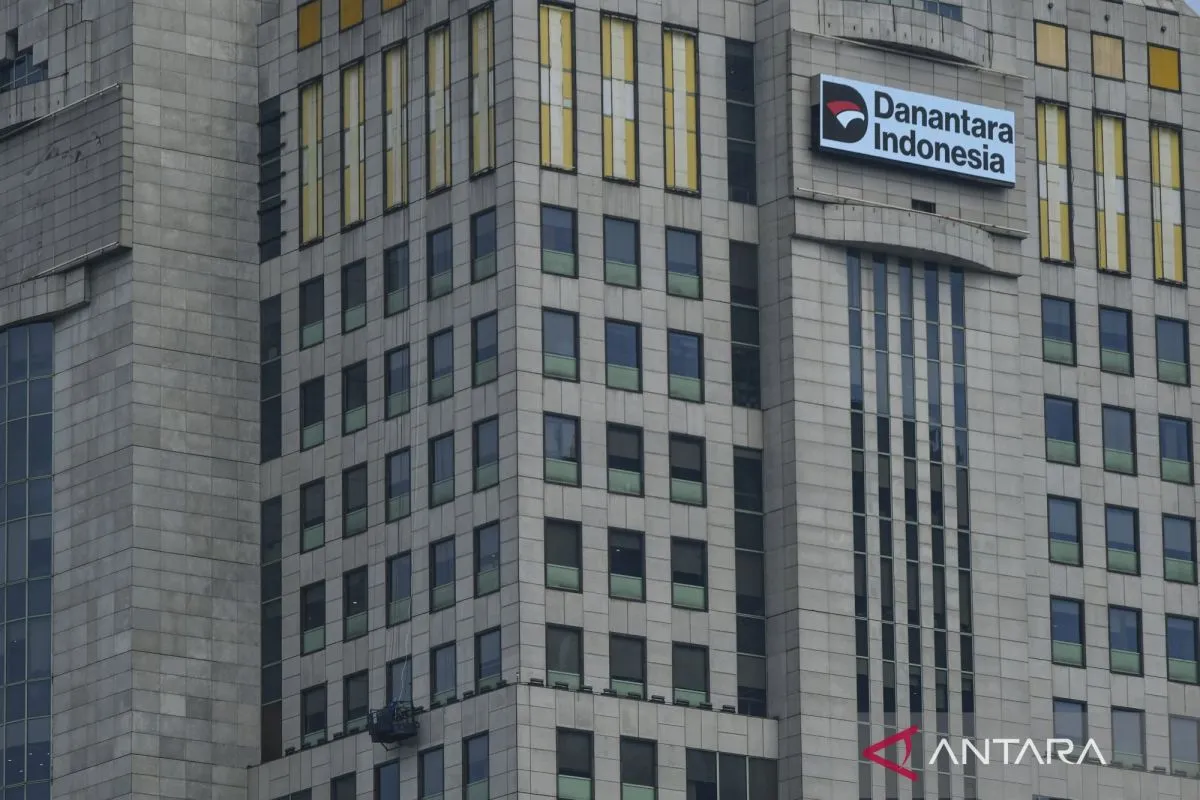
Danantara building in Indonesia’s capital Jakarta. (ANTARA)
Previously established on May 18 as an export agency, DSI is specifically tasked with handling exports of strategic natural resource commodities, with an aim to become their sole exporter by 2027.
Set to commence operations on June 1, 2026, DSI will initially oversee crude palm oil (CPO), coal and ferrous alloys. Subsequently, from September 2026, exporters will begin channeling their export activities through DSI.
Elaborating on the status transformation, Danantara’s Chief Investment Officer (CIO) noted that under Danantara, DSI will remain focused on generating profits, in line with its role as a sovereign wealth fund (SWF).
“Our goal is for DSI to be able to buy and then sell to the market. And the best way to look at it is the possibility of us getting a better price than the current one. Because it’s all about bargaining power,” Pandu added.
Beyond profitability, the transformation also forms part of the government’s broader push to curb under-invoicing practices (where export values are lower than actual price).
The status change likewise reshapes ownership. Under Indonesian Law No. 19/2003 on SOEs, a company may only be legally designated a SOE if the government holds shares in it directly. Accordingly, the government intervened through the SOE Regulatory Body, acquiring exactly 1% of DSI’s shares.
What does this mean for business?
Indonesia is fundamentally reshaping how it manages its most valuable resources and state wealth. Rather than allowing ministries, state-owned companies and private exporters to operate in parallel, the government is consolidating everything under a sweeping two-tier structure modelled after Singapore’s Temasek investment management agency. This consolidation vastly increases Jakarta’s macroeconomic leverage, allowing DSI to transition Indonesia from a passive price-taker to an aggressive price-maker on the global stage.
The ownership arrangement itself is a deliberate legal construction: Danantara retains 99% of the capital and operational control (enabling DSI to function with the agility of a private firm) whilst the government holds 1%, preserving sufficient political authority to keep the entity publicly accountable.
To translate that ambition into execution, DSI is expected to open new positions, drawing in technocrats as it races to build out its operational capacity ahead of the June launch.
About The Author




One thought on “State-owned enterprise given monopoly rights over select strategic minerals in Indonesia”