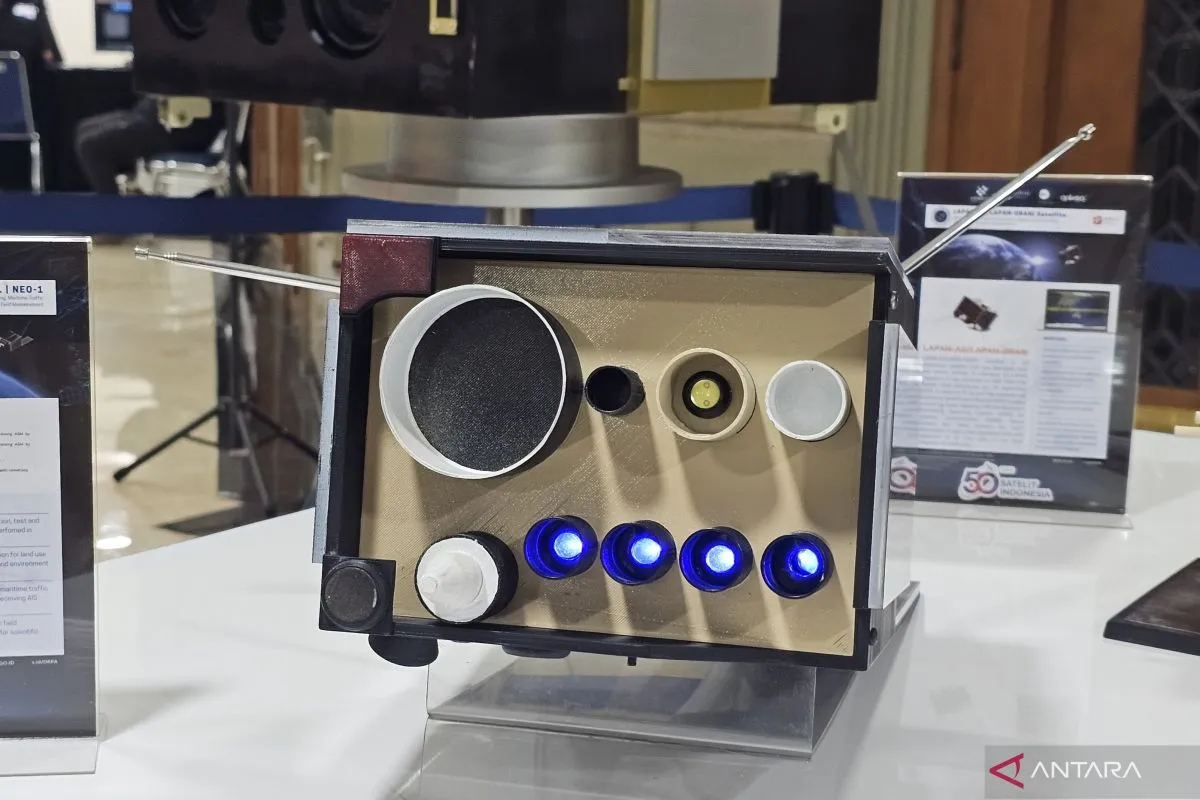
A miniature display of the NEO-1 satellite is showcased at the 50th anniversary of Indonesia’s satellite program in Jakarta, Indonesia, on July 8. (ANTARA/Livia Kristianti)
“We are laying the foundation so that Indonesia does not only become a user of space technology, but becomes a technology producer, service provider and a major player in the global space economy,” said BRIN Head Arif Satria.
NEO, the acronym for Nusantara Earth Observation satellite, is designed to be a mini observation satellite. It features medium- and high-resolution optical and thermal infrared sensors. It is also equipped with an Automatic Identification System (AIS). The data will serve vital public and government needs, including resource management for the agriculture and forestry sectors, maritime monitoring for ocean security, as well as disaster mitigation.
The spacecraft was developed through end-to-end national mastery of space technology, making it a crucial milestone for Indonesia’s space industry advancement and independence.
According to BRIN Head Arif Satria, “NEO-1 contains approximately 65% domestic content (TKDN)”. He added that this initiative demonstrates “Indonesia’s growing capability to master the entire satellite technology value chain”.
Moving forward, the agency aims to leverage its equatorial geographical advantage. Long-term plans include developing a national telecommunications satellite and building a National Spaceport (Bandar Antariksa Nasional) to eliminate reliance on foreign launch service providers.
“Mastering telecommunications satellite technology is a strategic investment that strengthens digital sovereignty, enhances economic competitiveness, and reduces dependence on foreign technology and service providers,” the BRIN Head said.
What does this mean for businesses?
Indonesia’s transition from a technology consumer to a regional producer holds immense potential to unlock commercial opportunities within aerospace manufacturing and precision electronics. Practically, the development of a national spaceport and sovereign, real-time data access will boost sectors like maritime logistics, mining and digital infrastructure, opening highly profitable avenues for private enterprises.
However, executing such advanced ventures successfully demands a highly specialised workforce. If Indonesia is to sustain this momentum, the education system must scale up to deliver graduates capable of meeting these strict technical standards, a trajectory where strategic government policy and funding will play a crucial role.
Kala Advisory helps investors move on openings like these as Southeast Asia builds out new high-tech and aerospace industries. Visit kala-advisory.com.
About The Author