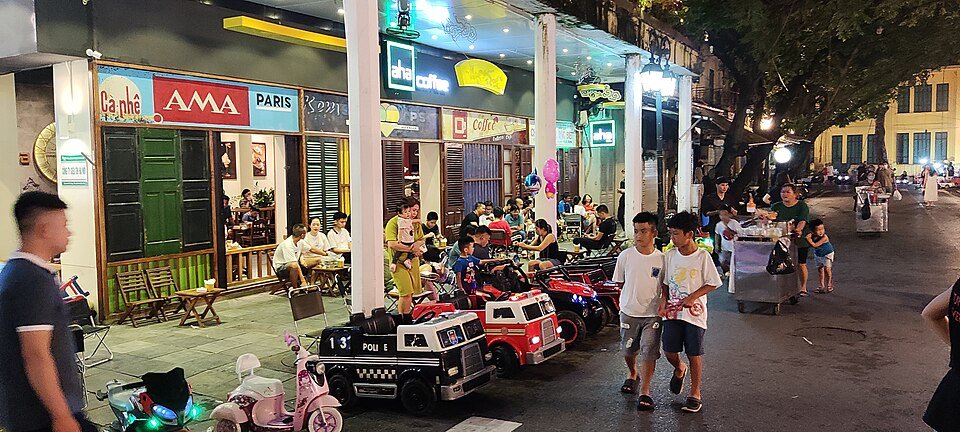
A bustling night-time scene at the Hanoi weekend market. (Wikimedia/Shyamal L.)
On July 15, the Hanoi People’s Committee officially issued the plan titled “Development of the Night Economy in Hanoi for 2026-2030, With a Vision to 2045”. This marked the execution step of the master plan ratified on May 9 under Decision No. 2419/QD-UBND signed by Vice Chairman Trương Việt Dũng. Just last month on June 15, the administration approved a formal resolution regulating investment, business guidelines and tailored operating hours for late-night zones.
The framework aims to drive the capital’s night-time economy, which is projected to contribute up to 5% of Hanoi’s gross regional domestic product (GRDP) by 2030, rising to 8% by the following decade. To achieve this, the city intends to boost night-time visitor spending to 25-30% of total travel expenditure by establishing four flagship schemes to develop the night-time economy, focusing on culture, entertainment, creative fields and rural craft tourism.
These initiatives will manifest in evening itineraries covering heritage and cultural hub concentrated across four primary sectors. First, Hoàn Kiếm, Cửa Nam and Ba Đình will emphasise historical walking streets and 3D mapping light shows at landmarks like the Thăng Long Imperial Citadel. Second, Tây Hồ (West Lake), Mỹ Đình and Đông Anh are slated for development to host late-night music festivals, open-air art spaces and premium dining. This will go alongside the Red River Corridor, which will feature outdoor events and night cruise sightseeing services. Lastly, the outlying districts such as Bát Tràng, Ba Vì and Sơn Tây will emphasise local specialities including agricultural experiences and traditional village tourism.
The initiative will be supported by the city’s Intelligent Operations Centre (IOC) and the iHanoi digital ecosystem. These bodies will advance cashless transactions, simplify licensing, as well as deploy digital maps for tourists to explore the night-time districts. This smart-city infrastructure will monitor safety, urban databases and transaction data.
What does this mean for businesses?
This statutory shift unlocks lucrative opportunities for the private sector. Retailers, restaurateurs, and event organisers can scale up operations via extended trading licences, pushing past standard curfews up to 2:00 AM or 24/7 in designated hubs. Streamlined, digital-first municipal approvals will significantly lower administrative barriers to entry for foreign and local hospitality investments. Furthermore, mandatory integration with cashless infrastructure and data-driven footfall maps will allow businesses to target tourist spending with high-precision digital marketing.
Kala Advisory helps investors turn openings like these into targeted, country-by-country entry plans across Southeast Asia. Visit kala-advisory.com.
About The Author