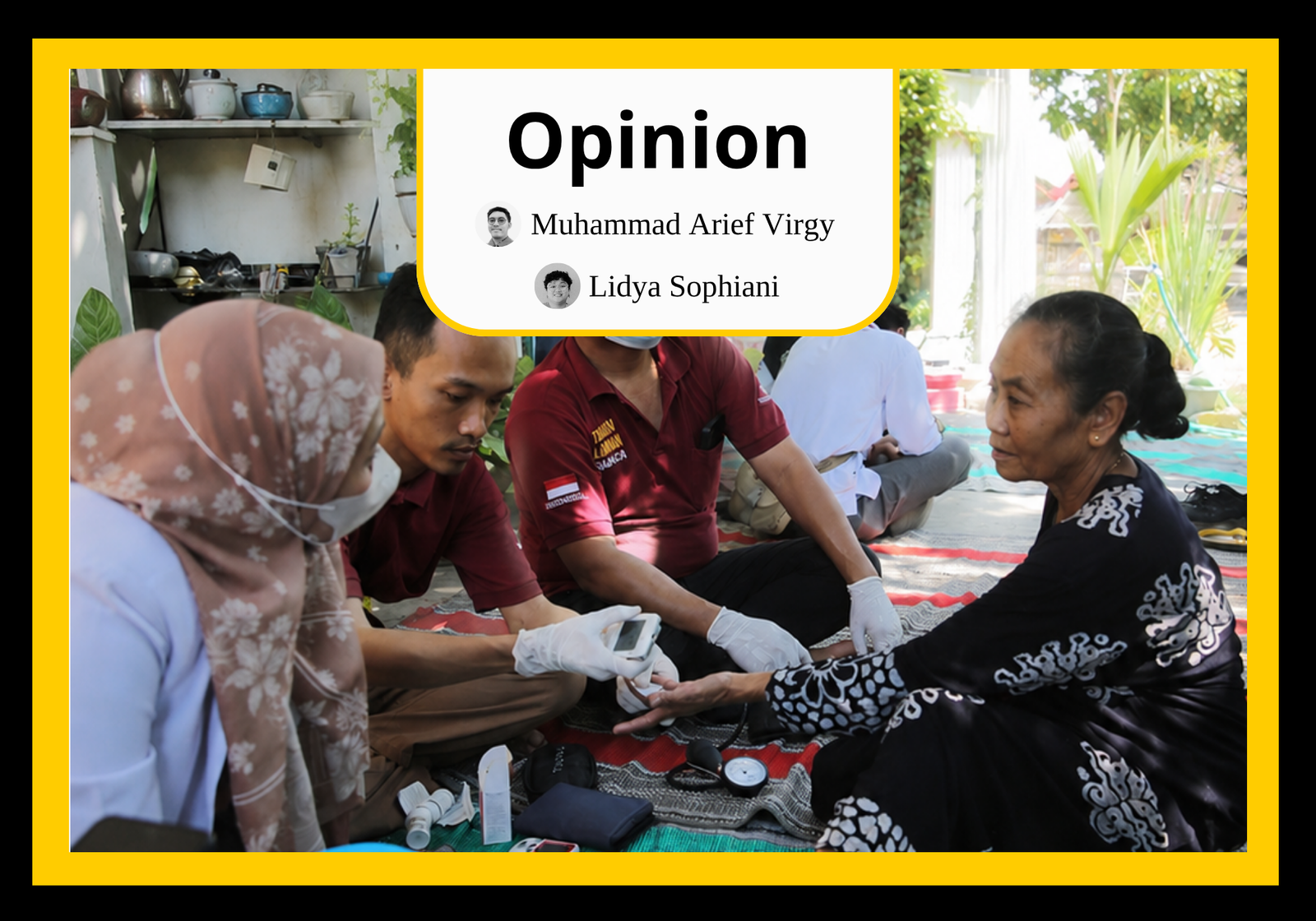
A health post worker in Tuban, Indonesia, providing healthcare service to locals in 2023. (Tuban Municipal Government/Agus)
Muhammad Arief Virgy is a Communication Policy Consultant at 1000 Days Fund and a Researcher at the think tank The Habibie Center. He earned a Master of Development Studies degree with a specialisation in Public Policy and Management from the International Institute of Social Studies, Erasmus University Rotterdam. Virgy has six years of experience working in public policy and development across several institutions, including the Center for Indonesia’s Strategic Development Initiatives (CISDI), a nonprofit organisation focused on strengthening Indonesia’s health system.
Lidya Sophiani is the Implementation Director at 1000 Days Fund, where she leads programs that strengthen local systems to reduce stunting and improve maternal and child health across rural Indonesia. Her work focuses on transforming ground-level initiatives into policy-backed, sustainable impact through strong government partnerships and community empowerment.
The views expressed are the authors’ own and do not represent SEA Daily or that of another organisation.
Health Workers Shortage

An obituary of Myta Aprilia Azmy, an Indonesian health worker who passed away at work, allegedly due to overworking. (Instagram/@medicstory.id)
On May Day 2026, a young doctor named Myta Aprilia Azmy died in an intensive care unit in Palembang, Indonesia.
She had been serving as an intern physician at a district hospital in the western province of Jambi. Colleagues reported that she had been working extended hours without regular days off, carrying a patient load that many considered unsustainable. Within three months, doctors’ associations documented three other intern physicians who died while working under similarly demanding conditions in hospitals stretching from South Sumatra to west Java. Whether overwork was the direct cause in each case remains contested. What is harder to contest is the pattern itself.
Myta’s death exposed a question Indonesia has yet to answer: what happens when a health system asks its workers to compensate for gaps that fiscal policy has not closed?
The shortage is not theoretical. In Indonesia’s western province of Nusa Tenggara Timur (NTT), up to 4.6% of the region’s community health centres operated without reliable access to a general practitioner. This is higher compared to the national average around 3.94%. But the problem extends beyond numbers. General practitioners today are expected to provide treatment, prevention, counseling, screening, palliative care and continuity of care for entire communities. Yet many barely have enough time to complete their curative responsibilities, let alone engage in the preventive services that could reduce demand on the health system in the long term.
Indonesia has not ignored this challenge. Programmes such as Nusantara Sehat were designed to attract clinicians to underserved areas. Medical education capacity continues to expand. More recently, the Ministry of Health has sought to strengthen primary healthcare through Ministerial Decree (KMK) No. 2015 of 2023, recognising the significance of more than one million community health workers: largely volunteer frontline caregivers over a million—mostly women—who deliver Indonesia’s preventive healthcare (nutrition counseling, growth monitoring, maternal support) through village-level health post systems (posyandu), often with minimal or inconsistent pay.
This workforce is extraordinary in scale. Few countries possess a network of community-based health workers as extensive as Indonesia’s. In many villages, they are the first people families turn to when a child stops gaining weight, when a pregnant woman misses an antenatal visit or when a caregiver needs advice. They represent the preventive capacity of the health system in its most immediate form.
Yet, reliance on community health workers has increasingly become a response to scarcity rather than a deliberate strategy for prevention.
A Structural Challenge
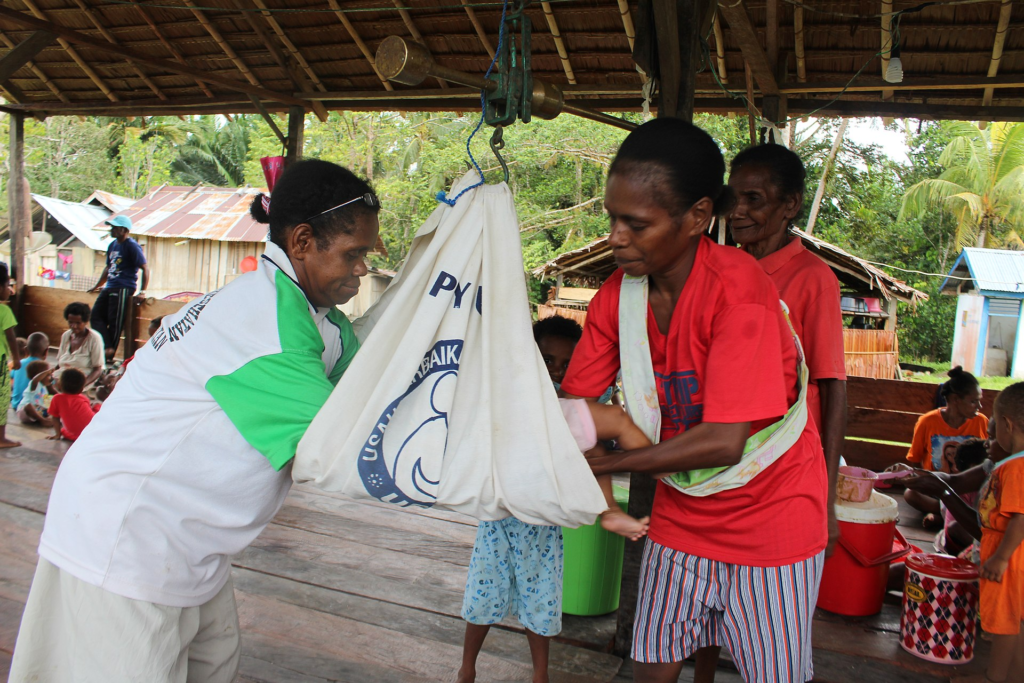
A village-level health post in Kampung Benawa, Papua Barat Daya in Indonesia in 2018. (Wikimedia/Lefaan)
The difficulty is often framed as a human resource problem. In reality, it is also a financing problem.
Since Indonesia’s decentralisation reforms in the early 2000s, local governments have assumed substantial responsibility for health service delivery. The premise was compelling: districts would be better positioned to understand local needs, recruit appropriate personnel and tailor services to their populations. But authority was transferred into a context where fiscal capacity varies dramatically from one district to another.
The consequences are visible.
In NTT province’s Rote Ndao, a pregnant woman experiencing complications reportedly endured a three-hour boat journey to the regional capital Kupang because the district struggled to retain an obstetrician. In Belu, still in NTT, delayed salary payments prompted physicians to stop working temporarily, interrupting essential services. In Teluk Wondama in Indonesia’s eastern province of Papua Barat, healthcare workers protested uncertainty surrounding performance allowances after fiscal tightening reduced regional spending capacity.
These are not isolated management failures. They reveal a structural feature of decentralisation: assigning responsibility without ensuring adequate fiscal space.
Most districts remain heavily dependent on transfers from the central government. Local revenues constitute only a fraction of total regional income. When transfers contract to accommodate national priorities, districts have limited room to protect health expenditures. The result is an uneven geography of care, where access to a doctor, a midwife or even a functioning primary healthcare team depends partly on where one happens to live.
Community health workers have absorbed much of this pressure.
For decades, they have delivered counseling, growth monitoring, referrals and health promotion activities with minimal or inconsistent remuneration. They have enabled Indonesia’s primary healthcare system to function despite persistent shortages of professional staff. Yet, their contributions continue to rely heavily on volunteerism.
That arrangement may have been acceptable when community health workers were envisioned as supplementary actors. It becomes harder to justify when they have become essential to maintaining service delivery itself, with minimum qualifications of 25 basic competencies.
Retention matters.
People remain in difficult places when they feel valued, supported, supervised, and compensated fairly. This is true for specialists deciding whether to stay in a remote district hospital. It is equally true for community health workers balancing unpaid health activities with household responsibilities and other sources of income.
The challenge is compounded by the legal framework governing health financing. Unlike education, which benefits from a constitutionally protected allocation equivalent to 20% of public spending, Indonesia’s health sector has no comparable minimum spending requirement. Health budgets therefore remain vulnerable to shifting priorities and political cycles.
Closing the Fiscal Gap
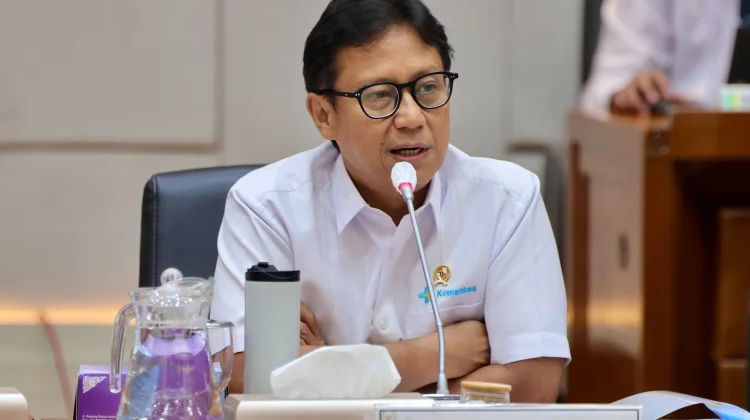
Indonesian Health Minister, Budi Gunadi Sadikin. (Indonesian Ministry of Health)
If health financing cannot be guaranteed through existing mechanisms, alternative approaches deserve consideration.
One option is earmarked taxation. Sugar-sweetened beverage taxes offer a compelling example. Modeling studies suggest that increasing prices by 20% could substantially reduce consumption while generating billions of Indonesian rupiah in annual revenue. Beyond fiscal gains, reductions in future treatment costs for diabetes and other non-communicable diseases could be considerable.
Another possibility lies in subnational financing innovations, including regional bonds or sukuk, which may provide districts with additional flexibility to invest in their health workforce.
None of these approaches will resolve Indonesia’s health workforce crisis overnight.
But they point toward a broader recognition: workforce shortages are not simply the result of insufficient training institutions, inadequate recruitment or individual choices. They reflect the priorities embedded within public budgets.
Health systems ultimately reveal what societies choose to fund.
Indonesia currently depends on more than one million community health workers who carry out some of the most fundamental functions of primary healthcare, often with little expectation of financial reward. At the same time, physicians continue to shoulder responsibilities that prevention could reduce.
The question is not whether Indonesia values primary healthcare. Policy documents already say that it does.
The question is whether the country is willing to finance primary healthcare as though it were truly foundational.
Because no health system can indefinitely ask its workers to compensate for structural gaps that only public investment can close.
About The Author