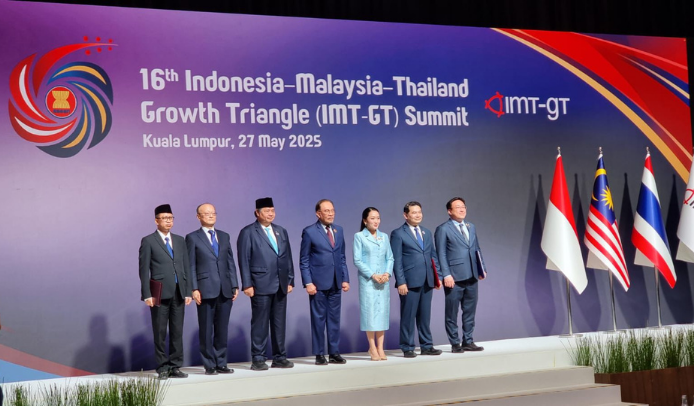
Representatives from Indonesia, Malaysia, Thailand at the 16th IMT-GT Summit in Kuala Lumpur, Malaysia, on May 27, 2025. (Coordinating Ministry for Economic Affairs of the Republic of Indonesia)
The committee was launched during a Cooperative Sector Roundtable Discussion and Business Matching Programme in Penang, Malaysia, on May 20.
Chairing the gathering, Datuk Seri Dr. Abdul Fattah Abdullah, president of both ASEAN Co-operative Organisation (ACO) and the Malaysia National Cooperative Movement (Angkatan Koperasi Kebangsaan Malaysia Berhad, ANGKASA), expressed optimism for the subregion’s considerable economic potential. “The region has enormous business potential, backed by a broad consumer base,” he remarked, adding that “cooperatives can no longer operate in silos or maintain a low profile. Instead, they need to work together to seize opportunities”.
The event was also attended by IMT-GT JBC Director Datuk Dr Mahadi Mohamad, along with country chairmen Natthanon Phongthanyawiriya of Thailand and Sjahrian Harahap of Indonesia.
To realise this growth vision, Abdul Fattah outlined that CJC will serve as a formal platform for cross border regular discussion to “deliberate on roles, proposals, challenges and solutions to strengthen cooperative participation in cross-border business activities”.
Crucially, Abdul Fattah elaborated that the tourism sector will be the first to be developed. This will encompass agro-tourism, healthcare, education as well as environmental tourism as those sectors are relatively simpler to start since it requires no upfront physical products.
The main challenge, he acknowledged, is differing national regulations, specifically customs procedures, health certifications and halal requirements. To address this, he called for streamlined and unified trade rules across the IMT-GT region, so that small cooperatives are not overwhelmed by complicated bureaucratic procedures.
What does this mean for businesses?
For business, particularly cooperatives and small enterprises, the CJS’s mandate to harmonise regulations could meaningfully lower the cost and complexity of regional expansion. With tourism-adjacent sectors earmarked as the first area of focus, operators in agro-tourism, wellness, education and eco-tourism stand to benefit most in the near term.
That said, the CJC’s impact will ultimately depend on how swiftly member governments translate these commitments into regulatory change. Businesses would do well to monitor the committee’s output and engage with their respective national cooperative bodies to ensure their interests are represented at the table.
About The Author