
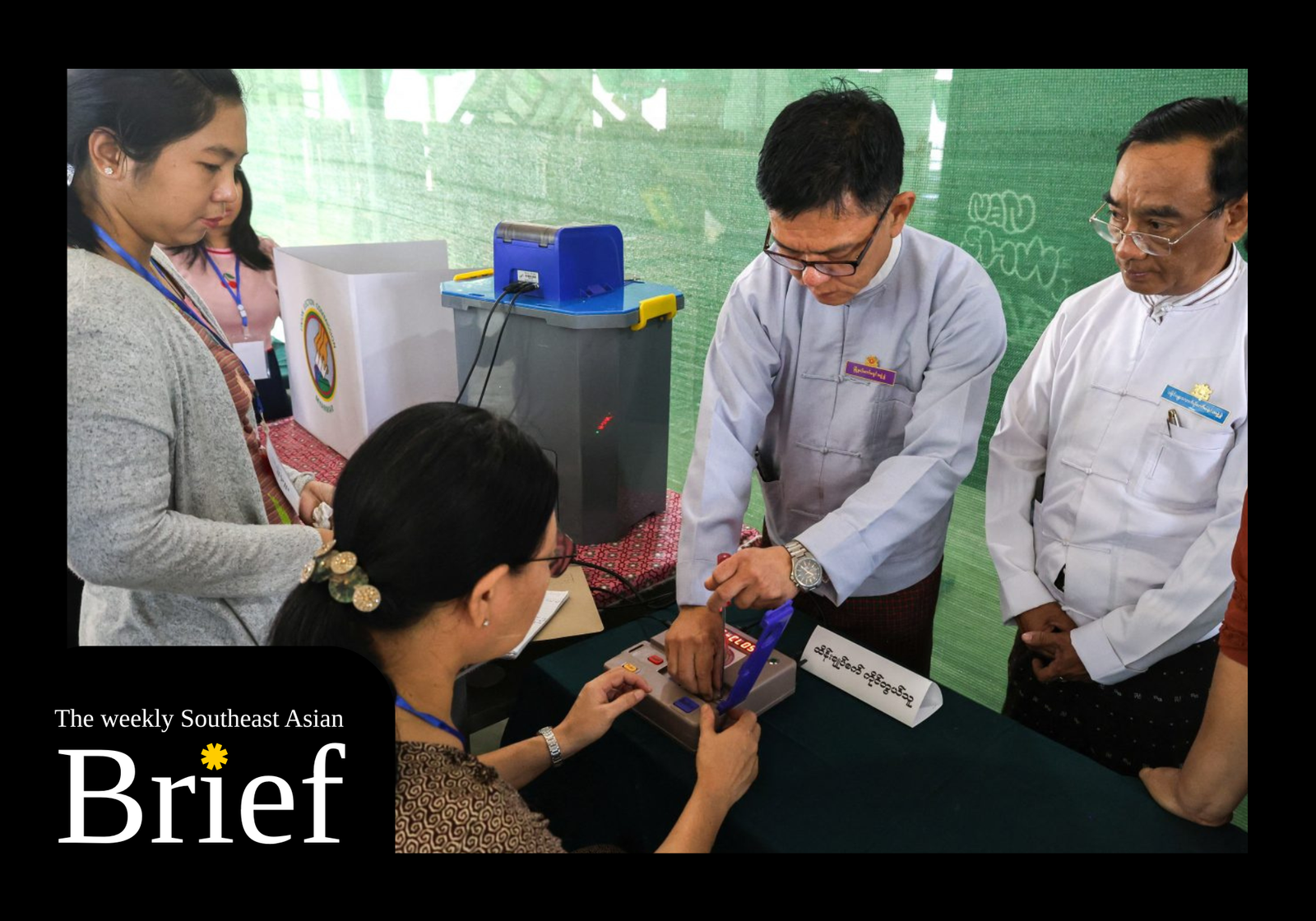
Myanmar’s Union Election Commission officials prepare a polling station inside a school ahead of the elections in Thingangyun Township, Yangon, on December 27. (Reuters)
Myanmar held their first phase of general election on December 28, the first election since the 2021 coup.
It took place amid the ongoing civil war and fierce violence, drawing international criticism.
While citizens were formally given voting rights, the process failed to adhere to pluralism and accountability.
The electoral process witnessed a really low voter turnout, intimidation, and repression during and prior to the voting. Ahead of the vote, some activists were jailed for protesting by placing banners that opposed the election.
With regards to the electoral results, the military stated that the voter turnout on the first phase was just as much as 50%. A major concern is the restriction of political parties to compete nationwide.
Although there are 57 parties with over 4,800 candidates, only six parties were allowed to compete nationwide, and the remainder were only able to compete in the local elections. Moreover, the election also introduced electronic voting machines, which further raise concern over the potential surveillance and biometric tracking.
Since the junta seized power in 2021, Myanmar’s democratic prospects have continued to decline.
Notably, the imprisonment of Aung Suu Kyi in 2021 and dissolution of the National League for Democracy (NLD) in 2023 mark the setback for democratic principles. Since the coup, there are 22,197 political detainees and over 5,000 have been killed.
Rather than treating it as an electoral process, the election serves primarily to legitimise the junta’s rule, who took power forcefully in 2021. Accordingly, the junta is maximising their efforts to win the election, even by using undemocratic means mentioned before.
Their efforts to gain international recognition is even more evident by the presence of observers that are friendly or neutral towards the junta, including Russia, China, Belarus, India, Cambodia, Vietnam, and Kazakhstan.
Nonetheless, Malaysian Prime Minister Anwar Ibrahim, who led the country’s chairmanship of ASEAN in 2025 stated that an ‘assessment will proceed in a sequenced manner’ to avoid violence and ensure inclusivity. It is with that spirit that continued engagement and close monitoring should be pursued.
About The Author



2 thoughts on “Myanmar’s post-coup election moves ahead amid conflict”