
Survival Work Under Algorithmic Control
Platform delivery riders navigate urban traffic in Malaysia, where millions rely on app-based gig work for their daily livelihoods. (Unsplash/Kelvin Zyteng)
Virtuous Setyaka is an International Relations scholar at Universitas Andalas and Director of the Center for Agrarian and Environmental Justice (CAEJ), focusing on political economy, social justice, and civil society in Southeast Asia. The views expressed are the author’s own and do not represent SEA Daily or that of another organisation.
Across the bustling streets of Jakarta, Manila, Bangkok and Ho Chi Minh City, the brightly coloured jackets of ride-hailing drivers and delivery couriers have become the ultimate symbol of Southeast Asia’s booming digital economy. For urban consumers, a hot meal, a parcel or a ride across town is just a tap away. Yet behind this seamless convenience lies a silent, escalating public health emergency: a chronic mental health crisis among the region’s millions of gig workers.
For years, tech giants and policymakers alike have celebrated the gig economy as an engine of inclusive growth. According to the e-Conomy SEA 2025 report by Google, Temasek, and Bain & Company, Southeast Asia’s digital economy surpassed 300 billion US dollar in gross merchandise value in 2025, expanding at a brisk 15 to 17 % annually. Yet this immense wealth rests on the shoulders of roughly 40 million gig workers across the region who operate with minimal safety nets. Together, Indonesia, the Philippines and Vietnam now account for more than 10% of all digital platform worker registrations globally.
Rather than serving as a casual side hustle, platform work has become a high-pressure survival mechanism in a region where informal labour still dominates up to 80 % of employment in several ASEAN economies. A 2026 survey across five major Indonesian cities revealed that 73.8 % of ride-hailing drivers turned to gig work simply because they could not secure formal jobs.
Hailed as flexible ‘independent partners’, these workers are increasingly governed by opaque algorithmic management. Unlike traditional employees who report to a human supervisor, gig workers answer to automated systems that dictate their routes, calculate fluctuating fares, and evaluate their performance in real time.
This algorithmic control creates an illusion of autonomy while enforcing relentless psychological pressure. In cities plagued by worsening gridlock and extreme weather, couriers must race against unforgiving delivery timers. A single low rating from an impatient customer, a rejected order or a missed daily bonus target can trigger algorithmic penalties—or worse, sudden account deactivation without due process. When one’s livelihood hangs on a digital thread, flexibility quickly curdles into hypervigilance and chronic anxiety.
The psychological toll is compounded by grueling hours and financial precarity. Findings from the ASEAN Secretariat’s Socio-Cultural Community Trend Report highlight that many platform drivers routinely log 12-hour shifts without rest days, earning an average of just 230 US dollar a month—often below regional minimum wages once fuel and vehicle maintenance are taken into account. Furthermore, a 2026 regional study on digital workers found that 20% experience chronic loneliness due to the lack of a physical workplace and peer support networks, deepening the risk of burnout.
Laws That Stop Short of Mental Health

A courier transports large packages through busy traffic in Hanoi, Vietnam. Across ASEAN, rapid e-commerce growth has outpaced social and mental health protections for independent riders. (Unsplash/Bernd Dietrich)
More troublingly, the region’s healthcare and legal frameworks have failed to keep pace with this reality. While a regional survey across six ASEAN nations showed that one in five job seekers now considers mental health benefits a workplace necessity, such support remains practically non-existent for independent contractors. In most Southeast Asian countries, seeking professional therapy is both costly and heavily stigmatised. Left untreated, chronic exhaustion and stress do not merely harm individual workers; they spill over into road safety hazards, strained family dynamics and long-term productivity losses for urban economies.
Some regional governments are beginning to address the regulatory gap. Singapore’s Platform Workers Act has set a regional benchmark by expanding work injury compensation and pension contributions. Meanwhile, Malaysia’s Gig Workers Act, which took effect in April 2026 to cover 1.64 million workers, mandates written contracts, basic accident insurance and dispute resolution mechanisms. However, even these progressive laws still stop short of guaranteeing comprehensive mental healthcare, algorithmic transparency or full social security parity.
Sharing the Risk Fairly
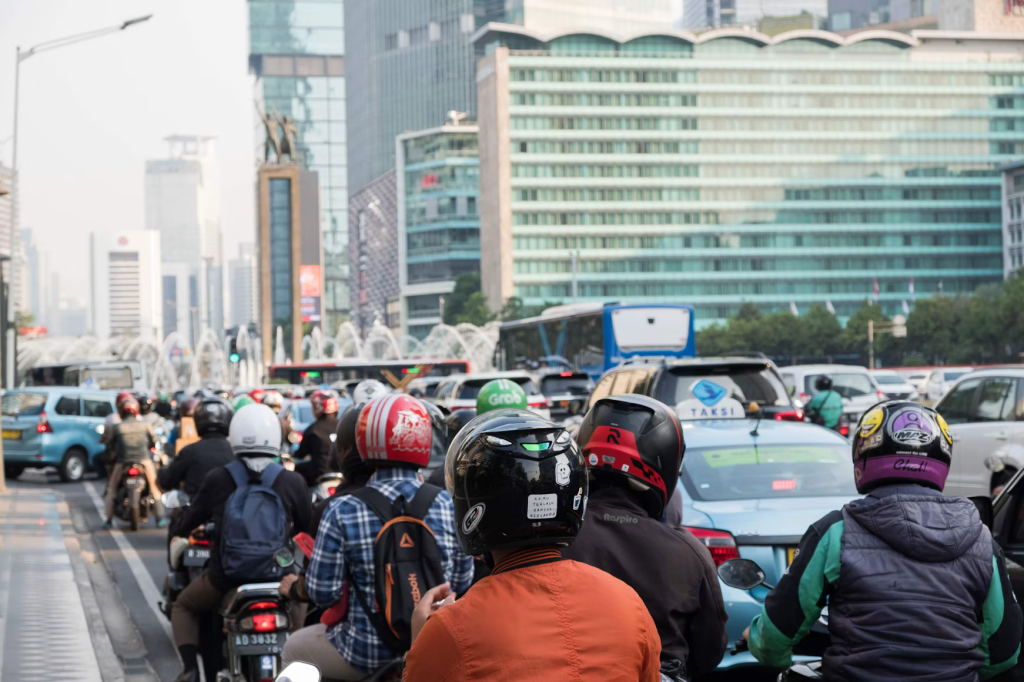
Commuters and delivery riders navigate heavy daytime congestion in Indonesia, where tight delivery timers and road hazards compound daily occupational stress. (Photo: Pexels/Adrian Pranata)
Addressing this crisis does not require dismantling the gig economy or stripping away the flexibility that many workers value. Rather, it demands a fairer distribution of risk between tech platforms, consumers, and the state.
First, governments across ASEAN must establish clear standards for algorithmic transparency and due process. Workers deserve to know how their fares and ratings are calculated, and they must have access to human-led appeals before facing account suspension. Second, policymakers and platform companies should collaborate to build portable social protection schemes that explicitly include mental health coverage, counselling hotlines, and paid rest periods. Finally, platforms must redesign incentive structures that currently reward dangerous speed over worker well-being.
Southeast Asia’s digital transformation has brought undeniable convenience to millions of middle-class households. But a truly sustainable digital economy cannot be built on the quiet burnout of the very people keeping its cities moving. If Southeast Asian leaders want their tech sector to be a model for the developing world, they must ensure that progress is measured not just by gross merchandise value, but by the dignity and mental well-being of its workforce.
About The Author