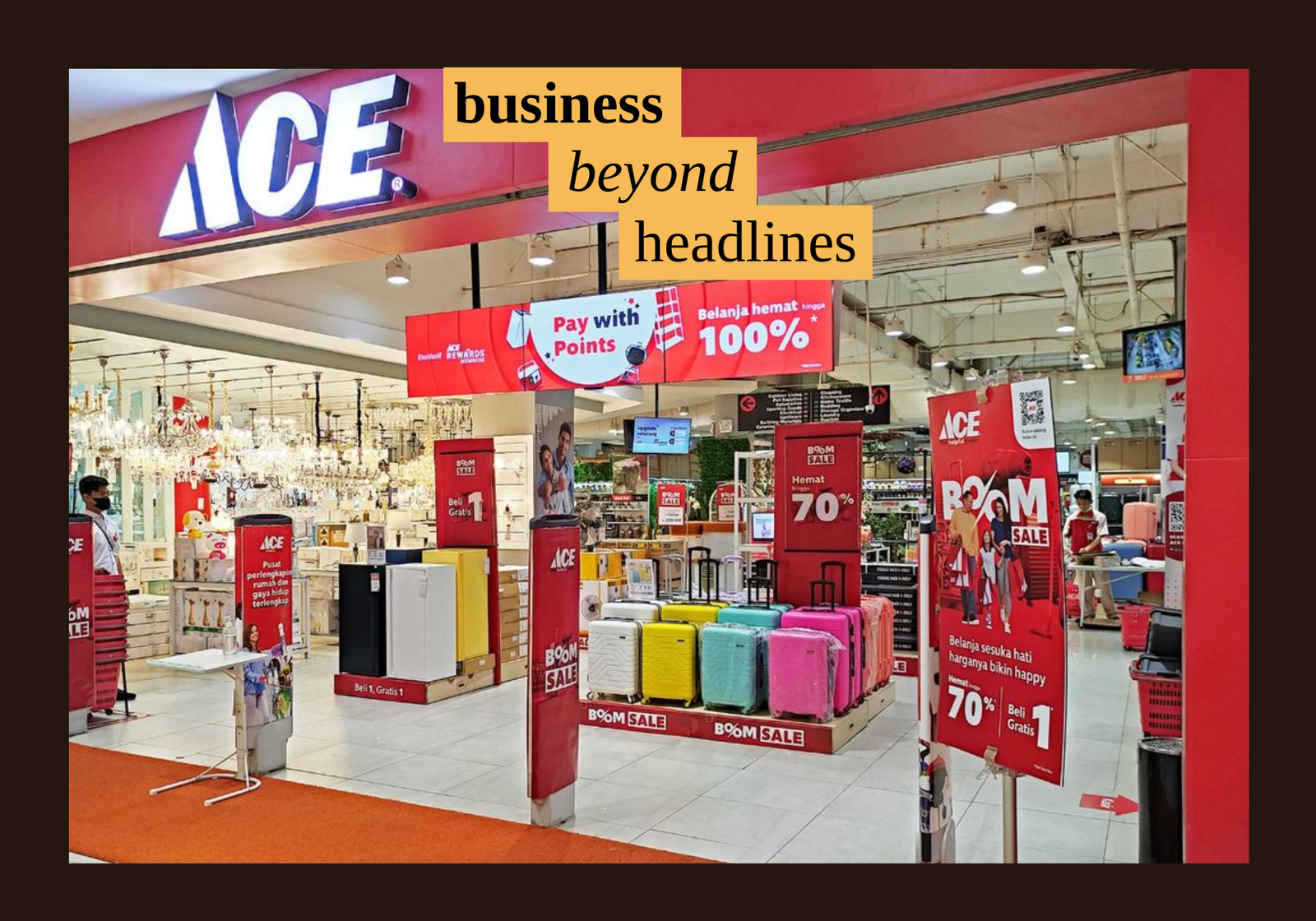
An Ace Hardware storefront in one of Indonesia’s cities. (PT ACE Hardware Indonesia)
Nineteen Months Without Ace
On 29 July 2026, Ace Hardware reopened in Indonesia with a single store at Sunter Mall, 19 months after its licence there ended. Ace Hardware is a US hardware retail cooperative owned by independent retailers. Its stores sell tools, paint and other home-improvement goods. For 29 years, Ace Hardware stores in Indonesia were run by PT Aspirasi Hidup Indonesia Tbk (AHI, formerly PT Ace Hardware Indonesia), part of the local Kawan Lama Group, under a licence from the brand owner, Ace Hardware Corporation. AHI is a broad-line home and lifestyle retailer in Indonesia. It offers a diverse product mix ranging from home improvement items and toys to furniture and housewares.
In September 2024, AHI announced that it would not renew that licence. The licence ended in December of the same year. In early 2025, AHI rebranded its 245-store network as AZKO. The reasoning became clearer in October 2026, when Teresa Wibowo, a director of AHI and CEO of PT Omni Digitama Internusa, described how the group weighed the brand owner’s new renewal requirements against the cost of keeping the Ace name. As she framed it, the question was whether royalties and other fees were worth paying for a name when the group could build its own.
Nineteen months after the licence ended, Ace Hardware was back in the Indonesian market. Its new partner is PT Mitra Adiperkasa (MAP), an Indonesian lifestyle retailer widely recognised for managing global brands like Starbucks and Zara. MAP opened its first Ace store at Sunter Mall on 29 July 2026 andhad three stores by mid-October. The case raises a question for foreign brand owners and their local licensees: how does bargaining power shift when a licensee develops the capabilities to operate without the brand?
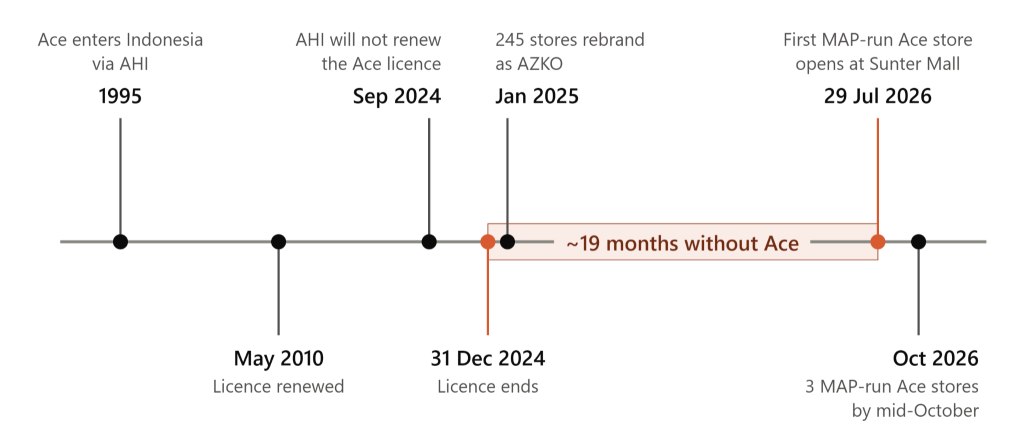
Timeline of Ace Hardware in Indonesia. (Vân Hồ)
Who Need Whom?
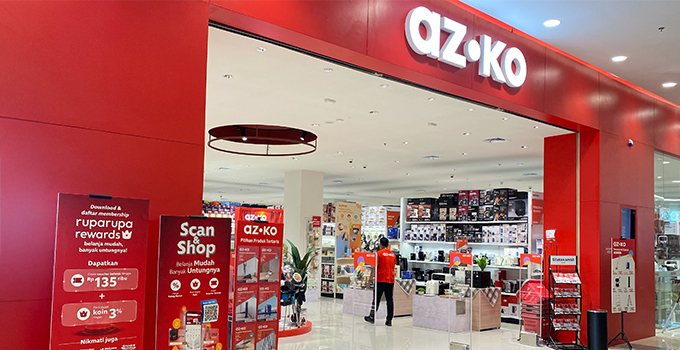
An AZKO facade, rebranded from what used to be an Ace Hardware store. (PT Aspirasi Hidup Indonesia)
The starting point is a mismatch between what the licence required and what the brand added. The licence required minimum US-dollar purchases and at least two new stores a year, and AHI also paid royalties based on retail revenue. Its first-half 2024 financial statements record royalty expense to Ace Hardware of about 26 billion Indonesian rupiah (1.6 million US dollars, at 2024 rates), which was roughly 0.6% of net sales of 4.13 trillion Indonesian trillion (252 million US dollars). Measured against revenue, this is a modest burden for a retailer of AHI’s scale. Measured against profit, it looks heavier, at roughly 7% of first-half net profit of about 366 billion Indonesian rupiah (22.3 million US dollars), so the royalty was not trivial. Even so, the rate alone does not clearly explain the exit. The burden may have lain in the whole package, which combined dollar purchase minimums, a store-opening quota and new conditions that, in Wibowo’s account, required changes on AHI’s side.
The fee may also have become harder to justify as AHI built an increasingly independent retail ecosystem. After the licence agreement with Ace had come to an end, AHI launched AZKO with 52 in-house brands, including Krisbow, KRIS, KLAZ, STORA and SOLEIL. The network behind them was large, at 245 stores across 75 cities. AHI’s public reporting does not say how much of its merchandise carried the Ace label, but the category mix shows the problem might be structural. Lifestyle products (home décor, furnishings and everyday household goods) accounted for about 43% in 2019, 44% in the first nine months of 2020, 42% in 2023 and 43% in the first quarter of 2024. This suggests that a substantial share of AHI’s revenue came from categories beyond Ace’s traditional hardware positioning, potentially weakening the case for paying royalties across total retail sales. The 2025 results point the same way, since with the Ace name gone and purchasing power weak, AHI’s sales still edged up 0.65%. Kawan Lama therefore had reasons to question how much value the brand contributed to its overall sales.
Beyond these terms, renowned Indonesian businessman and columnist Dahlan Iskan reported that Kawan Lama had sought a lower fee before the third renewal, arguing that the Ace brand contributed less than it once had. It fits Wibowo’s cost-versus-benefit reasoning. Either way, this was not a distress exit. AHI’s first-half 2024 profit rose 21%, and nine-month profit rose 18% on sales growth of nearly 14%. Same-store sales grew 9.8% in the first seven months. A struggling licensee may have little room to negotiate with the brand owner, whereas AHI’s growth gave it greater flexibility to consider alternatives.
Still, the move carried a cost. 2025 profit fell about 25%, which AHI attributed to weak purchasing power and operational deleverage, alongside AZKO promotion. Recovery has since set in, with nine-month 2026 profit rising 25.7% to 604.7 billion Indonesian rupiah (33.8 million US dollar) and the network reaching 282 stores. Yet that profit is only about 5% above the same period of 2024, before the licence ended. The rebound has so far mostly recovered the earlier fall rather than clearly showing that the rebrand paid off.
The termination did not end Ace’s interest in the market. The direct explanation comes from MAP, whose management said the opportunity arose when the brand owner went looking for a new partner. MAP consulted Kawan Lama about the split, then ran a feasibility study with the principal. The indirect reasons are easier to see. The brand retains strong awareness after nearly three decades and the retail industry association Aprindo expects retail to outgrow the national economy. AZKO’s results also show that a large home-and-hardware network can be profitable here and a brand owner without a network of its own cannot easily capture that profit alone. The separation ended Ace’s royalty income from AHI and may also have affected product sales to its former licensee, giving the brand owner a reason to find a replacement. The separation matters in both directions, since AHI kept its operating network and own-brand portfolio while Ace kept its trademark and the ability to appoint another licensee. Each held something the other could not immediately replicate.
MAP’s involvement also raises questions about Ace’s choice of operating model. Ace Hardware is part of a US retailer-owned cooperative, a structure built to supply independent stores rather than to run foreign chains. Abroad, its approach has been master and area agreements, offering partners a recognised brand, exclusive private-label products and distribution support. For Ace, this represents an asset-light route. It can draw on a partner’s local knowledge and retail infrastructure. A wholly owned subsidiary would have meant building, from almost nothing, a network of the scale AHI took 29 years to reach, whereas MAP already brought malls, experience with international brands and a loyalty base.
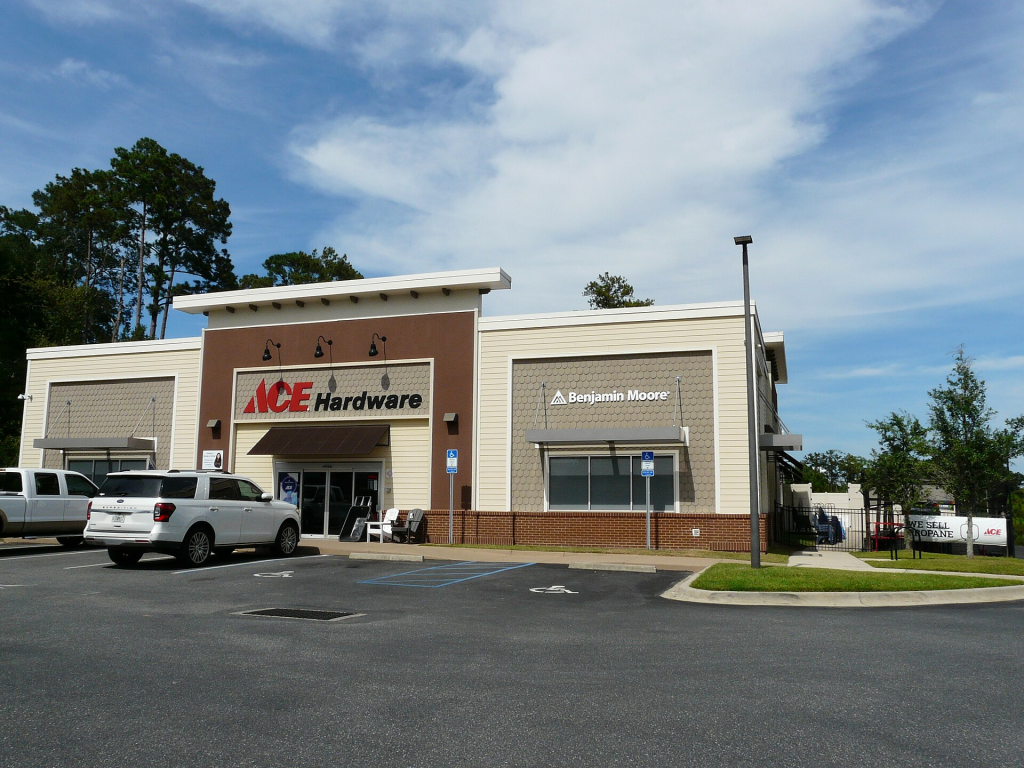
An Ace Hardware store in Bradfordville, Florida. In the US, Ace stores are supplied by a retailer-owned cooperative. (Wikimedia/The Bushranger)
The Indonesian case also exposes the limits of this model. A licensor depends on its partner’s capabilities and sees limited operational detail. A capable partner can therefore build enough capability to operate without the brand, as AHI did. When that partner leaves, the licensor has no presence in the market until it finds a replacement, which took Ace 19 months here. MAP presents the deal as diversification into a new segment and says it intends to bring the Ace concept as practised in the US, which suggests that MAP intends to reproduce the US Ace retail concept more closely in Indonesia. The partner it chose also differs from the one it lost. Despite MAP’s network of malls and experience, it still needs time to rebuild the store network, supply chain and consumer awareness that AHI already had.
Canada is the nearest parallel, though an imperfect one. Ace’s Canadian master licence passed through three successive licensees before Peavey ended the relationship at the end of 2024, citing the pandemic, supply-chain disruption, inflation and higher costs in small, remote markets. The aftermath differed from Indonesia on both sides. Ace Hardware discontinued supply to nearly 100 Canadian dealers rather than appointing a successor, while Peavey sought creditor protection and began closing its stores within a month of the licence ending. The contrast points in two directions. A licensee can be better positioned to leave the brand when a profitable business stands behind it, as AHI’s did and Peavey’s evidently did not. And a licensor’s ability to replace a departing partner depends on the market, since Indonesia, where AHI’s results showed what a large network could earn, drew a successor within months, while Canada, after two changes of licence holder in eight years, did not. The markets and the licences differ, notably Peavey’s four years against AHI’s 29, so the comparison is suggestive at best.
Lessons for Brands and Their Partners
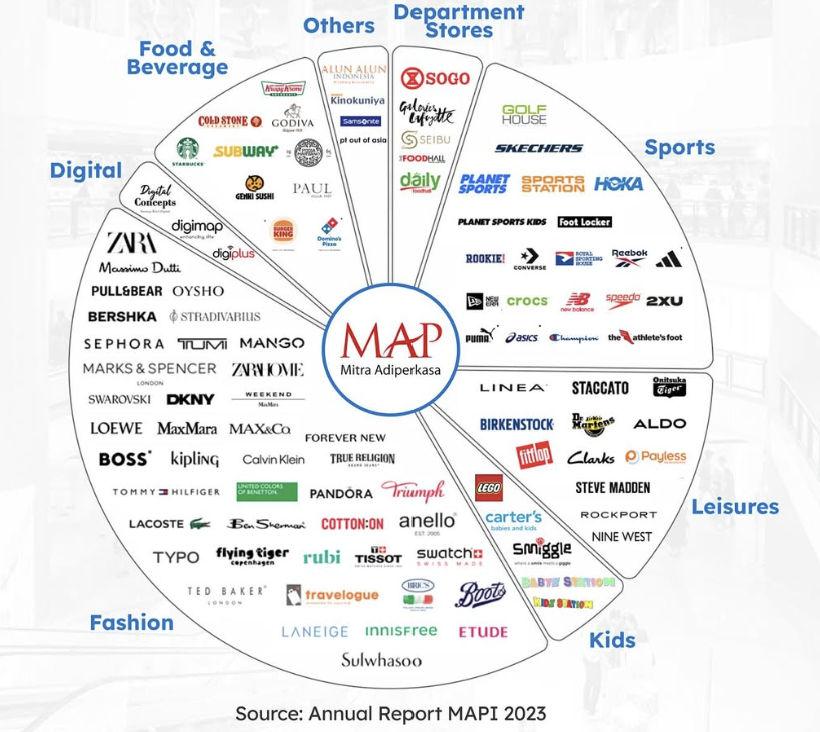
Brands under MAP’s management in Indonesia in 2023, before Ace Hardware was added to its portfolio in 2026. (Emtrade.id)
The next test is whether MAP can build a profitable network and whether AHI’s recovery holds. MAP has said it will expand gradually, starting with five to seven stores. Analysts expect its biggest risk to be early promotion costs and margin pressure, with market-share effects visible only in the medium term. Others flag cannibalisation in the Greater Jakarta region and competition from cheap Chinese imports sold online. The sector also depends on middle-class spending and property market conditions. Home improvement is new to MAP, while AHI’s established network and own brands may be advantages a new licensee cannot easily replicate.
For international brands and local licensees, the case highlights three considerations in licensing arrangements. First, the royalty structure matters. Licensing agreements can calculate royalties on different bases, such as total retail revenue or sales of licensed products alone. The choice can have significant implications for licensees, particularly those developing their own brands, making the scope of royalty-bearing revenue an important point to define in the contract.
Second, minimum purchase commitments denominated in US dollars expose local licensees to exchange-rate risk. When the dollar appreciates against the local currency, the domestic cost of meeting the same purchase commitment rises. This can put pressure on margins, especially for businesses heavily reliant on imports.
Third, both parties have a stake in the continuity of the partnership. Brand owners should consider how to maintain their market presence through a change of licensee, while local operators should weigh the value of an established international brand against the costs and potential of building their own. A transition may offer greater independence, but it also requires investment in a new brand identity and customer recognition. The case illustrates that ending a licensing agreement does not necessarily mean losing access to the market for the brand owner or losing the ability to compete for the former licensee.
About The Author