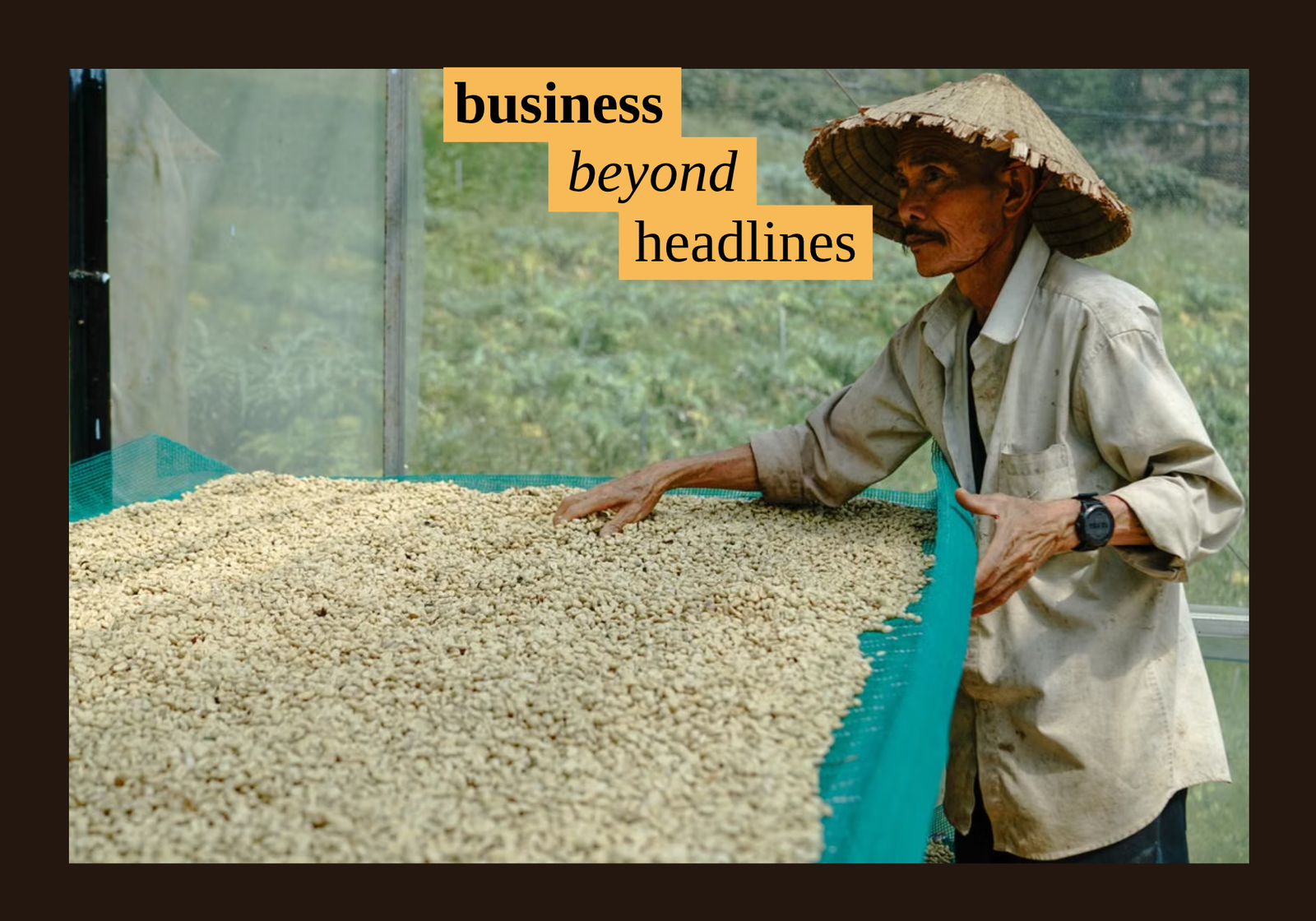
A farmer in Lâm Đồng, Vietnam drying coffee beans with traditional techniques. (Pexels/1500m Coffee)
Climate Volatility and EUDR, A Double Trouble
The planned formal implementation of the European Union Deforestation Regulation (EUDR) on the end December 2026 has coincided with severe climatic disruptions across Southeast Asia’s primary coffee producing regions. In Vietnam’s Central Highlands, specifically Đắk Lắk, Lâm Đồng and Gia Lai provinces, unprecedented heatwaves throughout 2024 and early 2025 depleted agricultural water reservoirs by nearly 35%, severely compromising the critical flowering window for Robusta trees and causing national harvest outputs to drop by 12% in the 2024 to 2025 crop year. At the same time, unseasonal heavy rain impacted freshly picked cherries in the 2024 harvest season in Indonesia’s Sumatra Selatan and Lampung provinces impacting bean quality and interrupting traditional open air sun drying operations. These compounding pressures are testing the supply chain integrity of the global beverage.
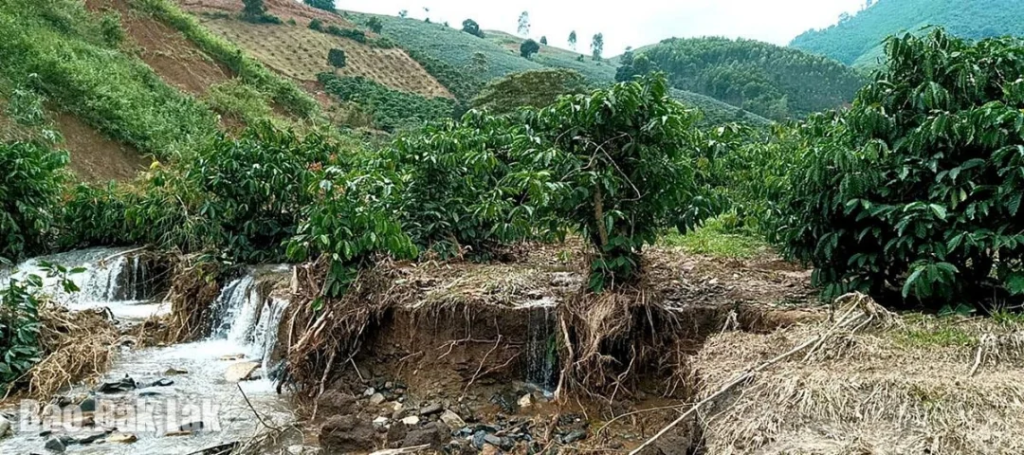
A flooded coffee plantation in Vietnam, a symptom of worsening extreme weather pattern. (Vietnam.vn)
Vietnam and Indonesia are still the leading contributors to the world’s coffee consumption. In the 2025 to 2026 marketing year, the USDA (United States Department of Agriculture) Foreign Agricultural Service estimates that Vietnam will be responsible for 17.7% of total world production and Indonesia for 6.9%. ASEAN member states exported in 2025 more than 32 million 60-kilogramme bags of green coffee and earned more than 7 billion US dollars in foreign currency, according to the International Coffee Organisation (ICO).
However, the upstream segment of this industry, spanning farm gate cultivation, wet and dry milling, primary processing and regional roasting facilities, is undergoing a structural realignment. The full enforcement of the EUDR means that global roasters based in Hamburg, Milan, and Singapore can no longer procure unmapped commodity green beans without exposing themselves to severe legal penalties and financial forfeitures equal to at least 4% of their annual turnover within the European Union (EU). Under the EUDR framework, any coffee entering the European single market must prove it was not grown on land deforested after the cutoff date of 31 December 2020. This mandate requires pinpoint accuracy, mandating precise digital plot polygon data for farms exceeding four hectares and single point Global Positioning System (GPS) coordinates for smaller plots. For regional aggregators, international trading conglomerates and commercial banks, the current challenge extends far beyond seasonal crop availability. It represents a systemic gap in upstream traceability, farm gate aggregation, and origin based primary processing infrastructure that threatens to decouple non-compliant smallholders from high value Western trade channels.
Divergent Vulnerabilities and the Restructuring of the Middle Mile Supply Chain
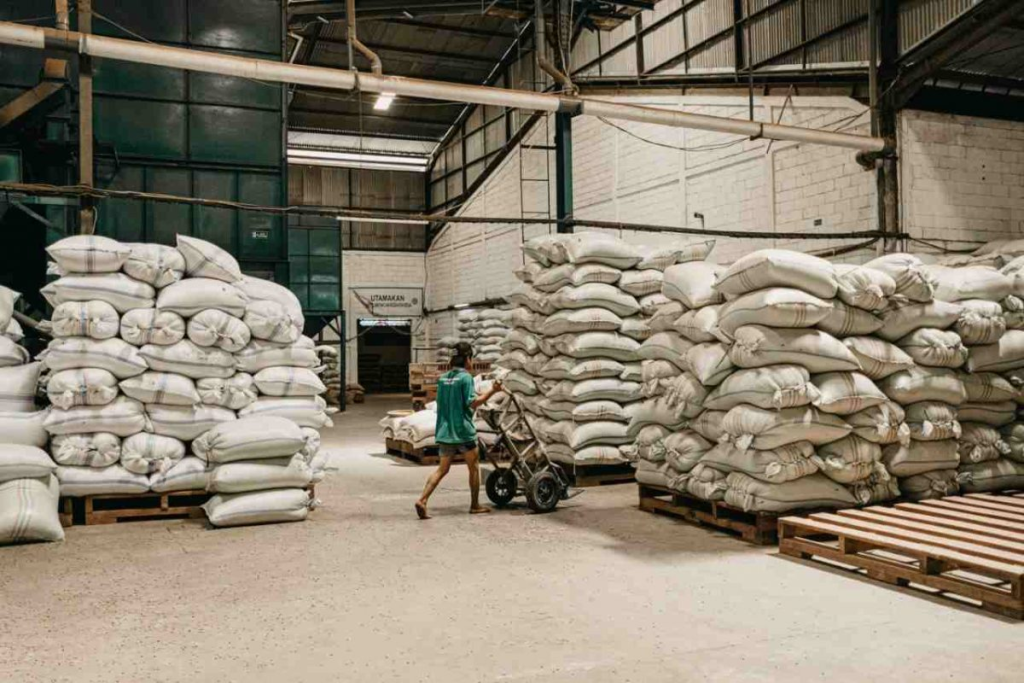
An Indonesian coffee warehouse owned by a local intermediary (or tengkulak in Indonesian). (Delta Coffee Roaster)
Understanding the upstream coffee crisis requires a comparative analysis of the distinct agronomic and structural models operating in Vietnam and Indonesia. Vietnam operates a high input, intensive monoculture production model where growers achieve exceptionally high productivity, averaging 2.5 to 3.0 metric tonnes per hectare. However, this high volume relies heavily on intensive chemical fertilisation and deep well groundwater irrigation. Figures from the General Statistics Office of Vietnam (GSO) indicate that rising fuel costs and groundwater depletion pushed farm gate production costs in Đắk Lắk to 65,000 Vietnamese dong (2.55 US dollar) per kilogramme in 2025. Although Vietnam’s highly commercialised farms are geographically consolidated, allowing over 40% of its coffee area to achieve sustainability certifications such as 4C and Rainforest Alliance by 2025, the country’s intensive monoculture remains acutely vulnerable to climate induced hydrological drought.
In contrast, Indonesia’s upstream coffee sector is defined by extreme structural fragmentation. According to 2024 statistics from the Central Bureau of Statistics (BPS) and the Indonesian Coffee Exporters Association (GAEKI), over 95% of Indonesia’s 1.27 million hectares of coffee land is cultivated by an estimated 1.8 million independent farmers. While ecologically resilient and less dependent on artificial irrigation, these smallholdings frequently overlap with protected forest buffer zones, such as the Bukit Barisan Selatan National Park in Indonesia’s western island of Sumatra. This spatial ambiguity creates an important bottleneck on compliance with European deforestation regulations, as hundreds of thousands of small farms do not have official land titles or mapped boundary polygons.
The central structural weakness of the region lies within the middle mile aggregation mechanism. Historically, upstream trade relied on informal local intermediaries, known in Indonesia as tengkulak or kolektor, and in Vietnam as local collectors. These traders buy mixed batches of unmapped coffee cherries at the farm gate, combine them at rural collection yards and resell them to primary dry mills. This informal aggregation creates a fatal blind spot for international compliance, because once coffee parchment from hundreds of unmapped farms is blended during primary dry milling, the resulting green coffee or primary roasted beans become permanently non-compliant for export to regulated European markets. As noted by Dr Le Van Hung, Senior Agronomist at the Western Highlands Agriculture and Forestry Science Institute (WASI), the legacy model of buying anonymous coffee cherries at the farm gate has become economically obsolete for export-oriented buyers, since any unmapped batch milled after 2024 loses access to premium international contracts.
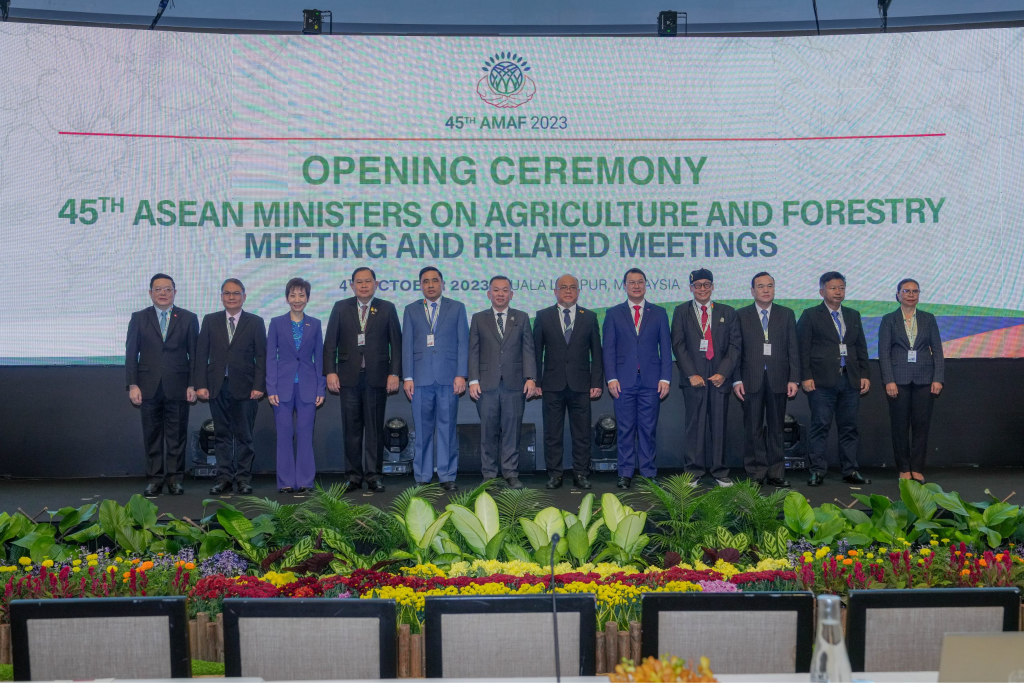
The 45th ASEAN Ministers on Agriculture and Forestry (AMAF) Meeting in 2023. (ASEAN)
At the regional governance level, the lack of a unified ASEAN agricultural compliance framework exacerbates these market frictions. ASEAN Ministers on Agriculture and Forestry (AMAF) in 2025 have initiated joint consultations on harmonisation of land registry standards. Diverging national land tenure legislation results in fragmented progress. Thus, Indonesia and Vietnam have been running separate bilateral economic diplomacy tracks with EU trade delegations in Brussels. Indonesian officials have advocated for the adoption of their national social forestry database models as proxy compliance indicators. Vietnam has leveraged bilateral Free Trade Agreement mechanisms with the EU to secure 15 million euros (16.6 million US dollar) in technical assistance grants for smallholder satellite mapping in the Central Highlands. This diplomatic divergence reveals how upstream compliance has transcended being a technical issue for private supply chains and has become a major battleground for sovereign economic statecraft.
Consequently, major global trading conglomerates, including Louis Dreyfus Company and Neumann Kaffee Gruppe, are actively bypassing traditional informal collectors. They are investing directly in origin located primary processing infrastructure, establishing closed loop procurement networks where wet milling, hulling and primary roasting take place within verified, traceably mapped production zones. This shift is creating a dual market structure across Southeast Asia, dividing the sector between capital=backed, traceable supply chains that secure premium export contracts, and unmapped, traditional chains forced to unload excess Robusta into a discounted price range.
Strategic Imperatives for Investors and Supply Chain Decision Makers

A session at the European Parliament, where the EUDR was voted in, with effects all the way to Southeast Asia. (European Parliament)
To navigate this structural transition, commercial banks, private equity investors and corporate supply chain leaders must fundamentally reevaluate how capital is deployed across Southeast Asia’s upstream coffee value chain. Rather than relying on traditional green bean trading and price arbitrage, smart capital must now pivot toward origin integrated primary processing and roasting infrastructure. Substantial commercial returns exist in funding modern, water efficient wet milling plants and eco-friendly roasting hubs situated directly within major producing clusters across Indonesia’s Sumatra and Vietnam’s Central Highlands. Facilities capable of outputting verified, origin roasted beans capture significantly higher profit margins, selling directly to global roasters at a premium of 300 to 500 US dollar per metric tonne over London Robusta futures while insulating buyers from middle mile compliance risks.
From a financial structuring perspective, multilateral development institutions such as the Asian Development Bank (ADB) and international commercial entities are increasingly tying credit facilities to verifiable deforestation free benchmarks. In 2025 alone, over 450 million US dollars in sustainability linked trade finance were issued to major agribusinesses operating across Indonesia and Vietnam, with interest rate discounts directly contingent upon achieving 100% geolocation verification across primary supplier networks. Unmapped farm gate sourcing is now seen as a material Environmental, Social and Governance (ESG) risk by commercial banks, increasing corporate borrowing costs by 150 to 200 basis points.
There are other capital opportunities for scaling offline agritech solutions and climate adaptation measures. Venture capital needs to concentrate on smartphone-based mapping software for smallholder aggregation that operates on low bandwidth, enabling rural cooperatives to capture polygon coordinates at the point of primary collection even without an internet connection. In tandem, capital allocation in Vietnam must support drought resilient rootstock nurseries and precision drip irrigation systems to protect yields against El Niño weather cycles, while investment in Indonesia should focus on shade grown agroforestry rehabilitation that increases smallholder yields from 0.8 to over 1.5 metric tonnes per hectare without encroaching on protected forest canopy boundaries.
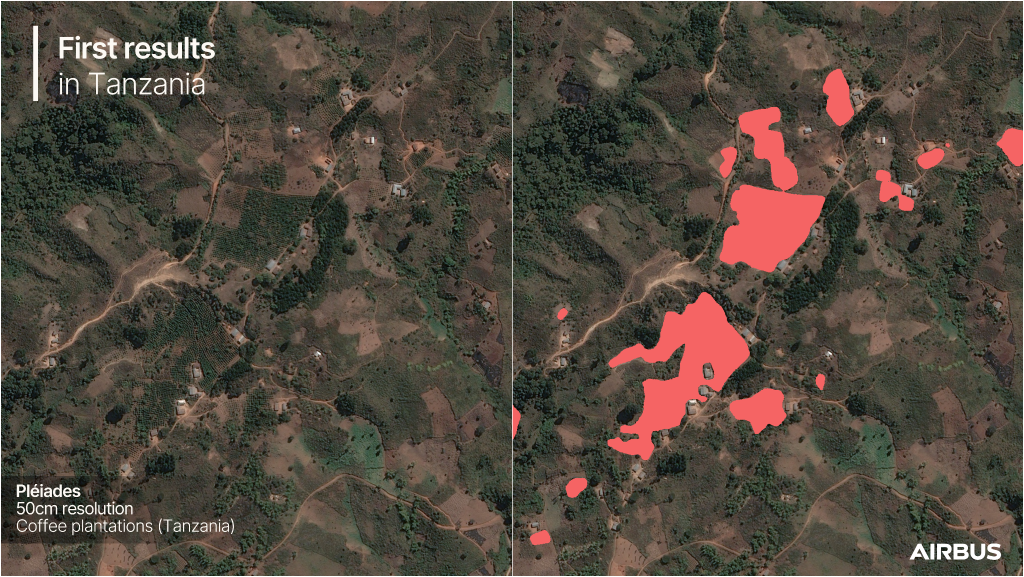
A coffee plantation satellite imaging in Tanzania, which will be a more common practice after the full enforcement of the EUDR. (Airbus)
Looking ahead over the next 12 to 18 months, market watchers and corporate strategists should monitor three critical developments. The first is an accelerated shift toward primary roasting directly within host producing nations, as international brands seek to reduce shipping weights by up to 18%, lower freight carbon footprints and secure total supply chain verification prior to export. The second development is a widening price bifurcation, where compliant Robusta is projected to command a 15 to 20% price premium over unmapped green beans, forcing non-compliant volumes to permanently divert toward emerging, price sensitive markets in China, India, and the Middle East. Finally, the speed with which the Ministry of Agriculture of Indonesia and Vietnam’s Ministry of Agriculture and Rural Development (MARD) roll out centralised digital land registries between 2025 and 2026 will ultimately determine whether independent smallholders remain integrated into high value global trade or face systemic market exclusion.
About The Author