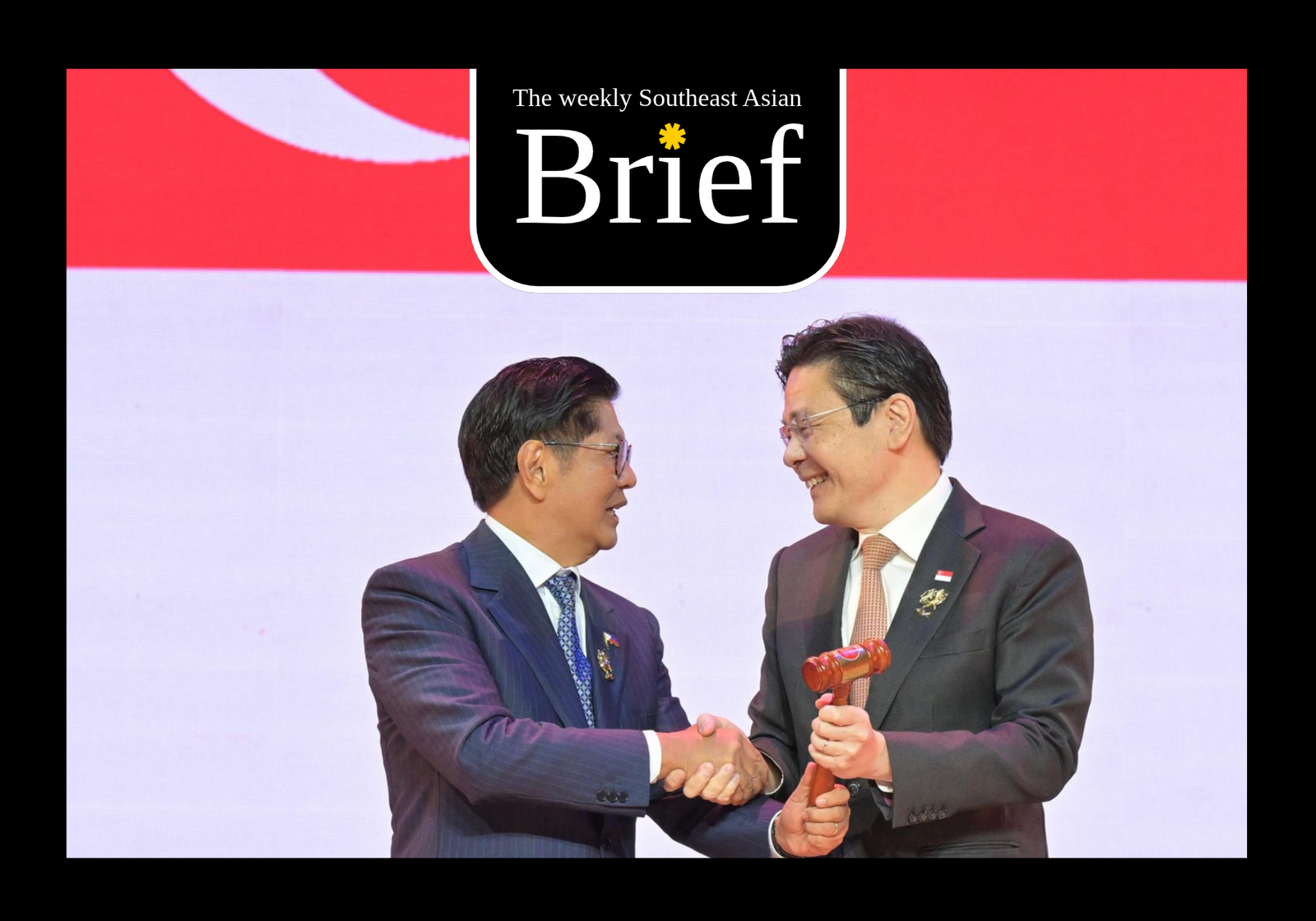
Philippine President Ferdinand Marcos Jr. handing over the Philippines’ ASEAN chairship to Singaporean Prime Minister Lawrence Wong on November 17. (ASEAN Secretariat)
Between November 15 and 17, the 49th ASEAN Summit in Manila placed regional economic integration at the centre of discussions as Southeast Asean leaders pursued to strengthen cooperation in digital transformation, regional connectivity and supply-chain resilience. As the Philippines concluded its ASEAN chairship, it left incoming chair Singapore a series of economic commitments, setting the direction for the region’s next phase of cooperation. However, the challenge for the 2027 chairship will be to advance the Philippines’ initiatives into more sustainable economic cooperation and ensure that their benefits extend across Southeast Asia.
The 2026 chairship’s most significant achievements was the signing of the ASEAN Digital Economy Framework Agreement (DEFA), which establishes a legally binding regional framework for digital trade, cross-border data flows, electronic payments, digital identity, cybersecurity and consumer protection. It is expected to enter into force in early 2027, providing a foundation for businesses to operate more easily across ASEAN markets. Moreover, it could benefit micro, small and medium-sized enterprises (MSMEs), which often face regulatory and financial barriers when expanding beyond their domestic markets.
The agreement also mirrors ASEAN’s growing recognition that digital infrastructure and regulatory compatibility are becoming essential to economic competitiveness. As businesses increasingly rely on electronic transactions, digital services and cross-border data exchange, differences in national regulations can increase operating costs and restrict market access. Establishing common rules could reduce these barriers and encourage greater participation in regional digital trade. Still, the benefits will depend on whether member states can align their domestic regulations and provide businesses with the infrastructure and technical capabilities needed to use these systems.
Beyond digital trade, the 2026 chairship advanced cooperation in the semiconductor industry through the ASEAN Semiconductor Roadmap. The initiative seeks to strengthen regional participation in semiconductor supply chains, including integrated circuit design, advanced packaging and high-performance computing. This is relevant as global demand for semiconductors continues to grow alongside AI, telecommunications and advanced manufacturing. Greater regional coordination could allow ASEAN economies to complement one another’s industrial capabilities rather than compete independently for investment.
On the other hand, energy connectivity was another important component of the Philippines’ economic agenda. The ASEAN member states signed the Enhanced Memorandum of Understanding on the ASEAN Power Grid (APG), strengthening the framework for cross-border electricity trade, infrastructure planning and investment. The agreement could allow countries to access electricity from neighbouring economies, diversify energy sources and improve the reliability of regional power systems. It also creates opportunities to integrate renewable energy into national electricity networks.
These initiatives form part of a broader effort to strengthen ASEAN’s economic resilience amid disruptions to global trade and supply chains. In 2026, strategic trade management and regional cooperation on supply-chain security were also advanced, recognising the importance of maintaining access to critical goods and technologies. These measures are increasingly relevant as geopolitical tensions, export restrictions and competition over strategic industries affect global commerce.
For ASEAN, stronger regional production networks could reduce dependence on individual external suppliers and improve its ability to respond to disruptions. However, diversification will require more than attracting foreign investment, which requires member states to also develop complementary industries, improve logistics infrastructure and establish predictable trade policies.
The transition to Singapore’s 2027 chairship will be important in determining whether these initiatives develop regional agreements. With the 2027 theme, “Deeper Integration, Wider Partnerships”, emphasising stronger cooperation in finance, digital technologies and energy, alongside efforts to move towards a more integrated ASEAN market. Singapore inherits several frameworks from the Philippines, but its challenge will be to translate these commitments into practical and sustained economic cooperation.
With this, Singapore could prioritise the implementation of DEFA by strengthening interoperability in digital payments, improving regulatory coordination and supporting businesses entering regional markets. Its financial and technological capabilities could also help mobilise investment in semiconductor manufacturing, digital infrastructure and emerging technologies.
However, greater integration must account for differences in economic development among ASEAN members. Member states with more advanced digital infrastructure and industrial capabilities could attract a disproportionate share of investment, while less-developed economies risk remaining concentrated in lower-value segments of regional supply chains.
Singapore’s chairship also coincides with the 50th anniversary of ASEAN-EU dialogue relations in 2027, creating opportunities to expand the region’s external economic partnerships. The EU is an important source of trade, investment and technology for Southeast Asia, with bilateral merchandise trade reaching 292.8 billion US dollar in 2024. This could build on existing negotiations and cooperation frameworks to encourage more investment and diversify the region’s economic relationships.
The Philippines has left ASEAN with important foundations for digital integration, industrial cooperation and regional energy connectivity. Yet, agreements alone cannot guarantee stronger competitiveness and economic resilience. Singapore’s ability to sustain this agenda will still depend on whether it can turn the region’s commitments into operational infrastructure, compatible regulations and investment opportunities that benefit member states at different levels of development.
As ASEAN approaches its 60th anniversary in 2027, the main challenge will be to ensure that deeper integration does not remain an institutional ambition, but becomes a practical foundation for the region’s long-term economic position.
About The Author