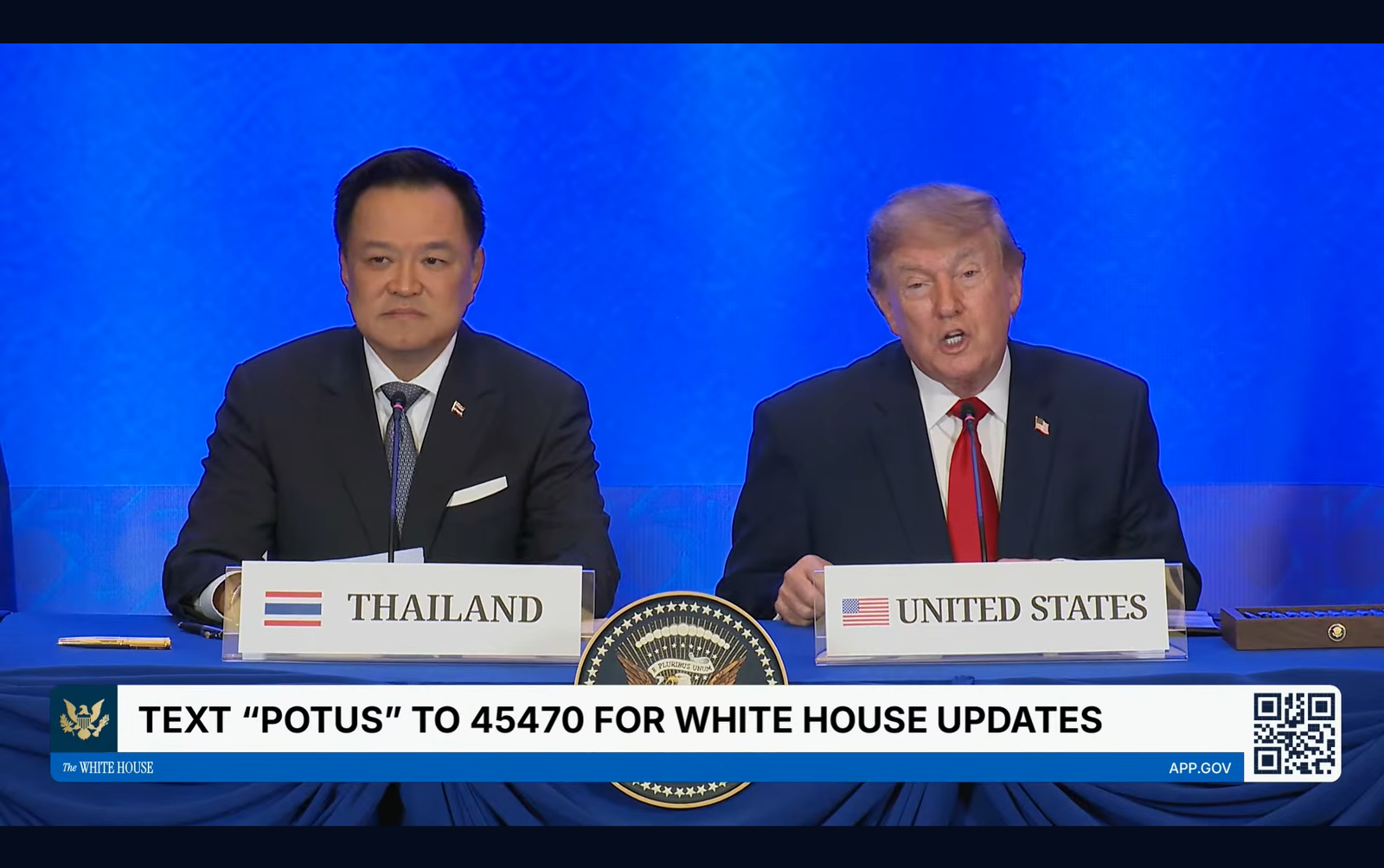
Thai Prime Minister Anutin Charnvirakul and US President Donald Trump during a briefing on the Joint Statement on the Agreement on Reciprocal Trade, on November 17. (The White House/YouTube)
The US and Thailand reached a preliminary trade accord on the sidelines of the 49th ASEAN Summit on November 17. President Trump claimed in a subsequent press briefing that Bangkok “will eliminate all tariffs on US exports”, adding that it is “something that the US has been asking for a long time”.
Heightening public misconceptions swiftly prompted the Thai Minister of Commerce Suphajee Suthumpun to issue a clarification that the country “has not agreed to eliminate all tariffs on US imports”, further emphasising that tariff reductions are only one part of the pact.
The minister underscored that the joint statement has not been signed, noting that President Trump “likely wanted Americans to hear a positive message”.
Indeed the Agreement on Reciprocal Trade (ART) will only enter into force after both parties finalise the legal details, which is projected for early 2027.
Notably, however, Thailand has committed to buying an estimated 2.6 billion US dollars in American agricultural products. With the US remaining as Thailand’s largest export market (beside China), Bangkok certainly faces an asymmetrical disadvantage.
Analysts thus view such a “concession” as an effort to safeguard what remains in a volatile trade environment. Keeping exports flowing is vital to preserving the livelihoods of over one million Thais, as their jobs depend on it.
Thailand currently faces a 19% baseline reciprocal tariff cap from the US, negotiated down from an initial proposal of 36%. In 2025, Bangkok recorded a 51.36 billion US dollar trade surplus with Washington.
Kala Advisory helps exporters and investors look beyond the headlines to turn selective tariff cuts and procurement pledges into actionable market entry assessments across Thailand and Southeast Asia. Visit kala-advisory.com.
About The Author