Probo Darono Yakti is a Lecturer in International Relations at Universitas Airlangga and Director of the Center for National Defence and Security Studies. The views expressed are the author’s own and do not represent SEA Daily or that of another organisation.
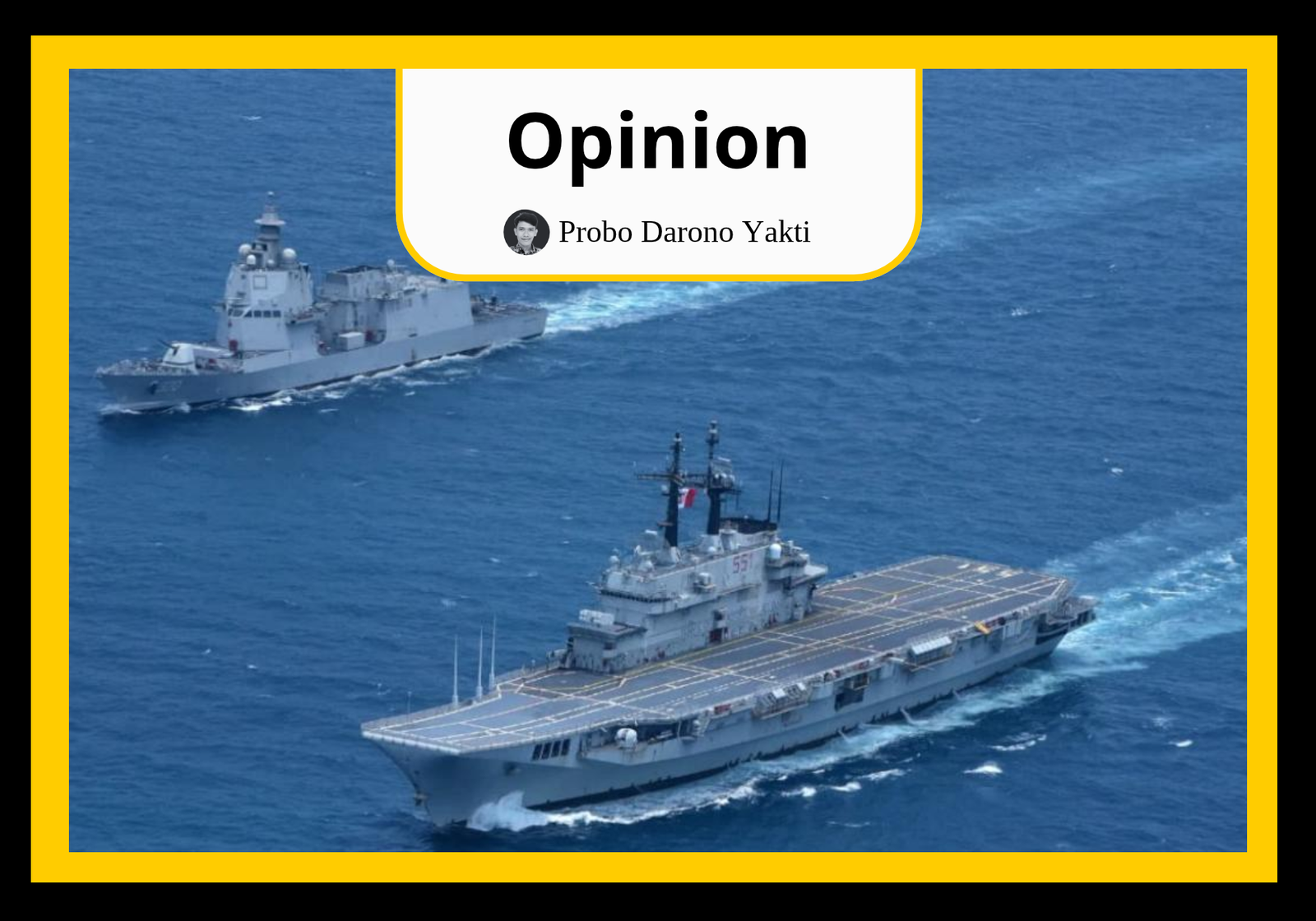
Future KRI Sriwijaya, escorted by Brawijaya (background), arriving in Indonesia on 18 September 2026. (Wikimedia/Indonesian Navy)
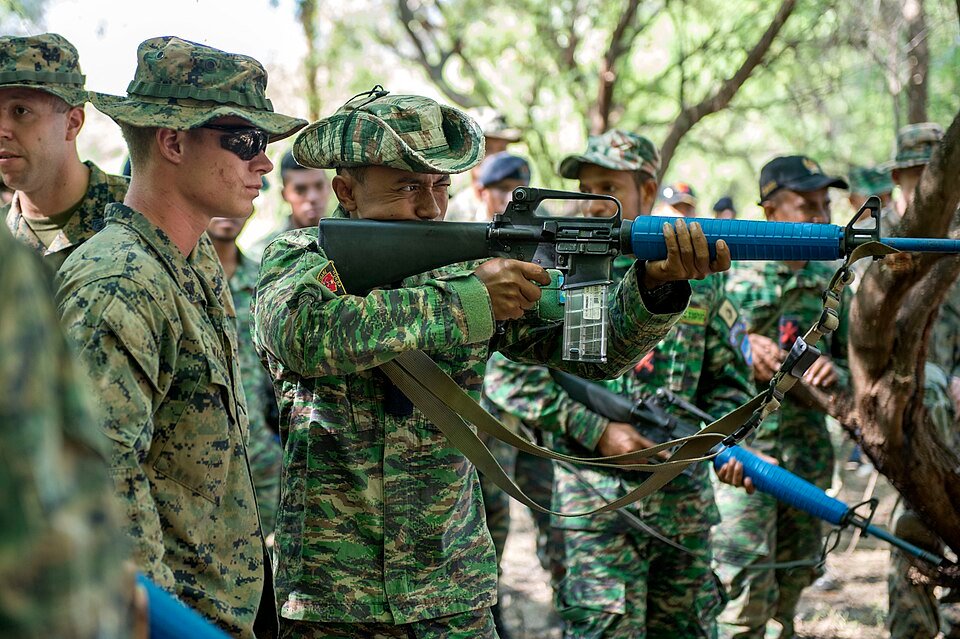
On November 12, Indonesia staged the peak of its Amphibious Operations Exercise in Tangerang City, bringing together 1,718 personnel, naval combatants, Marines, Kopaska special forces, helicopters and Indonesian Air Force T-50 fighters. After the amphibious assault, defence leaders also observed a trial of Berani Mati, a domestically developed high-speed unmanned surface vessel (USV) equipped with artificial intelligence (AI). The Ministry of Defence presented the exercise as an example of how Indonesia’s active-defence strategy can be implemented through the Perisai Trisula Nusantara doctrine.
The exercise is a more revealing marker of Indonesia’s maritime modernisation than any single procurement announcement. Less than two months earlier, the former Italian Navy carrier Giuseppe Garibaldi had entered service as KRI Sriwijaya-100. Indonesia is therefore not simply adding ships. It is trying to combine a carrier, larger surface combatants, amphibious forces, uncrewed systems, air power and forward infrastructure into a force capable of operating across very different maritime theatres.
Simply put, Indonesia is modernising several maritime logics at once, from anti-access/area denial (A2/AD) and persistent presence in Natuna to longer-range naval operations and joint-service support. None of these choices is inherently contradictory. But a collection of capable platforms does not automatically become a coherent maritime force. Indonesia needs a clearer operational concept connecting what each capability is for, where it should operate and how it should support the others.
Several Maritime Logics at Once
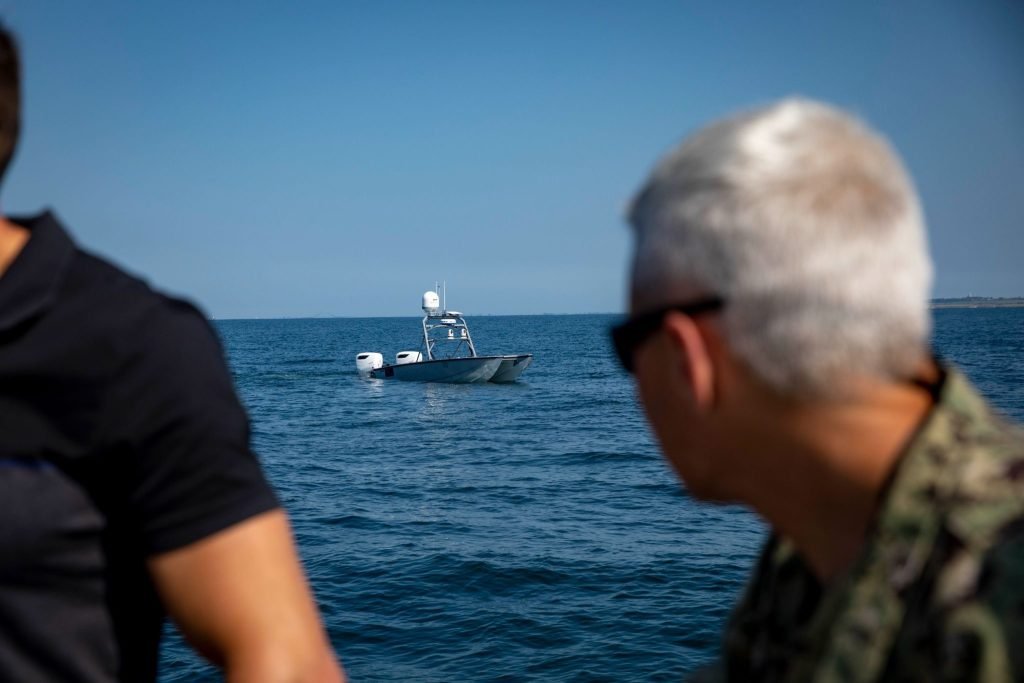
An unmanned surface vehicle operates during BALTOPS 2023. Indonesia’s recent testing of the domestically developed “Berani Mati” USV highlights the growing role of autonomous systems in maritime warfare. (Wikimedia/US Navy)
The first logic is sea denial. In contested approaches such as the North Natuna Sea, Indonesia does not need to control every stretch of water continuously to complicate an adversary’s calculations. Mobile anti-ship missiles, submarines, fast attack craft, coastal sensors and uncrewed systems can make access dangerous and expensive. Alfin Febrian Basundoro recently argued that better dual-use infrastructure in Natuna could strengthen precisely this kind of persistence by allowing Indonesian patrol vessels to remain closer to contested waters.
The second logic is sea control and sustained presence. Indonesia still needs frigates, patrol vessels, maritime patrol aircraft and replenishment support to escort shipping, enforce jurisdiction, conduct anti-submarine warfare and maintain a visible state presence. These missions cannot be outsourced to cheap drones or shore-based missiles. They require platforms that can remain at sea, communicate across long distances and operate with other services and civilian agencies.
The third logic is maritime support and limited projection. This is where the newly-acquired light aircraft carrier KRI Sriwijaya-100 potentially matters most. Indonesian defence authorities have highlighted its role in command, humanitarian assistance, helicopter and drone operations, while the Navy has also linked the ship to wider modernisation of its Integrated Fleet Weapon System. These functions make more sense for Indonesia than trying to imitate the strike-carrier model of the US or China.
The three logics are compatible, but only if planners specify where one begins and another ends. A navy can deny access in one theatre, sustain presence in another and use a large aviation platform for command or humanitarian support elsewhere. The doctrinal task is to connect those missions rather than allow each acquisition to generate its own justification after the fact.
The carrier is a doctrinal stress test
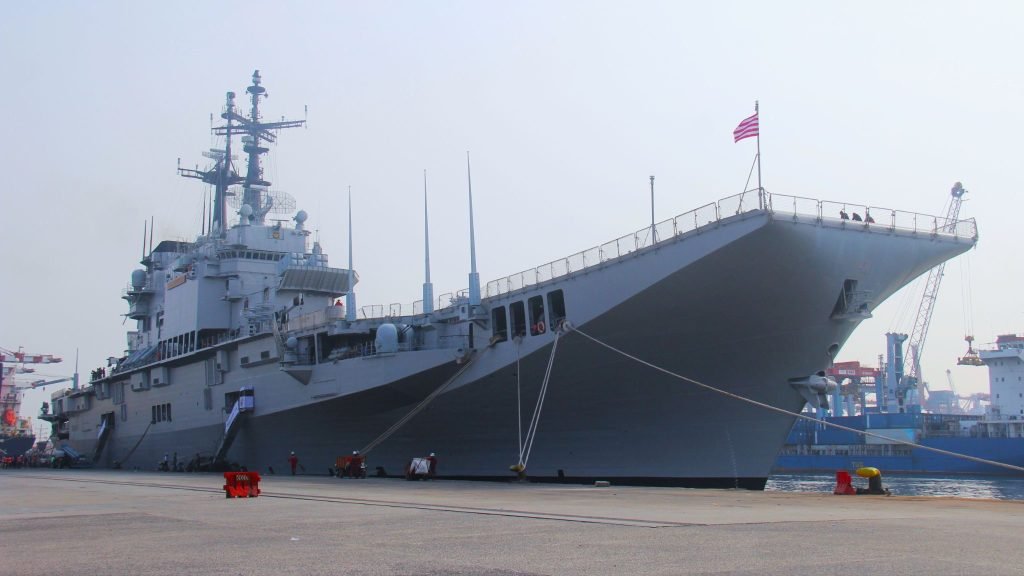
KRI Sriwijaya-100 at Tanjung Priok, Jakarta. Indonesia’s first aircraft carrier expands the Navy’s options for aviation, command and support, while creating new requirements for integration, logistics and protection. (Wikimedia/Jauhsekali)
KRI Sriwijaya-100 makes this ambiguity harder to ignore because large ships create large support requirements. A carrier needs trained air crews, deck personnel, escorts, logistics, maintenance, secure communications, intelligence and protection against threats above, below and on the surface. Its value therefore depends less on the hull itself than on the network surrounding it.
That is why the wrong debate is whether Indonesia “needs” an aircraft carrier in the abstract. The better question is what missions justify the costs of operating one. A mobile command platform for archipelagic emergencies, helicopter operations, maritime surveillance, uncrewed systems and joint-service support may fit Indonesia’s geography. A prestige platform searching for a wartime mission after acquisition would not.
This distinction is particularly important because the vessel is still expected to undergo further retrofit and modernisation. That creates an opportunity. Before configuration decisions harden into sunk costs, Indonesia should decide which mission set takes priority and what supporting capabilities are necessary to make the ship useful.
Platforms should follow missions. Missions should not be invented to justify platforms.
Drones do not solve doctrinal incoherence
Mochammad Arif and Bagus Mangundiwiryo recently used Ukraine’s Black Sea experience to show why Indonesia should take uncrewed systems seriously. Their core point was not that drones can replace major warships, but that affordable systems become powerful when integrated with intelligence, secure communications, sensors and conventional platforms. That lesson applies directly to KRI Sriwijaya-100.
The useful question is not whether Indonesia should choose between a carrier and drones. It is how the two could work together. A large ship could act as a command and aviation node, frigates could provide escort and long-range sensors, uncrewed surface and underwater vehicles could extend surveillance, and shore-based missiles could form a denial layer around sensitive approaches.
But such a network only works if planners can answer basic operational questions. Who detects the target? Who confirms its identity? Who decides how to respond? Which platform carries the most reliable picture and how is that picture shared if satellite links are disrupted or electronic warfare degrades communications?
Without answers, Indonesia risks buying connectivity in theory while operating separate fleets in practice. The challenge is therefore not simply technological. It is organisational, doctrinal and joint.
Geography should shape the force
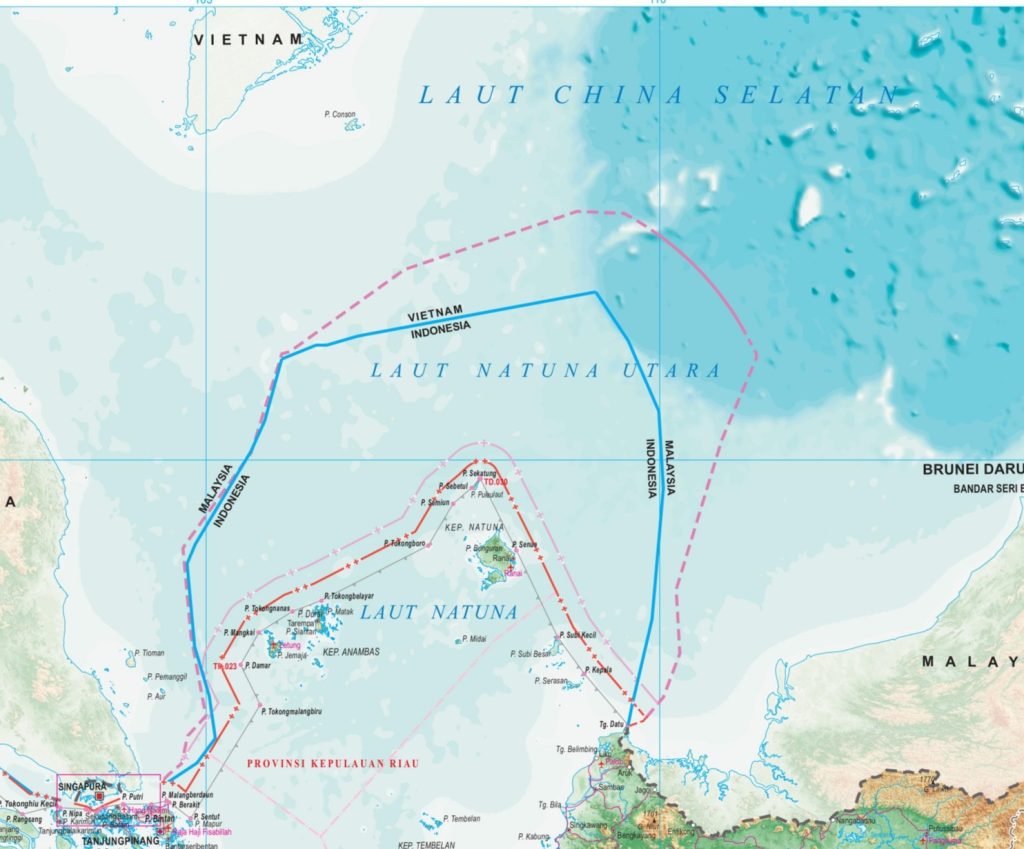
An Indonesian map of the North Natuna Sea which borders the South China Sea, a politically sensitive maritime area. (Indonesian Government)
Indonesia also needs to resist the temptation to impose one operational model across all of its waters. The North Natuna Sea, the Malacca and Sunda straits, eastern Indonesia and the approaches to the Pacific present different problems. Geography should determine which layer of maritime power takes priority.
Natuna requires persistence, surveillance and credible denial. The Indonesian archipelagic sea lanes require continuous monitoring, traffic security and the ability to keep strategic passages open. Eastern Indonesia demands mobility, logistics and surveillance over vast distances, while deployments farther into the Indian or Pacific oceans serve presence, diplomacy and limited power projection.
This argues for one coherent doctrine with different operational layers, not one uniform fleet posture. Sea denial can protect sensitive approaches. Sea control and persistent patrol can secure sea lanes and the exclusive economic zone. Large support platforms can move aviation, command capacity and humanitarian assistance across the archipelago.
The strongest counter-argument is that Indonesia already has naval doctrine, force-development plans and the Integrated Fleet Weapon System, so calls for “one maritime doctrine” risk oversimplifying an existing institutional architecture. That objection is valid. Indonesia does not need to start from a blank sheet of paper.
What it does need is a more explicit operational concept for the capabilities now entering service. The arrival of a carrier, the growing emphasis on uncrewed systems and A2/AD, and investment in outer-island infrastructure change the force faster than older categories alone can explain. Doctrine must evolve with the force it is meant to organise.
Procurement should follow doctrine
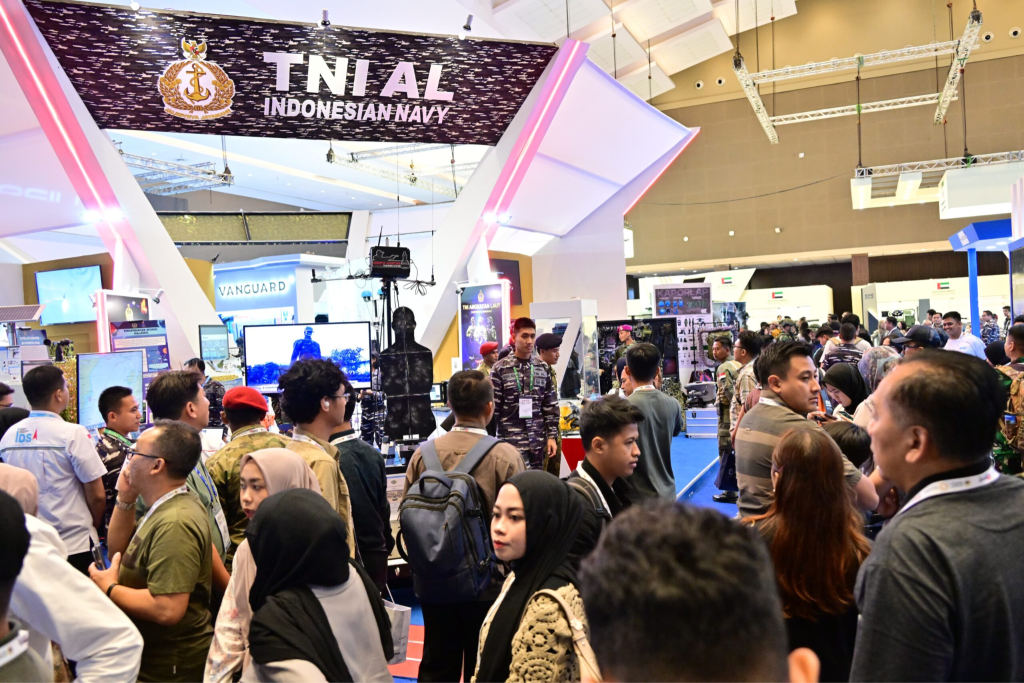
Indonesian Navy’s stand during the Indo Defence Expo 2025. (Indonesian Navy)
In sum, before approving the next major maritime platform, the Ministry of Defence and the Indonesian Navy should ask what mission it performs, where it will operate, what protects it, what data it requires and which other systems it must connect to. Those answers should shape basing, training, ammunition, communications, maintenance and exercise design.
Exercises should also test the force as a network rather than as individual platforms. A realistic scenario could combine KRI Sriwijaya-100 as a command node, frigates as escorts, shore-based sensors, uncrewed systems, maritime patrol aircraft and land-based strike assets. The purpose would not be to stage an impressive fleet review, but to discover where data links, command relationships, logistics or rules of engagement fail under pressure.
This approach would also help Indonesia avoid a familiar procurement trap: acquiring sophisticated hardware while underfunding the less visible systems that make it operational. A carrier without escorts and sustainment, drones without secure data links, or missiles without reliable targeting information may look formidable in an inventory while contributing little to deterrence.
Indonesia’s naval modernisation has reached the point where adding another platform is no longer the most difficult part. The harder task is deciding what kind of maritime force Indonesia wants to become.
A carrier, drones and an A2/AD network can coexist. They should perform different jobs inside the same operational logic. Indonesia does not need one more maritime capability as much as it needs a doctrine capable of making its growing capabilities work together.
About The Author