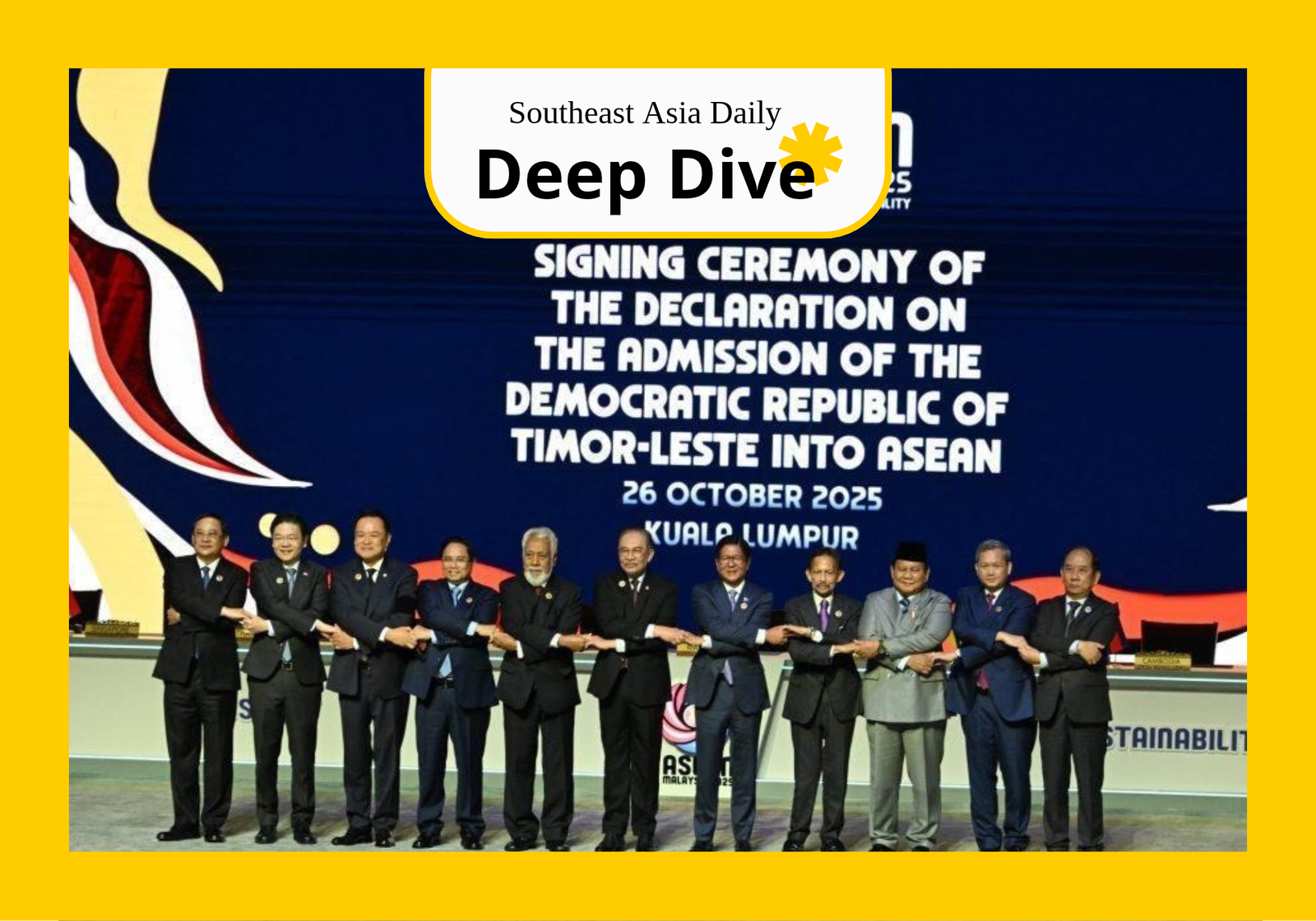
The Admission of the Democratic Republic of Timor-Leste into ASEAN’s Declaration in Kuala Lumpur, Malaysia. (ASEAN Secretariat
A Historic but Demanding Chapter
October 26 marks the first anniversary of Timor-Leste’s official integration into ASEAN. After years of struggle and delay following its membership application in 2011, Timor-Leste’s accession into ASEAN was greenlit by all member states in 2022. This culminated in the Signing of the Declaration on the Admission of Timor-Leste into ASEAN as the 11th member at the Opening Ceremony of 47th ASEAN Summit and Related Summit on 26 October 2025.
This historic event marked an important moment for the young nation, which had long sought closer political, economic and diplomatic integration with its Southeast Asian neighbours. For the regional bloc, the decision reaffirmed its commitment to regional inclusion and cooperation.
However, securing a place within ASEAN is only the beginning. As Timor-Leste celebrates its first year of membership ahead of the 49th ASEAN Summit that takes place in Manila from 10 to 12 November 2026, the more difficult task is turning diplomatic recognition into meaningful economic opportunities, stronger domestic institutions and a greater voice in regional affairs.
Has Anything Changed?
Economic Integration
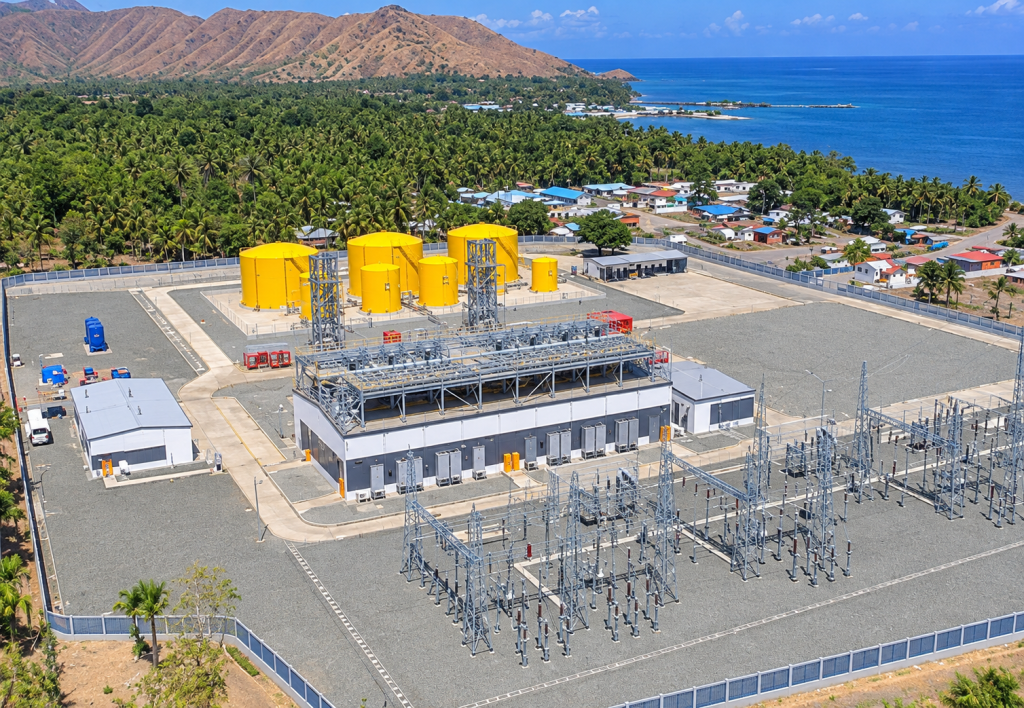
The Hera power plant in Dili, Timor-Leste. (Office of the Prime Minister of Timor-Leste)
Before joining ASEAN, Timor-Leste was already struggling to move beyond dependence on petroleum revenues and government spending to sustain its economy. Its Strategic Development Plan 2011–2030 thus seeks to build a more diversified economy driven by productive businesses, competitive exports and sustainable employment in sectors such as agriculture and tourism. The ultimate objective is to expand domestic production, create jobs and improve living standards while reducing dependence on oil production.
ASEAN membership was expected to support this transition by giving Dili greater access to regional markets, investment and technical assistance. Agreements such as The ASEAN Trade in Goods Agreement (ATIGA) establish rules on tariffs, rules of origin and customs procedures, and could potentially help eligible Timorese coffee, which accounts for 35% of its total export, access regional markets on preferential terms. Separately, the ASEAN Comprehensive Investment Agreement (ACIA) provides a framework for investment liberalisation, protection, facilitation and promotion, which could make the country more attractive to investors in non-oil sectors.
However, Timor-Leste’s accession to both agreements remained under discussion in October 2026, according to Vice Minister for ASEAN Affairs Milena Rangel. Furthermore, the aforementioned economic challenges remain substantial as Timor-Leste’s dependence on oil continues, with continued withdrawals from the Petroleum Fund raising concerns about Dili’s long-term fiscal sustainability. Its trade position also highlights the challenge of building a more productive domestic economy. According to the National Institute of Statistics of Timor-Leste (INETL), the country experienced a trade deficit of about 885 million US dollar in 2025 (against a nominal GDP of 2.06 billion US dollar in the same year) with oil and natural gas remaining the country’s top export commodity.
One year after accession, there is not yet convincing evidence that ASEAN membership has increased Timor-Leste’s exports, investment or employment. Indeed, the World Bank’s April 2026 economic report recorded Timor-Leste’s non-oil GDP grew by 4.5%, while INETL reported that coffee exports rose from around 17 million US dollar in 2024 to 35 million US dollar in 2025. These are some encouraging progress but it should not be seen as evidence of economic gains resulting from ASEAN membership as it has only been one year since the country was admitted into the organisation.
The clearest changes so far concern access to regional economic cooperation and the work of preparing to use it. By September 2026, Timor-Leste had acceded to 51 ASEAN economic agreements, although further accessions remain necessary, including to ATIGA and ACIA. Their benefits for agricultural exports and non-oil investment therefore remain prospective rather than realised.
Beyond these agreements, another crucial development can be seen through inclusion of Dili in the Initiative for ASEAN Integration (IAI) Work Plan V (2026–2030) where it can get support in areas including agriculture, education, skills development and microenterprise development. The country has also submitted project proposals on sustainable tourism, youth development, digital skills and coffee production. These initiatives could help strengthen local businesses and human capital, although their impact will depend on implementation and sustained support.
The main challenge now is turning these opportunities into tangible economic outcomes. Timor-Leste must complete the necessary agreement accessions, strengthen its institutions and help local producers meet regional standards and compete in wider markets. Without improvements in productive capacity, infrastructure, skills and access to finance, businesses may be unable to take advantage of the opportunities membership offers. As Associate Professor Dr. Khoo Ying Hooi of Universiti Malaya noted, the ultimate test of economic integration is whether it leads to stronger local businesses, more jobs and improved livelihoods, particularly for young people, women and rural communities.
Governance Reform
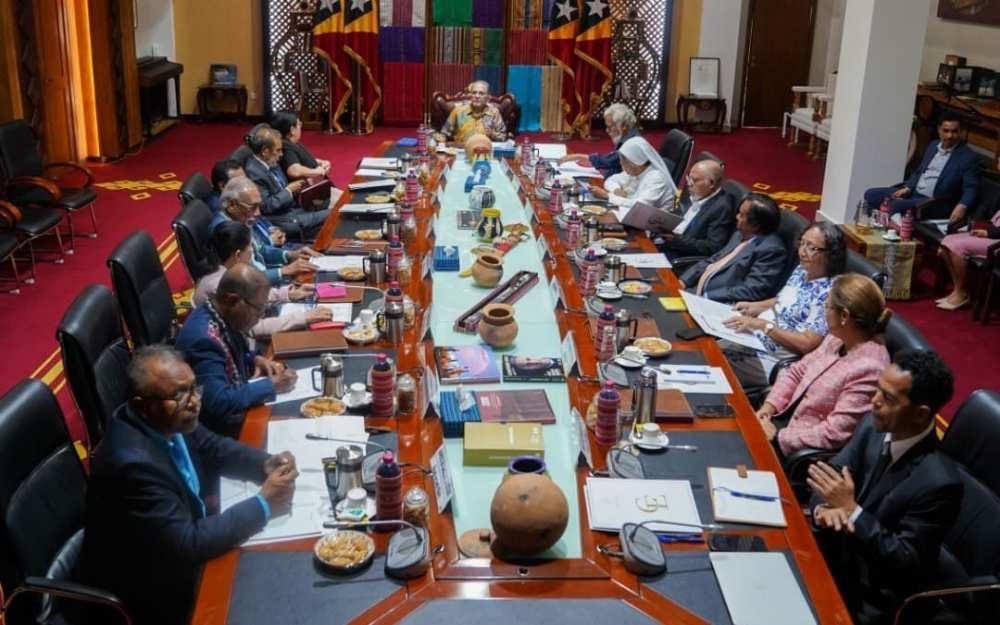
Timor-Leste’s President Convened an Exceptional Meeting With All the Nation’s Leaders to Discuss Economic matter (Governo de Timor-Leste)
On the other hand, ASEAN membership begins to reshape Timor-Leste’s domestic legal and administrative framework. Before accession, the country had already agreed on the majority of the 66 Priority 1 legal instruments mentioned in its membership roadmap. These instruments include ASEAN’s three pillars: political-security cooperation, economic integration, and socio-cultural development. Similarly, in June 2026, Timor-Leste’s Parliament approved resolutions concerning the ASEAN Agreement on the Movement of Natural Persons (MNP) which facilitates the movement of qualified professionals between member states. The agreement shows how regional commitments can require domestic institutions to administer professional mobility and related procedures.
However, accession to regional agreements did not automatically mean that the country had the domestic laws, administrative procedures and institutional capacity needed to implement them. Illustrative of this is the MNP agreement, where Dili’s resolution only approved a technical reformatting of Timor-Leste’s existing commitments and did not change their content or scope. Timor-Leste continued to face constraints in regulatory capacity, coordination between government agencies and the administration of trade and public services.
More substantial domestic reforms are still taking place, however, when in September 2026, Vice Minister Rangel said the government was preparing 60 legal instruments to implement its ASEAN commitments, with nearly 50 expected to be completed in 2026-2027. The measures cover areas including trade facilitation, competition, customs reform and customs agency operations, with some requiring approval by the Council of Ministers or Parliament before taking effect.
To coordinate further reforms, on October 21 the Council of Ministers approved the National Roadmap for the Implementation of ASEAN Economic Commitments 2026-2030. The framework is supported by 19 Sectoral Strategic Action Plans for 2026-2030 and 19 Sectoral Work Plans for 2026-2027, intended to establish a framework for assigning responsibilities across government institutions, coordinating sectoral reforms and monitoring progress. This represents a concrete change in how the government organises and oversees the implementation of its ASEAN commitments. Nevertheless, it is an implementation framework rather than evidence that the proposed legal and administrative reforms have already been completed.
Customs and border management illustrate the gap between existing capacity and the changes still required. For instance, ASEAN’s Trade Facilitation Framework promotes simpler customs procedures, transparent trade regulations and better coordination among border agencies. However, Dili is not yet party to this framework. Thus, although Timor-Leste launched its National Single Window in 2021 followed by its Trade Information Portal in 2024, the World Bank’s April 2026 assessment found that paperless trade remains limited, coordination between border agencies is weak and customs risk-management systems are not yet fully operational. The country also lacks sufficient testing and certification facilities for products such as coffee, fisheries and seaweed. These gaps could make it harder for local exporters to meet regional requirements and benefit from improved market access.
The challenge is now to translate these commitments into domestic laws, policies and administrative practices. This will not be easy given Timor-Leste’s limited institutional and human-resource capacity, with the Asian Development Bank identifying weak coordination between government agencies, unclear procedures and procurement inefficiencies as obstacles to effective implementation. These weaknesses could slow regulatory reforms and make it difficult to enforce ASEAN commitments consistently. Although the government approved a national roadmap in October 2026 to coordinate implementation, its success will depend on whether public institutions have the resources and capacity to carry it out. As Professor Khoo has emphasised, formal membership should not be confused with substantive integration. Timor-Leste must now demonstrate that it can turn its regional commitments into meaningful domestic progress.
Diplomatic Influence
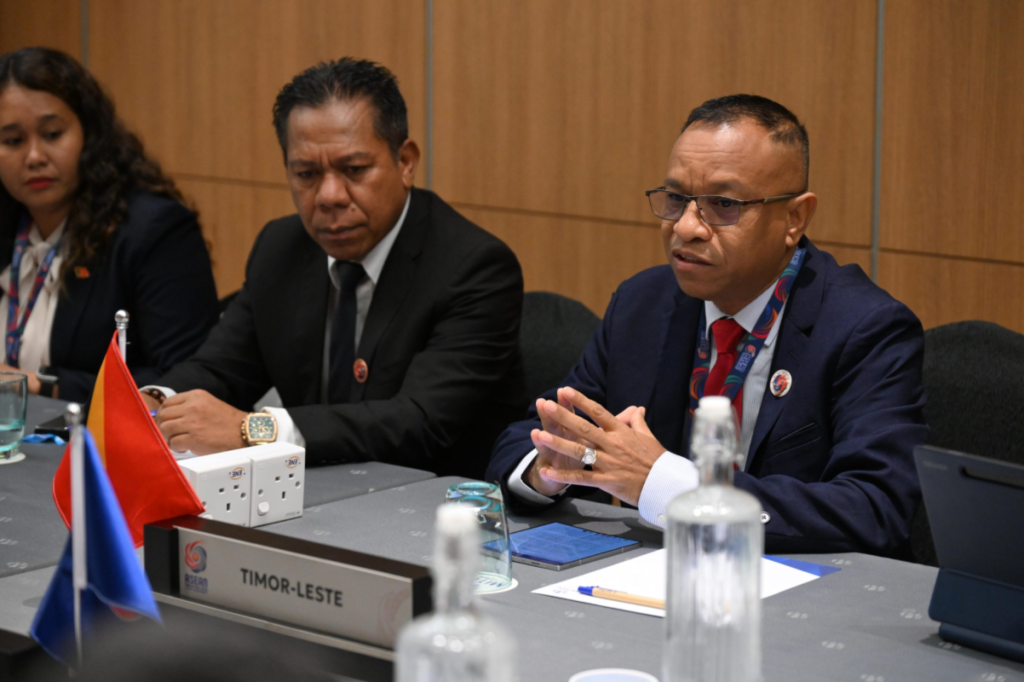
Minister of Foreign Affairs and Cooperation of the Democratic Republic of Timor-Leste, Bendito dos Santos Freitas, during a meeting with ASEAN Secretary-General, Kao Kim Hourn in 2025. (ASEAN Secretariat)
As a young nation coming out of its struggle for independence and democratic transition in recent years, Timor-Leste offers a unique perspective in ASEAN’s discussion on topics like human rights, democracy, Myanmar and the tension between the principle of non-interference and the need for collective regional responsibility. President José Ramos-Horta, a Nobel Peace Prize laureate in 1996, also gives the country an internationally recognised voice and influence.
Timor-Leste’s diplomatic potential is also shaped by its comparatively strong democratic credentials and longstanding relationships with Western partners, particularly Australia, the United States and the European Union. Freedom House’s 2026 assessment classifies the country as “Free”, with a score of 73 out of 100, placing it among Southeast Asia’s strongest performers in political rights and civil liberties. Some analysts have described it as the region’s only liberal democracy. These credentials could give Dili greater credibility when raising issues such as human rights, democratic governance and international law, while its external relationships could help connect ASEAN with development and diplomatic partners beyond the region.
This can be achieved for example through more active participation within the ASEAN Intergovernmental Commission on Human Rights (AICHR) and the ASEAN Institute for Peace and Reconciliation (ASEAN-IPR), which conducts research and promotes cooperation on conflict management and resolution. Its external partnerships could also support dialogue and cooperation between ASEAN and development partners, including through ASEAN’s relations with the European Union and other dialogue partners.
This has been particularly visible in Dili’s response to the Myanmar question. In February 2026, Timor-Leste appointed a prosecutor to examine allegations of crimes committed by Myanmar’s military leadership under the principle of universal jurisdiction which was responded by Myanmar in the expulsion of Timor-Leste’s chargé d’affaires and the accusation that Dili violates ASEAN’s non-interference principle. The dispute illustrates the tension between Timor-Leste’s emphasis on accountability and ASEAN’s preference for consensus and non-interference. It also shows that membership gives Timor-Leste a platform to express its positions, but not necessarily the power to persuade other members.
In its first year of membership, Timor-Leste has gained direct participation in ASEAN’s diplomatic processes. It has taken part in regional engagements including the ASEAN–Australia Forum and ASEAN–EU ministerial discussions, and appointed its first permanent representative to the ASEAN Secretariat. These developments give Dili greater access to regional consultations and the opportunity to contribute to discussions as a full member. Nevertheless, Timor-Leste’s growing participation has yet to translate into significant influence over ASEAN’s collective positions. Its actions on Myanmar have not produced a unified regional response, while the dispute with the military authorities exposed the limits of its ability to advance accountability within ASEAN’s consensus-based system. The country must also demonstrate that it can build support among member states with different political priorities.
A more sustained opportunity will come in 2029, when Timor-Leste is due to assume ASEAN’s rotating chairmanship. The role would give Dili responsibility for chairing key ASEAN meetings, helping coordinate regional priorities and representing the bloc in relations with external partners. It could use this platform to give greater attention to peacebuilding, reconciliation, human rights dialogue and cooperation with international partners.
Professor Khoo believes Timor-Leste’s regional standing will depend less on its size than on its ability to build diplomatic coalitions and translate its principles into practical initiatives. To achieve that, it requires the understanding of ASEAN’s internal dynamics, developing relationships with other member states and identifying areas of shared interest. Timor-Leste will need to demonstrate constructive diplomacy and the ability to build consensus.
From Membership to Meaningful Integration
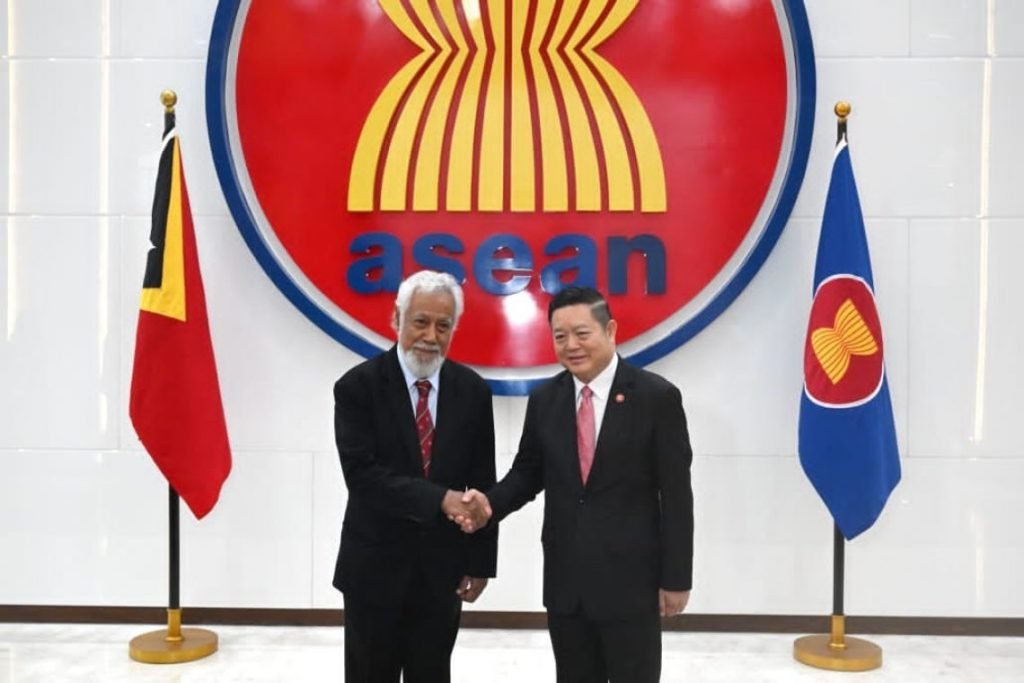
Secretary-General of ASEAN welcomes the Prime Minister of the Democratic Republic of Timor-Leste H.E. Kay Rala Xanana Gusmão to the ASEAN Headquarters (ASEAN Secretariat)
One year after accession, Timor-Leste has made important progress in establishing its place within ASEAN, from joining regional economic agreements and preparing domestic reforms to participating more actively in diplomatic processes. However, these developments have yet to translate into clear economic gains, fully implemented institutional reforms or significant influence over ASEAN’s collective positions. The challenge now is to turn the opportunities created by membership into practical outcomes through economic diversification, stronger public institutions and sustained engagement with other member states.
As Timor-Leste looks towards its 2029 ASEAN chairmanship, the coming years will test whether it can transform the promise of membership into tangible outcomes for its people and a constructive role in Southeast Asia. Having a seat at the table is an achievement, but making that seat matter is the greater challenge.
About The Author