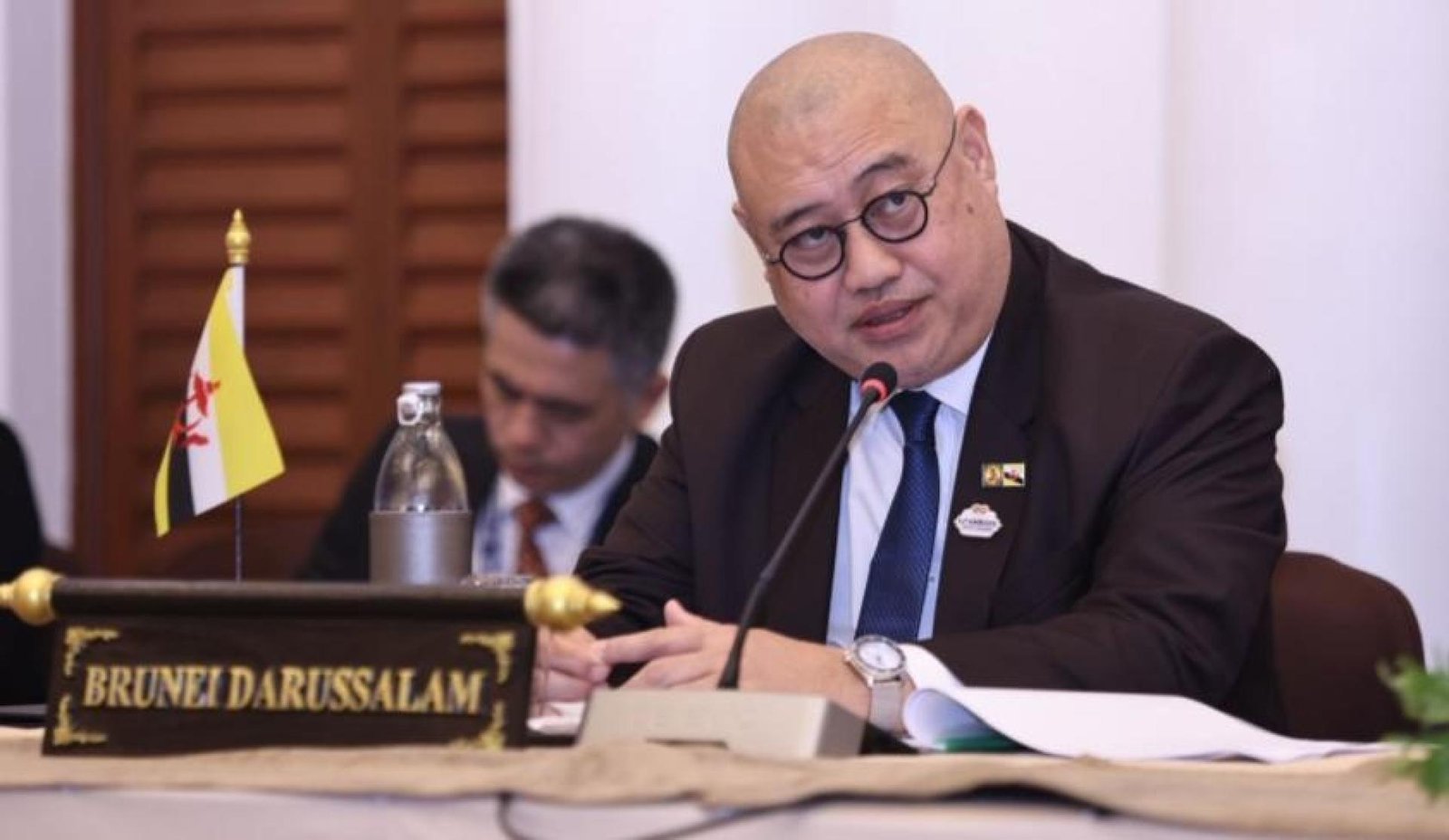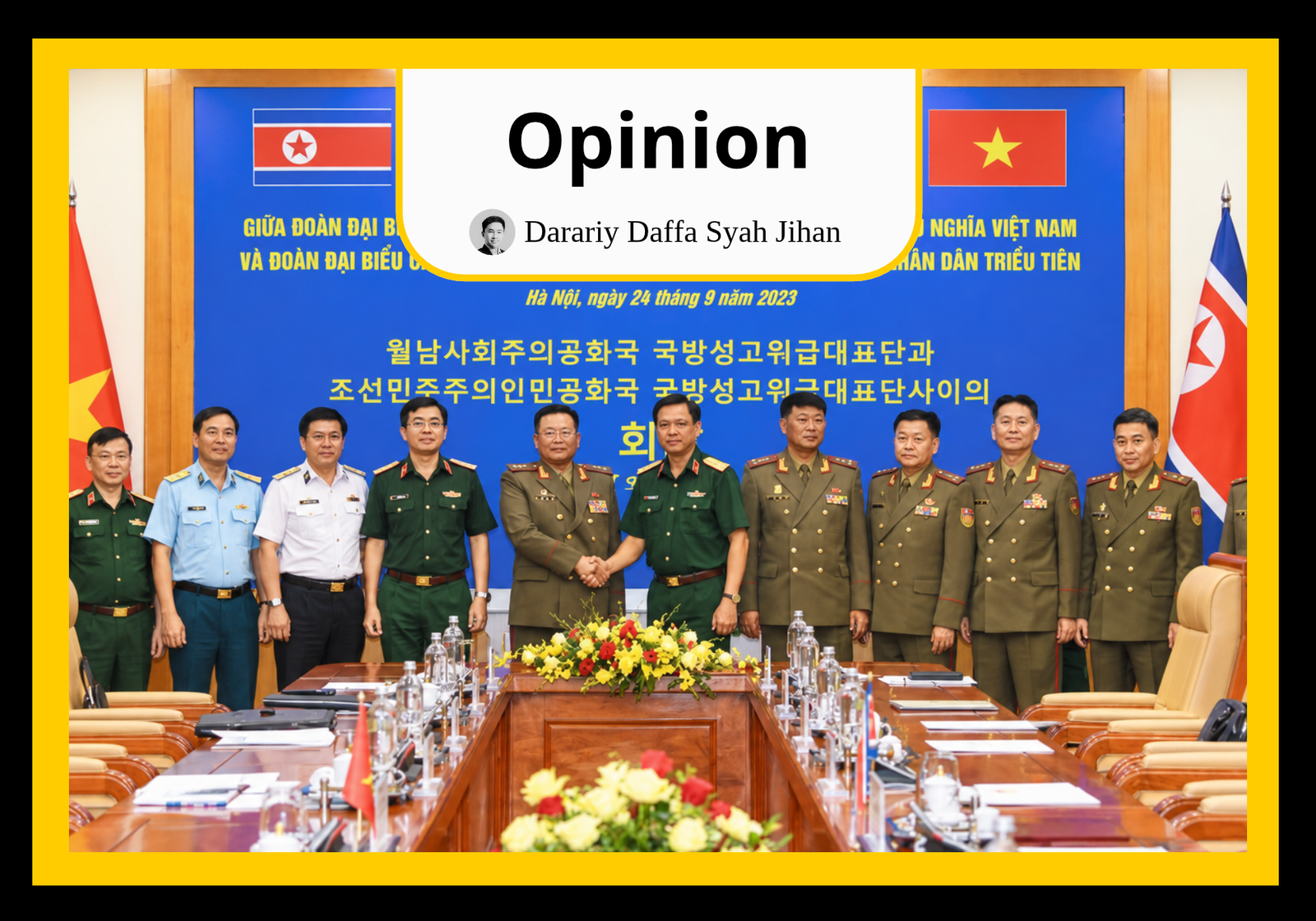
A meeting between the Vietnamese and North Korean delegations, led by General Nguyen Truong Thang and General Ryo Chol Ung. (Vietnam.VN)
Darariy Daffa Syah Jihan is an Undergraduate Student at Universitas Airlangga. The views expressed are the author’s own and do not represent SEA Daily or that of another organisation.
Intentionality in Preferences for Partnerships
In September 2026, the Deputy Ministers of Defence of Vietnam and North Korea, Nguyễn Quang Ngọc and Kim Song-gi, met in Hanoi to follow up on a letter of intent (LoI) that had been announced a year prior. From Hanoi’s perspective, this agreement was seen as positive, leading to exchanges of delegations, political party cooperation as well as exploration of educational and training know-hows. Defence Minister Phan Văn Giang subsequently received the North Korean delegation and encouraged the realisation of defence cooperation as a “pillar” of bilateral relations. A major question arose at the same time: why was Hanoi the target? As a country that is maintaining close partnerships with Seoul and Washington, why is it seeking to deepen military relations with a country subject to UN sanctions?
From an ideological perspective, Vietnam and North Korea are two of only five countries in the world still ruled by a communist party, with diplomatic ties that date from the start of the Cold War. Meanwhile, from the perspective of sanctions evasion, analysts have warned that any country drawing closer to Pyongyang risks being seen as complicit in helping North Korea circumvent sanctions. Both of these interpretations are subsequently viewed as a transition towards Pyongyang’s sphere of influence.
The September talks centred on delegations, party work and training, rather than arms transfers, joint military exercises or technology exchanges. On the other hand, discussions on economic exchanges focus solely on agriculture, sport and tourism, sectors not sanctioned by any international framework. Security-leaning issues, such as arms purchase, were not on the agenda. This is significant as a country shifting its geopolitical direction should, in theory, move to test the sensitive aspects of what is on offer in such cooperation. Hanoi, however, has opted for cooperation that is far removed from the potential for sanctions, hinting at a hedging tendency.
One Step Closer to Seoul, One Step Closer to Pyongyang
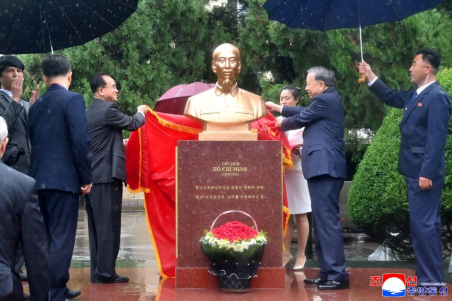
The inauguration of the statue of Vietnamese historical figure, Ho Chi Minh, at the Vietnamese Embassy in Pyongyang. (KCNA)
Hedging is not just buying different goods from different supplies. A state may favour to one partner on one issue and another at a different moment, without fully committing to either, so there is no single relationship foreclosed to other countries. This logic is related to Hanoi’s ‘bamboo diplomacy’ foreign policy, which emphasises Vietnam’s behaviour of planting strong roots with sturdy and ‘flexible branches’. The roots are the non-negotiable, independence and territorial integrity core. This is why Hanoi can embrace Seoul and Pyongyang within the same year, because the branches are free to bend towards whichever partner circumstances require.
This approach is consistent with Vietnam’s manoeuvring hitherto, as recently seen when Vietnamese President Tô Lâm became the first foreign leader to be warmly received by South Korean President Lee Jae Myung in August following the former’s inauguration. Shortly after, in October 2025, Tô Lâm travelled to Pyongyang, marking the first high-level visit by a Vietnamese leader since 2007. It is worth noting that Pyongyang extended the invitation despite Tô Lâm having only recently visited Seoul. Subsequently in 2026, President Lee visited Hanoi, during which Tô Lâm pledged to support peace and stability on the Korean Peninsula, whilst Seoul sought to revive inter-Korean dialogue. In these exchanges, both sides agreed to expand cooperation in the fields of diplomacy, defence and security.
Independently, each of these bilateral relationships carry its own distinct benefits. Seoul offers material value, with more than 10,000 South Korean companies operating in Vietnam, whilst Pyongyang provides diplomatic and symbolic worth. Analysts noted that Hanoi is seen to be positioning itself as a potential mediator between North Korea and the US. Furthermore, from the perspective of Vietnam’s foreign policy, the inter-party channel (between the Communist Party of Vietnam and the Workers’ Party of Korea) carries historical legitimacy. This is evident in: (1) Vietnam’s announcement in August 2026 of plans to build a memorial and restore the graves of North Korean soldiers who fell during the Vietnam War; as well as in (2) Kim Jong-un’s letter sent in September 2026, reaffirming North Korea’s commitment to deepening relations on Vietnam’s National Day. Relations with countries such as Vietnam help to portray North Korea not as an isolated nation in transition, but as a regular and ordinary participant in international affairs. Correspondingly, North Korea is arguably willing to compromise this limited form of cooperation as it aims to expand its diplomatic engagement beyond its traditional partner, China.
When “Hedging” Is Considered Partnership
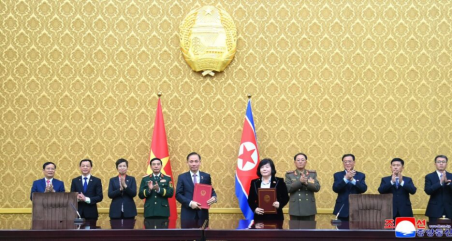
Signing ceremony for a defence cooperation agreement between North Korea and Vietnam. (NK NEWS)
In the broader picture, Vietnam’s ‘hedging’ forms a pattern, demonstrating that its international relations investment is not an exception to cooperation. In a historical context, for instance, Russia and Vietnam signed a technical-military agreement in 2021. It began with Russian President Putin’s visit to Hanoi the day after signing a joint defence pact with Kim Jong-Un. Furthermore January 2026 showcased the other side of the spectrum, when the Vietnamese Ministry of Defence signed a 250 million US dollar agreement with Israel’s Rafael to produce Spike anti-tank missiles locally. This comes after President Joe Biden’s visit to Hanoi, which elevated US–Vietnam relations to the level of a Comprehensive Strategic Partnership (CSP). It established the highest tier in Vietnam’s diplomatic hierarchy with cooperation, spanning the fields of semiconductors, energy and critical minerals. On the other hand, Vietnam’s partnership with Seoul has been at its highest level since 2022. This indicates that, to some extent, North Korea can be perceived as yet another partner country in Hanoi’s diplomatic engagement list. Threaded carelessly, however, it might irk Seoul in the long run and put at risk the over 95-billion-US dollar investment in Vietnam from South Korean.
The controversy of Hanoi’s hedging, however, stems from the view that the term is merely an euphemism for ‘affiliation’. Every diplomatic engagement, however symbolic, lends legitimacy to governments subject to UN sanctions. In the broader picture within Southeast Asia, Pyongyang has also forged ties with Indonesia and Singapore. Since ending its COVID-era border closure in 2023, it has re-engaged Southeast Asia in phases, and increasingly through states with no ideological affinity to it.
Given the diverse interests among ASEAN member states—and not to mention its consensus norm—forging a united front is highly complex.
Such considerations must be taken seriously.. There are at least three factors that determine the viability and limits of this strategy. Firstly, hedging is likely to prove unsuccessful if it attempts to replicate full diplomatic normalisation——which is typically characterised by high-stakes transfers relating to weapons, technology and logistics, as well as easily observable joint activities. Yet, the evidence so far suggests Hanoi is still hesitant to such overt alignment. Secondly, it is worth noting that engagement can exert constructive influence. For instance, when North Korea designated Seoul as its primary enemy, Vietnam emerged with its unique capacity to urge restraint and to mediate through dialogue between the two Koreas. Ultimately, hedging is not a permanent safe haven. Reliance on such a diplomatic approach should depend on conditions that must be monitored.
Three Steps Forward
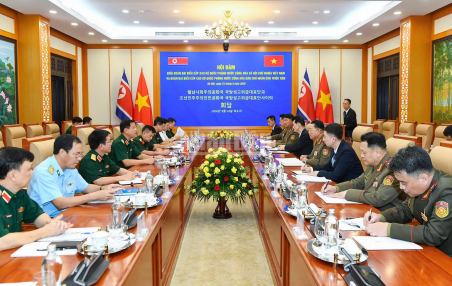
The process of discussing the Memorandum of Understanding between the Ministries of Defence of the two countries, signed in 2025 (Vietnam.VN)
The most significant scenario centres on the potential long-lasting cooperation between Vietnam and North Korea, which remains largely symbolic due to UN sanctions, North Korea’s entrenched dependence on China and Russia, as well as the ongoing escalation of US-China rivalry. Viewed from a transitional perspective, any shift from training and party politics to technical or logistical exchanges would trigger sanctions monitoring, a backlash from Seoul and its partners, as well as a significant impact toward Vietnam’s reputation. On the other hand, a breakthrough agreement reached between the US and North Korea in the future could lead to the lifting of sanctions, and Vietnam would be one of the countries to benefit most—enabling it to capitalise on its long-standing ties to serve as a gateway.
To ensure this stability, Hanoi needs to state openly what is and is not covered by the 2025 LoI, with the aim of keeping its activities outside the scope of sanctions and safeguarding its relationship with Seoul. Simultaneously, ASEAN needs to learn that the principle of non-interference is used to regulate how its member states treat one another, not as a justification for determining where the bloc stands on important matters. ASEAN should reaffirm its position on denuclearisation at the ASEAN Regional Forum, whilst viewing its member states’ bilateral engagement as a form of liaison rather than a breach of protocol. Furthermore, ASEAN needs to agree on common indicators to detect shifts in policy, and request those member states engaged with Pyongyang to provide explanations to their partners.
About The Author