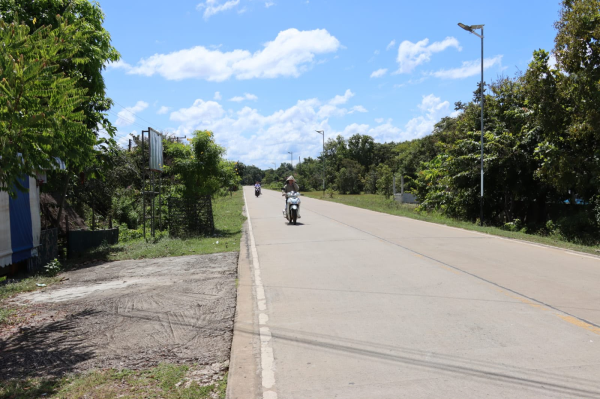
“Road access and facilities have been improved in Champasak, southern Laos through an initiative which runs from 2019 to 2026 (Lao News Agency)
On October 31, tourism infrastructure across several destinations in southern Laos has undergone extensive improvements under a regional development project, with upgrades spanning roads, bridges, passenger facilities and visitor attractions in the Champasak province.
In Ban Nakasang, construction included a 2.9-kilometre reinforced-concrete road and a 60-metre access route to the parking area. Facilities at the passenger and tourist port also received upgrades, including a riverside walkway, safety railings, steps to the boat dock and solar-powered lighting. The ticket office, waiting area and parking facilities were renovated, while a former wooden-surfaced steel bridge was replaced with a concrete structure.
Further improvements extended to Don Det, where three concrete roads covering approximately 5.9 kilometres were constructed. Parking facilities at Hua Don Det and the former port were also improved, alongside the development of a new viewpoint. Meanwhile, Don Khone received five new roads spanning 12.3 kilometres, three bridges along the IRL-05 route and improvements to the old locomotive exhibition site and parking area in Ban Hang Khone.
The works fall under the second phase of a 48.8 million US dollar project, financed through a 47 million US dollar grant from the Asian Development Bank (ADB) and 1.8 million US dollar contribution from the Laos’ government, according to ADB Country Director for Laos Shanny Campbell.
Signed in October 2018, the wider initiative runs from 2019 to 2026 across Luang Prabang, Vientiane and Champasak. Beyond improving visitor facilities, better transport links and public infrastructure are expected to make tourist destinations more accessible to local communities, small businesses and travellers with different needs. By strengthening connections between attractions and supporting local economic participation, the project seeks to distribute tourism benefits more widely rather than concentrating them in established visitor hubs.
About The Author