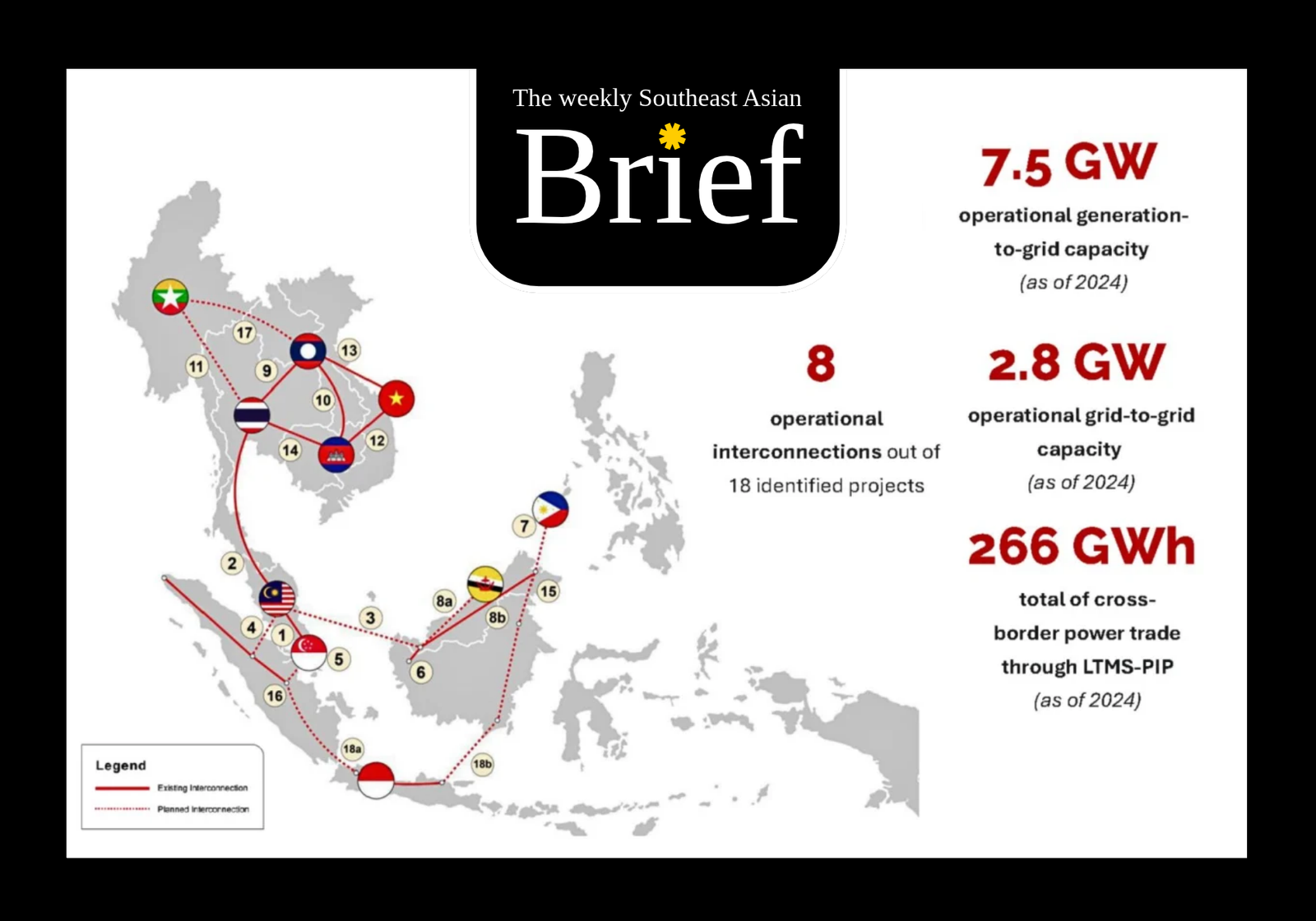
Overview of the ASEAN Power Grid capacity (Suruhanjaya Tenaga)
On October 8, ASEAN energy ministers endorsed the 9th ASEAN Energy Outlook (AEO9) at their annual meeting in Manila. The ASEAN Centre for Energy report identifies stronger regional connectivity as a pathway towards a more secure energy future, but it leaves open the question of who pays for that connectivity and who benefits from it. Through the ASEAN Power Grid (APG) programme, member states aim to strengthen electricity interconnections and facilitate cross border power trading. Connecting power systems is not simply an engineering challenge. It also requires governments to reconcile competing national interests, unequal financial capacities and different regulatory frameworks. While regional energy integration could allow ASEAN to make better use of its collective resources, its success will depend on whether cooperation can overcome the very inequalities that make integration necessary.
Energy security doesn’t necessarily mean energy self-sufficiency. By connecting national power grids, ASEAN countries could reduce their reliance on domestic energy production and gain access to electricity generated elsewhere in the region. This is particularly valuable because renewable energy resources and electricity demand are unevenly distributed across member states. Countries with surplus renewable electricity could potentially supply neighbouring markets, allowing the region to use its resources more efficiently. Cross-border electricity trade could also diversify supply options, improve system reliability and reduce vulnerability to disruptions in individual countries. As demand grows, sharing electricity could therefore offer a more flexible alternative to each country independently expanding its energy infrastructure. Regional integration would transform energy security from an exclusively national concern into a shared regional responsibility.
However, a connected grid does not automatically create an equal playing field. Building and maintaining cross-border infrastructure requires substantial investment in transmission networks, submarine cables and domestic electricity systems. Countries with greater financial resources and more advanced infrastructure may be better positioned to attract investors and benefit from electricity trading. Meanwhile, countries with limited capital may struggle to connect their domestic networks to regional systems, even when they possess valuable renewable energy resources. If these disparities remain unaddressed, integration could reinforce existing economic inequalities rather than reduce them. Questions about who pays for infrastructure, how electricity prices are determined and how financial risks are distributed could further complicate cooperation. Consequently, the success of the APG should not be measured solely by the number of connections established, but also by whether those connections create meaningful benefits for countries with different levels of development.
Beyond financial disparities, electricity may cross borders more easily than political differences can be resolved. Effective regional energy integration requires compatible technical standards, transparent trading arrangements and coordinated infrastructure planning. However, ASEAN member states retain different regulatory systems and national energy priorities. Governments may also hesitate to depend on neighbouring countries for essential electricity supplies, particularly when energy security is closely linked to economic stability and national sovereignty. Such concerns create a tension between regional interdependence and national control. Even when governments recognise the economic advantages of cooperation, differences in policy implementation and political commitment can delay projects or restrict cross-border electricity flows. Physical connectivity, therefore, must be accompanied by institutional cooperation. Without consistent rules and mutual trust, the APG risks becoming an ambitious infrastructure project that cannot deliver its full potential.
Addressing these challenges requires ASEAN to pursue integration that is both coordinated and inclusive. First, member states should strengthen regional agreements on electricity trading, technical standards and infrastructure planning to create greater certainty for governments and investors. Second, regional financing mechanisms and partnerships with development institutions could help countries with limited financial capacity participate in cross-border projects. Third, investment must extend beyond regional connections to improve domestic electricity networks. After all, electricity delivered across a border cannot benefit communities if inadequate infrastructure prevents it from reaching consumers. These measures would help ensure that regional integration complements national energy development rather than disproportionately benefiting countries that are already better equipped. Cooperation must also preserve flexibility for member states to pursue different energy pathways while working towards shared regional objectives.
Ultimately, the ASEAN Power Grid represents more than an effort to connect electricity networks. It is a test of whether regional cooperation can translate shared resources into collective resilience. Interconnected systems could improve electricity distribution, diversify energy supplies and support the region’s transition towards cleaner energy. Nevertheless, unequal investment capacity, regulatory fragmentation and competing national interests could undermine these benefits if they are not addressed. ASEAN must therefore treat equitable financing, domestic infrastructure development and institutional coordination as essential components of energy integration, not secondary considerations. The real test of a borderless grid is not how many countries it connects, but whether those connections make the entire region more secure.
About The Author