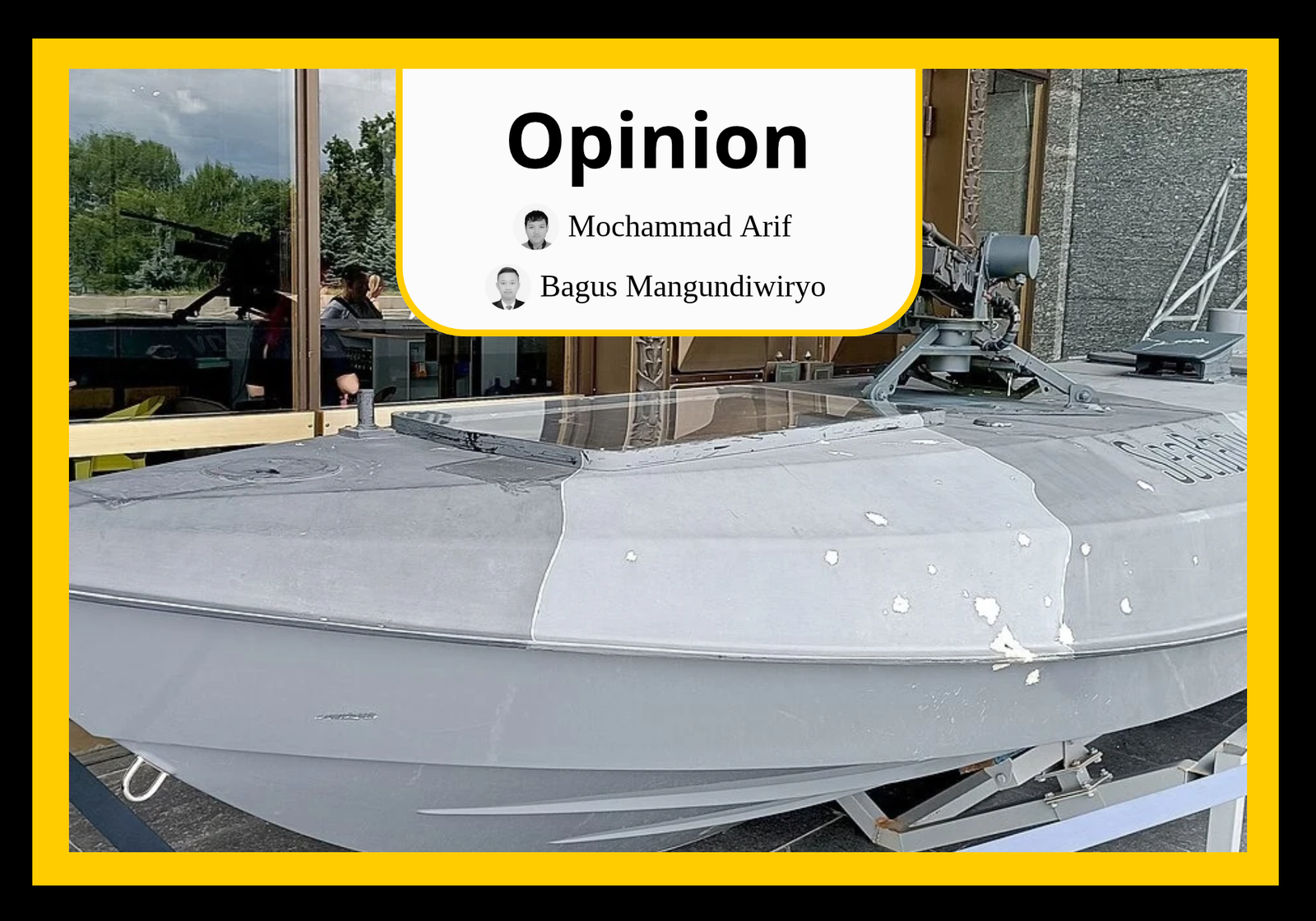
A Ukrainian “Sea Baby” maritime drone. (Wikimedia/Zenwort)
Bagus Mangundiwiryo, S.I.P., M.Han, is an independent maritime security analyst and an alumnus of Universitas Pertahanan RI.
Mochammad Arif is Secretary and Research Fellow at the Center for National Defense and Strategic Studies.
The views expressed are the authors’ own and do not represent SEA Daily or any other organisation.
How Ukraine Shifted the Maritime Balance
Russia’s war in Ukraine has undermined a long-held assumption of naval warfare: that the bigger fleet wins. Ukraine has no navy capable of matching Russia’s Black Sea Fleet. Yet, with home-built missiles, uncrewed surface vessels (USVs) and off-the-shelf commercial technology, it has inflicted heavy costs on a far stronger adversary.
Indonesia, an archipelagic state of more than 17,000 islands astride some of the world’s busiest chokepoints, has a good reason to pay attention. The point is to understand how affordable technology, integrated into a broader defence system, can complicate an adversary’s operations and strengthen deterrence at sea.
The Russian invasion showed that even sophisticated warships are vulnerable. A notable example occurred early in the conflict; in April 2022, Ukrainian Neptune anti-ship missiles struck the Russian cruiser Moskva, which later sank. It was not a drone attack, but it demonstrated the danger large warships face when operating within range of a capable coastal strike system.
Kyiv then widened its campaign to include USVs, such as the Magura V5 and the Sea Baby. Used against Russian naval assets and maritime infrastructure, they have been credited with damaging or destroying several vessels, including a Ropucha-class landing ship. Combined with Neptune missiles and low-orbit satellite communications, they pushed Russia to relocate much of its fleet from Sevastopol to Novorossiysk, farther from Ukrainian reach.
The value of these uncrewed systems lies less in their low price than in the dilemma they pose. A navy facing many small, mobile targets must commit surveillance, weapons and personnel on a scale that no single threat would demand. Cost asymmetry compounds the problem: defending against cheap drones with expensive air-defence missiles drains both magazines and budgets.
This is asymmetric warfare at sea. Rather than match Russia ship for ship, Ukraine has sought to make the Black Sea steadily more dangerous and costly for the Russian fleet. Missiles, drones, intelligence networks and access to commercial satellite communications have offset much of its conventional weakness.
Tactical improvisation alone does not account for these results, however. Uncrewed vessels rely on good intelligence, navigation, communications, target identification and coordination with other assets. Electronic warfare can disrupt them, defenders can intercept them before they reach their targets and, ultimately, they lose their edge once an opponent adapts. Ukraine’s experience is better understood as a change in how maritime power is applied than as a story of cheap drones replacing warships.
What It Means for Indonesia
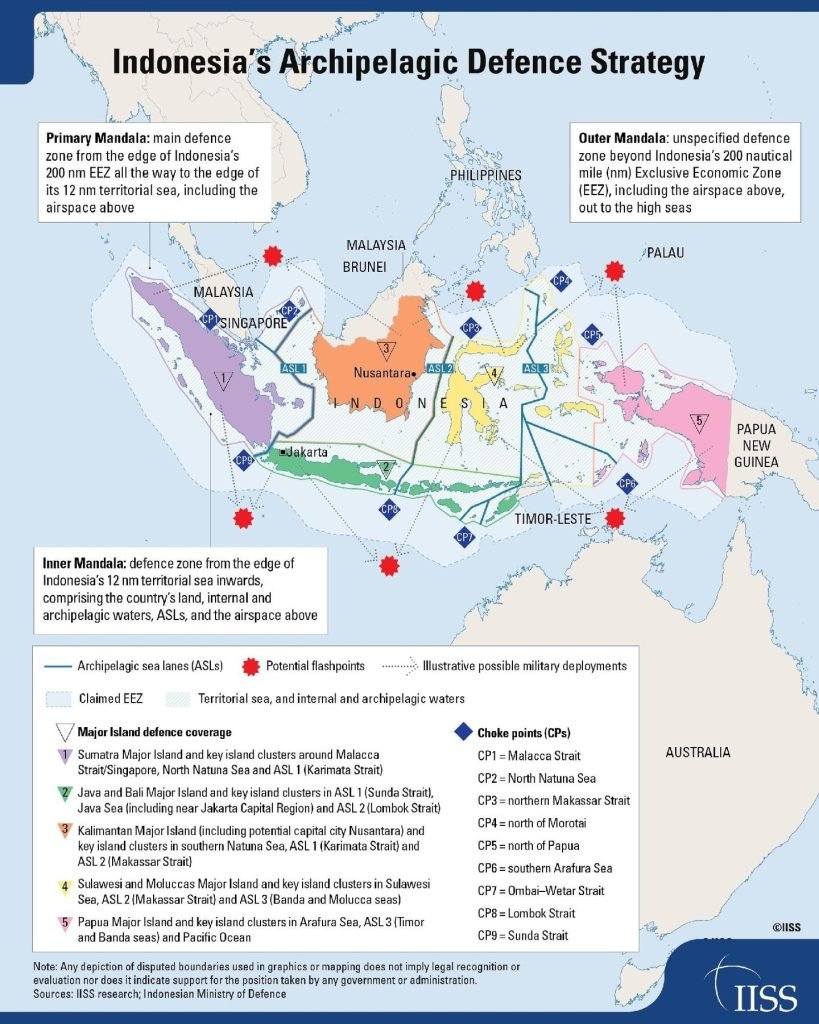
Map illustrating Indonesia’s archipelagic sea lanes (ALKI) and defence coverage (IISS)
Indonesia’s strategic environment is different. Its maritime security concerns span the Natuna Sea, the Malacca Strait and the Indonesian archipelagic sea lanes (ALKI), which link the Indian and Pacific oceans. ALKI I runs through the Sunda Strait and the South China Sea approaches (left-most line in the image above), whilst ALKI II through the Lombok and Makassar straits (centre line in the image above), and ALKI III through the eastern waters towards the Pacific (right-most line in the image above). These lanes carry commercial shipping, energy supplies and other economic activity on which Indonesia and its regional partners depend.
Jakarta is already modernising its fleet, including through the acquisition of modern frigates, and is working to move the navy from a largely coastal force towards one projected to operate farther from home waters. Major surface combatants remain indispensable, however. They signal the state’s presence on the high seas, support maritime diplomacy and serve as command hubs for long-range force projection. Submarines and frigates also provide capabilities that small uncrewed systems cannot easily replace, including sustained patrols and anti-submarine warfare.
But large ships carry their own risks. Without layered protection, a frigate is a tempting target for swarms of uncrewed surface vessels, kamikaze aerial drones and coastal cruise missiles. This is no longer a theoretical concern as it reflects how recent naval conflicts have unfolded.
One answer to this vulnerability is manned-unmanned teaming (MUM-T). In this model, a crewed warship acts as the command node for a group of USVs and uncrewed underwater vehicles (UUVs) operating around it. The drones extend the ship’s sensor reach, screen it against approaching threats and take on riskier or more repetitive tasks. Done well, MUM-T allows a small number of expensive platforms to cover far more water than they could alone.
Uncrewed systems could also help fill wider gaps. USVs could support patrols, monitor suspicious activity and extend surveillance, while UUVs could assist with seabed mapping, infrastructure inspection and certain maritime security tasks. Combined with coastal radar, satellite imagery, patrol aircraft and existing naval command networks, they could give Indonesian authorities a more comprehensive picture of activity at sea.
All in all, planners should define the operational problem before choosing the equipment. Monitoring a busy shipping lane, detecting illegal activity near an outer island and responding to a hostile naval force are distinct missions. Each calls for different sensors, endurance, communications and rules for the use of force.
A2/AD Demands More Than Just Missiles
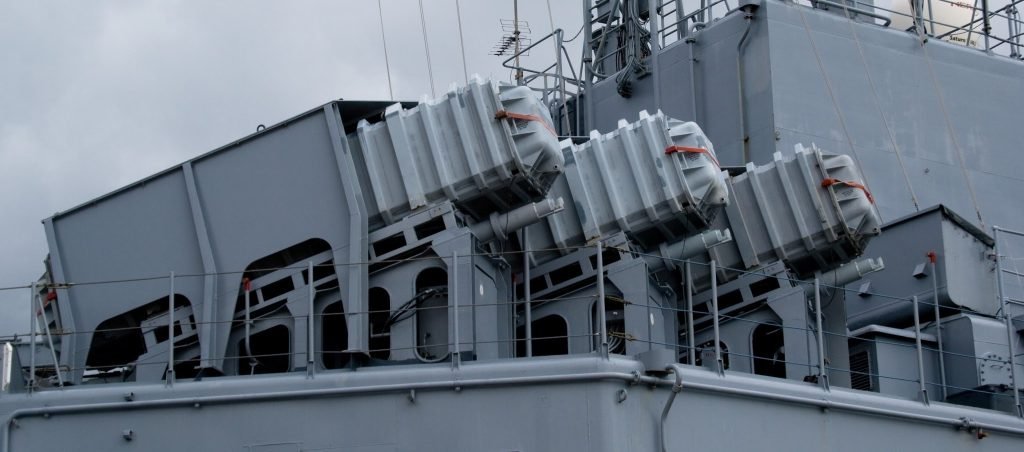
An Exocet missile launcher mounted on a warship. (Wikimedia/Ludovic Péron)
A credible coastal defence cannot rest on anti-ship missiles alone. It must be able to detect, identify and track potential threats, share information across agencies and respond before an adversary achieves its objective. In other words, a credible A2/AD (Anti-Access/Anti Denial) requires a full ecosystem.
Around the Malacca, Sunda, Lombok and Makassar straits, mobile coastal missile batteries, passive radar sensors and drone bases on outer islands could create a deterrent without spreading an expensive surface fleet too thinly. Uncrewed systems should be one component of that network, not a cheap substitute for conventional platforms. Without secure communications, dependable maintenance and a clear command structure, a fleet of drones may add little to Indonesia’s real capacity to deter. Partnerships with commercial satellite providers could improve intelligence-sharing, but they raise questions about data security and dependence on foreign infrastructure.
The Legal Gap
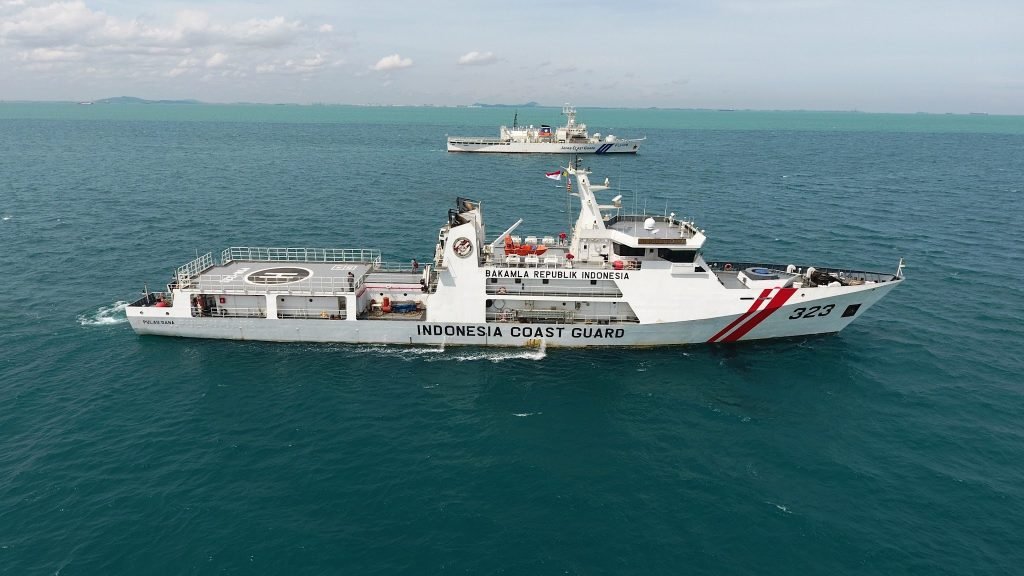
An Indonesian Coast Guard (Bakamla) patrol vessel at sea. (Source: Wikimedia)
Indonesia must distinguish between strengthening surveillance and imposing restrictions that conflict with the United Nations Convention on the Law of the Sea (UNCLOS). As an archipelagic state, it holds important rights over its maritime zones, but it must also guarantee safe navigation and archipelagic sea lanes passage as reflected in existing regulations (Law No. 32 of 2014 on Maritime Affairs and Law No. 34 of 2004 on the Indonesian Armed Forces). Neither framework anticipated autonomous systems. The legal status of uncrewed vessels carrying out law enforcement at sea, and the use of artificial intelligence (AI) in selecting lethal targets, remain undefined while overlapping agency mandates add to the uncertainty. Until Jakarta issues clear implementing regulations and operating doctrine, including for the navy and air force, legal ambiguity will slow adoption. Questions of accountability, identification and the use of force need answers before a crisis arrives.
Building the Capacity to Adapt
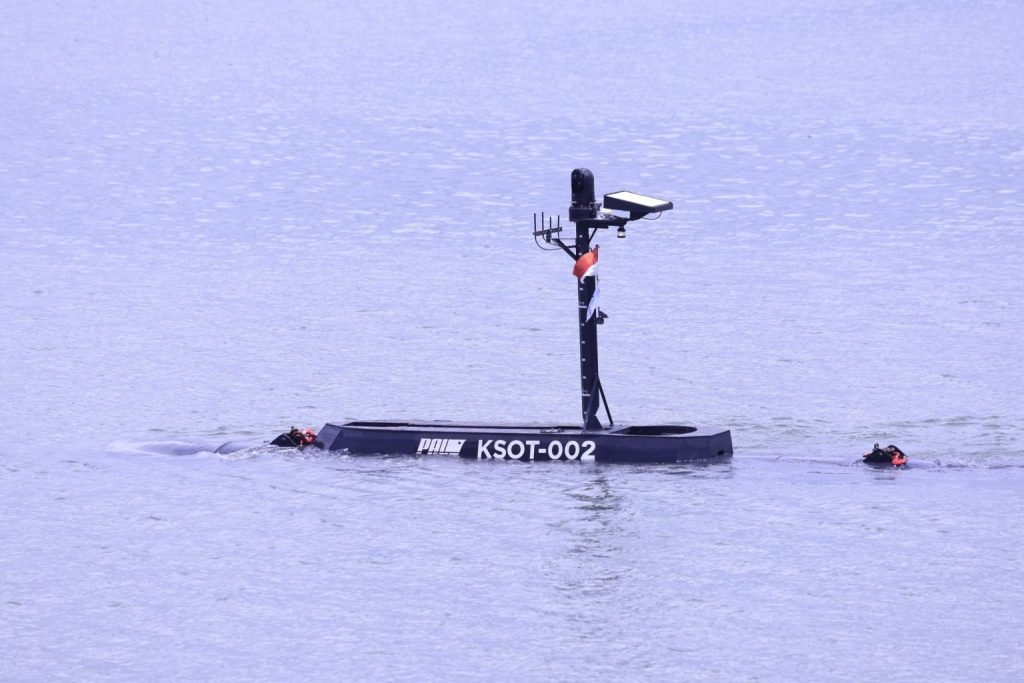
The locally designed autonomous submarine (KSOT) produced by PT PAL Indonesia. (Ministry of Defence of Indonesia)
Buying equipment is only part of the job. Indonesia must concurrently invest in domestic research, software integration, maintenance and counter-drone capabilities. PT PAL (the state-owned maritime manufacturing), universities, research institutions and private technology firms should be engaged to help develop and produce USVs and UUVs at scale, to ultimately reduce dependence on foreign supply chains.
Costs also extend beyond the purchase price. A cheap drone becomes an expensive capability if its parts are hard to replace, its software cannot be updated locally or its communications are easily jammed. Efficiency should be measured not only by low cost but also by how well a system endures and protects national interests, especially as countermeasures against drones improve. Budgets should therefore cover the whole life cycle, including training, repair and secure data links.
Ukraine’s experience will not hand Indonesia a ready-made doctrine. The Black Sea is not the Indonesian archipelago. Still, the war has made one thing hard to ignore: maritime advantage increasingly depends on how well a state combines platforms, information and the ability to adapt.
Indonesia’s task, therefore, is to build a force that can sustain its presence, spot threats early and impose costs on those who challenge its interests. Pairing a modern blue-water fleet with locally built uncrewed systems does potentially serve that goal and strengthen Indonesia’s claim to be a global maritime fulcrum. What matters is not how many drones Indonesia acquires, but whether it can make them a dependable part of its maritime defence.
About The Author