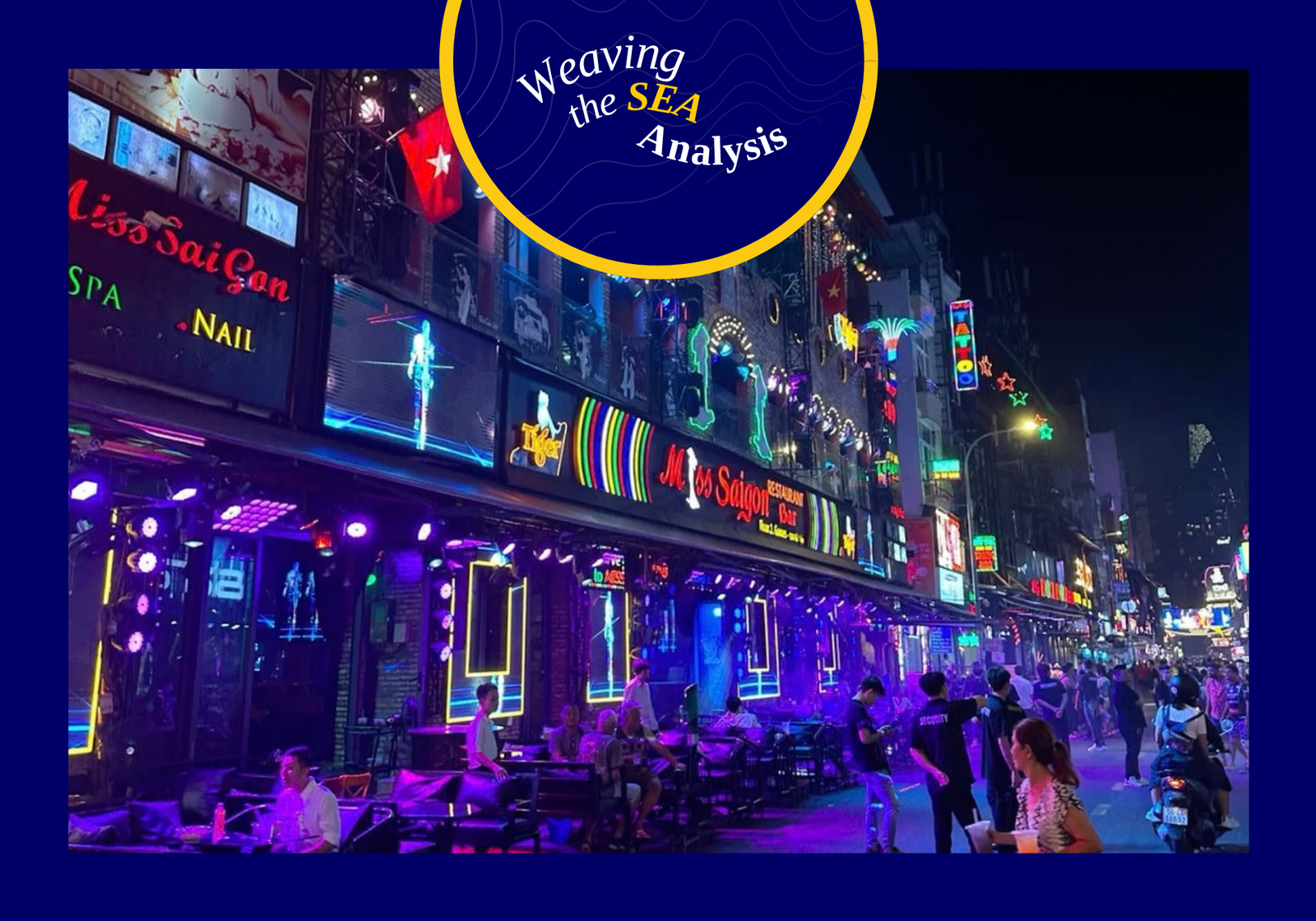
Bùi Viện Street, Ho Chi Minh City, a hub for nightlife and tourism in southern Vietnam which features Vinahouse frequently in the background. (Hà Khánh Lê)
This is a top 3 entry in the Weaving the SEA Essay Competition 2026, written by Hà Khánh Lê. Her essay follows Vinahouse from a food stall speaker to a Bùi Viện Street bottleneck, asking who gets to decide what a shared space should sound like.
At around 8 a.m., I sat down for breakfast at Mì Mực Phú Quý. The morning was quiet enough that I could hear the sea between the houses. Aside from two men finishing their iced milk coffee, the yard was mostly empty. Near the door, resting on a plastic stool, a black portable speaker was playing an electronic remix of 999 Đóa Hồng. Each time the seller lifted her ladle, steam rose from the pot of squid broth, drifting past the speaker. Bowls clinked against stainless steel tables, change was handed back, a passing motorbike slowed down to check if the stall was open. When a new customer pulled up a chair, the seller called out an order without lowering the volume. No one seemed to pay particular attention to it. No one asked for it to be turned down either. I sat there for thirty minutes. The bass kept thumping against the concrete floor. It was just there.
I had run into that sound many times before, always in places where nobody had come specifically to listen: roadside stalls, residential alleys or gatherings of friends. It slips into spaces shared by people who may not have chosen to hear it. When a sound becomes part of everyday life like this, a question follows: who gets to decide what a place should sound like?
Music in the Background
Vinahouse playing in the background while my mother records my dog. (Hà Khánh Lê)
In my house, music usually starts around 10 a.m. My mother turns on the speaker beside the television and leaves it playing while she moves around the house doing chores. Once, I asked her why she played it so loudly. Her answer was simple: “Ở nhà mình buồn quá, mở cho đỡ buồn,” staying home alone is too boring, so I turned it on to feel less lonely.
For my friend Hoàng Bách, silence creates the opposite problem. When I asked him how he could study with music playing, he told me, “Tính ra mở nhạc mới học được đó.” Music, it turns out, helps him to study.
Inside our home, the speaker has become part of the backdrop against which routine takes shape: housework, studying, eating and even resting. The music does not announce itself as an event. It is simply there. Until someone asks it to stop.
Our neighbour is a man in his sixties who lives right next door. He does not like music. When he comes over to complain, he asks my mother why she plays it so loudly and whether she thinks about the other people in the neighbourhood: “Cô mở nhạc to như thế, gây ồn ào xóm làng, không nghĩ cho người khác à?” Yet the disagreement does not belong neatly to one side, other neighbours sometimes defend my mother, telling him that they do not mind the music and that he is the only one who finds it bothersome.
The same speaker, in the same neighbourhood, means different things to different people. For my mother, it keeps an otherwise quiet house from feeling empty. For Bách, it makes studying less oppressive. For the man next door, it crosses a line. The speaker is inside our house. But the sound does not stay there.
A Genre on Trial
A Vinahouse DJ session by DJ TILO in Vietnam, illustrating how the genre sounds. (Youtube/DJ TILO)
The disagreement over Vinahouse is not limited to neighbours sharing a wall. It also plays out in Vietnam’s own music press. In a Znews feature House remixes, Vinahouse and Vina Deep House were described to have dominated remix culture on TikTok and reported growing criticism that producers were leaning on the same formula so often that the genre’s identity had begun to blur.
The same article carried a counterpoint from producer Hoaprox, who argued that House, like any other genre, has its own character, its own audience and its own value and that a producer willing to put in the work can still make something of quality within it, meaning the real issue was how a track was made, not the genre itself. Vinahouse, in other words, is not only heard; it is also judged. But whatever critics make of the genre, people keep encountering it in ordinary places, which is exactly where I ran into it next.
A walk through Bùi Viện Street in Ho Chi Minh City in 2024. (Youtube/Travel Here)
I often go through Bùi Viện Street—Vietnam’s most famous nightlife and backpacker strip in Ho Chi Minh City’s District 1—after class, even though the detour adds about ten minutes to the journey. Bùi Viện is not quiet and that is precisely why I seek it out.
Just past 8:30 p.m., I turned in from the Đề Thám intersection. Within twenty steps, the bass from two open-front venues opposite each other met in the middle of the street, vibrating beneath my shoes. The music, tables and pedestrians narrowed the space into an awkward bottleneck. Ahead of me, three backpackers stopped short, shielding their ears as they looked for a way through rows of plastic stools on the pavement. Threading right past them came a vendor wheeling a cart of fruit. She steered through the crowd without stopping or looking toward the speakers. I stepped into the gap behind her cart and kept walking.
That brief stretch showed me how differently the same soundscape can be experienced. A Tuổi Trẻ report, based on observations on the night of 10 April 2022, found music still playing loudly on Bùi Viện after 11 p.m, with venues facing each other blasting music at the same time. The report noted passers-by covering their ears and people walking together struggling to hear one another. A nightlife street brings people with very different reasons for being there into the same narrow space: those drinking and socialising share the pavement with people working, commuting or living upstairs.
Vietnam’s current noise standard, QCVN 26:2025/BNNMT, sets different limits depending on location and time of day, with stricter limits at night. Yet a regulatory standard cannot settle the question of what a street should sound like. It only makes one fact clear: sound in a shared space is never entirely private.
A Regional Phenomenon
A funkot (funky kota or city funk) DJ set by DJ Almira Berto in Indonesia, a cultural equivalent of Vinahouse in Indonesia. (Youtube/DJ ALMIRA BERTO REAL)
Vietnam is not the only place where popular music travels beyond the people who chose it. In Indonesia, a similar tension appears in the story of funkot, a fast electronic style whose name comes from funky kota, or city funk. In a 2021 Jakarta Post feature, writer Almer Mikhail recalled taking a night bus whose driver blasted pop songs remixed in the funkot style. The music interrupted his sleep at first, though his reaction shifted as the journey went on. The driver had chosen the soundtrack of the journey, but the passenger had not. Funkot itself has also crossed social boundaries, the Jakarta Post article describes it as a style once associated with lower-income groups before later reaching a wider audience. Music does not stay with the person who presses play. It enters buses, alleys and pavements where other people have to experience it as well.
A Rot hae (รถแห่) performance in Thailand, cultural equivalent of Vinahouse in Thailand. (Youtube/สยามไลท์โชว์ – Siam live show)
In northeastern Thailand, the movement of music becomes literal. Rot hae (รถแห่), live-music trucks, mount performers and sound systems onto converted vehicles and drive them directly into the roads of Isan communities, rather than waiting for an audience inside a hall.
A 2024 journal article by Rungladit Jaturapaisan and Somsuk Hinviman, documented the practice through document analysis, field observation, and interviews with researchers, truck-band owners, and audiences. The performers blend contemporary popular music with traditional Isan melodies and the crowd’s response often includes a signature waist-shaking move known as the Ban Dao dance, with young people dancing alongside the truck as it moves.
Rot hae is not a version of Vinahouse, its history and communal traditions belong entirely to Thailand. But it brings performance into everyday space the same way music at the Phú Quý stall or on Bùi Viện becomes part of routines already underway: not because an audience gathers for it, but because it pushes into the middle of daily life.
Back to the Speaker
A food stall in Phú Quý playing Vinahouse in the background. (Hà Khánh Lê)
I think again about the speaker at Mì Mực Phú Quý. The customers ate. The seller ladled broth. People arrived, ordered, and left. The track did not stop simply because no one had come specifically for it; it continued because it did not need a reason to be there.
I think about my mother switching it on to keep the house from feeling empty. I think about the neighbour who hears the same rhythm and wants it stopped.
At the noodle stall, the music never asked for an audience. For thirty minutes, I simply finished my bowl while the bass thumped quietly into the morning. Then I paid and walked away.
The music remained.
Maybe home isn’t where everyone agrees on what to hear. Maybe it’s where a sound has been around long enough that its absence would be noticed.
About The Author