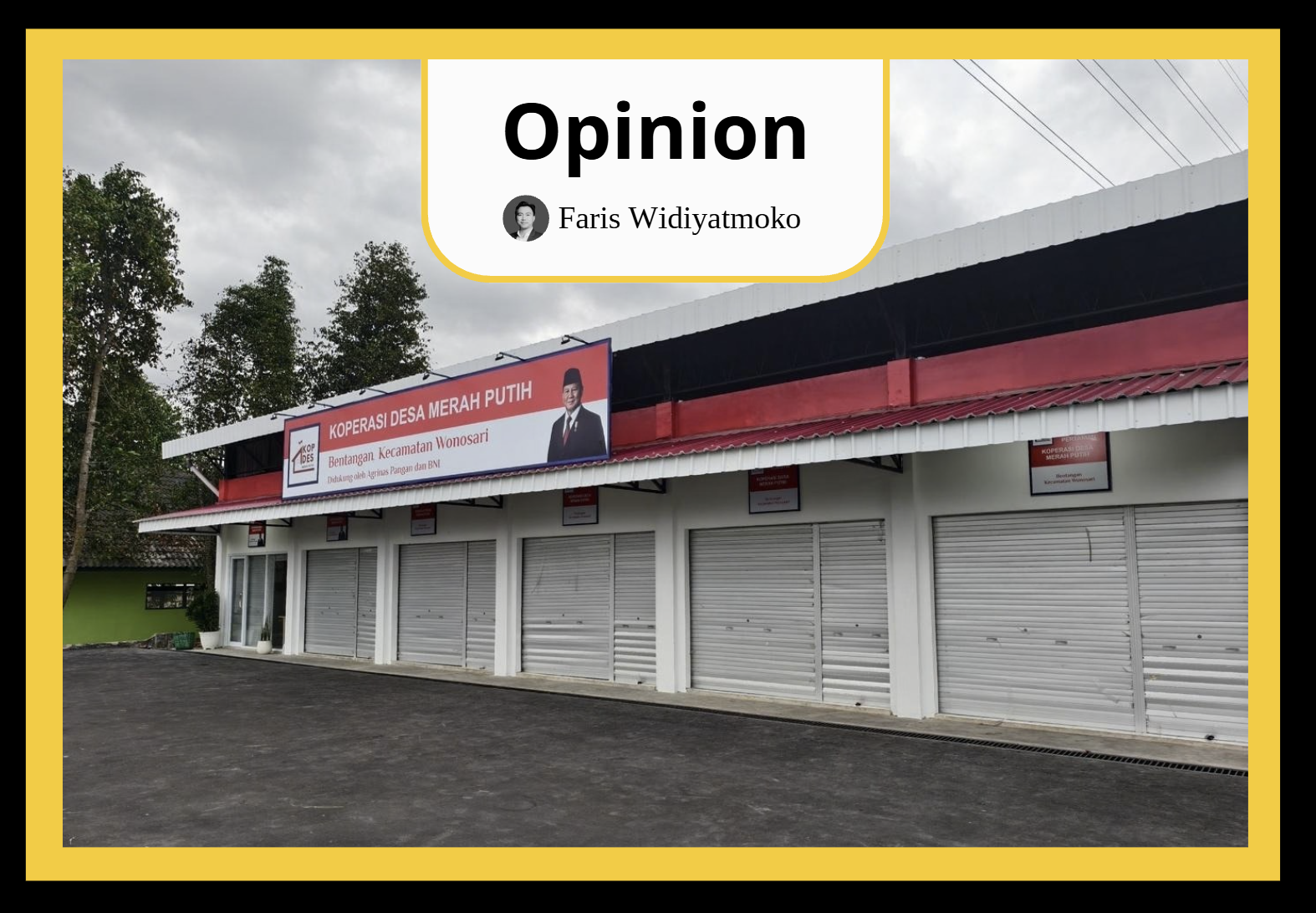
Kopdes Merah Putih Bentangan Klaten. (Wikimedia/ BiographyWriter45)
Faris Widiyatmoko is a lecturer at the Political Science Department of Universitas Pembangunan Nasional “Veteran” Jakarta and Director at Politika Research and Consulting. The views expressed are the author’s own and do not represent SEA Daily or that of another organisation.
Imagine a village cooperative with a straightforward purpose: to manage a village pharmacy, open a community clinic, provide savings and lending services, operate cold storage for agricultural produce and help farmers reduce their dependence on middlemen. This is the vision behind Indonesia’s Red and White Cooperatives (Koperasi Merah Putih/KMP). Recently, however, these cooperatives have also been given the opportunity to explore activities that extend well beyond the traditional village economy; mining. Through the signing of Government Regulation No. 39 in October 2025, cooperatives had been given the legal authority to manage mining concessions of up to 2,500 hectares.
The KMP programme is a central instrument in supporting Indonesian President Prabowo Subianto’s campaign promise of achieving sustainable food self-sufficiency. However, KMP has been facing mounting criticism surrounding the state budget constraint, its top-down structure, its effectiveness and hidden agenda . Nevertheless, as the new mining concession regulation is enforced, the question goes further than merely what cooperatives can do for village economies, but also how far their role can responsibly expand into new sectors. Hence, rather than seeing this development solely as a contradiction, it may be more necessary to view it as an “opportunity” to consider carefully how cooperatives can grow while preserving their original values.
A Small Flame from Rochdale

John Bright’s Fieldhouse Mills, Rochdale, Lancashire. (Wikimedia/ Dr Neil Clifton)
To understand the significance of this discussion, it is worth looking back at the origins of the cooperative movement. In 1844, a group of factory workers in Rochdale, England, established what became known as the Rochdale Society of Equitable Pioneers. Their initiative emerged from the economic difficulties and inequalities they experienced through their everyday lives.
Indonesia’s first vice president and one of its founding fathers, Mohammad Hatta, understood the significance of this history best. In his classic work ”Membangun Koperasi dan Koperasi Membangun” (“Building Cooperatives and Cooperatives Building”), he emphasised that cooperatives grow from a sense of solidarity and common interests among their members. Ideally, therefore, cooperatives should have strong roots within the communities they serve. As a democratic, member-owned economic collaboration, the basic idea remains simple: from members, by members and for members.
This raises an important question for the KMP today. If cooperatives are being developed with substantial support and direction from a higher structure (e.g. the state), how can they ensure that they retain the spirit of community ownership and participation that has always been central to the cooperative movement? The answer need not be either-or. Strong government support and genuine member ownership can potentially work together, provided that the cooperative remains accountable to its members and responsive to local needs.
Two Sides of the Opportunity
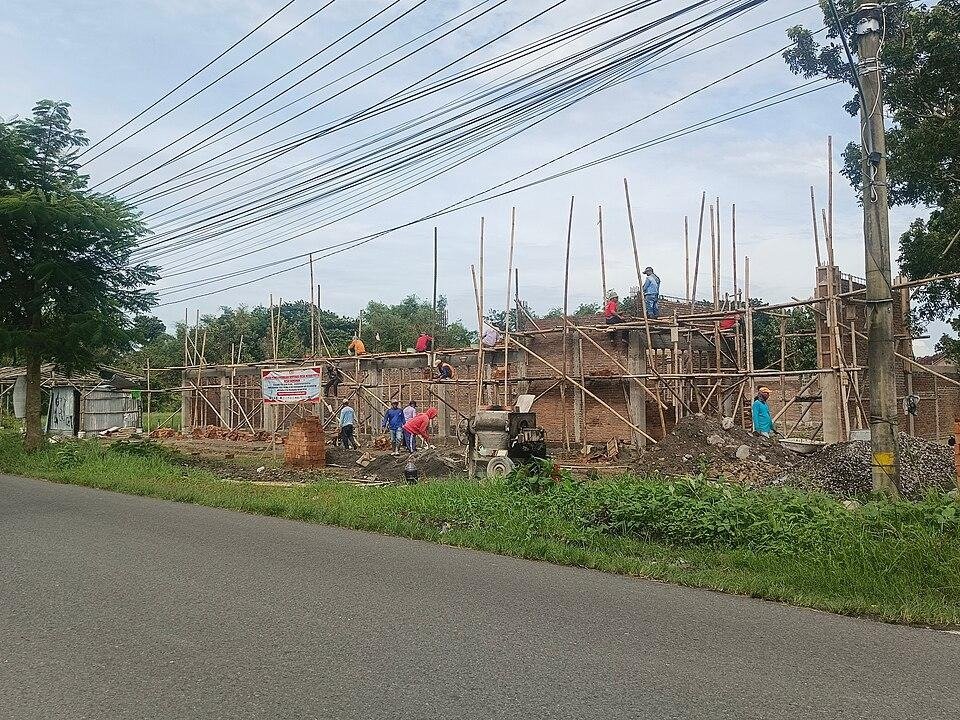
Koperasi Merah Putih Desa Sawahan, currently under construction. (Wikimedia/ Dani Safa Adi Nugraha)
There are understandable arguments on both sides of the discussion. On the positive side, allowing cooperatives to participate in mining could open a new pathway for communities to gain greater access to the economic benefits of natural resources.
It could firstly contribute to the democratisation of access to natural resources, as mining traditionally only involves large companies with substantial financial and technical resources. Giving cooperatives an opportunity to participate could, under the right governance arrangements, allow a greater share of the economic benefits to reach local communities.
Second, mining could provide an additional source of income for communities with genuine mineral potential. Cooperative members could potentially benefit through business profits, dividends, employment and other economic activities connected to the mining operation.
Lastly, community participation could potentially help create stronger relationships between local communities and mining operators. Where communities have a meaningful stake in an economic activity, there may be greater opportunities to build trust, improve dialogue and share responsibility for managing its social and environmental impacts, especially as mining operations are often ravaged by horizontal conflict.
These opportunities, however, need to be accompanied by strong safeguards. First, expanding into mining represents a significant new direction for KMP. The challenge is to ensure that such expansion strengthens rather than distracts from the cooperative’s original mission.
The second consideration is institutional capacity. Mining requires specialised expertise in geology, engineering, occupational health and safety, environmental impact assessment, reclamation, risk management and capital investment. These requirements are foundationally different from the skills needed to operate a village pharmacy, savings and lending service or agricultural supply chain. This does not necessarily mean cooperatives should be excluded from mining. It does, however, suggest that any participation should be supported by appropriate technical expertise, professional management, transparent partnerships and strong regulatory oversight.
The third consideration is governance. If a mining licence is held by a cooperative, an important question is how decision-making power will be distributed. Members, cooperative managers, village authorities, professional partners and investors may all have different interests. Clear and good governance arrangements will therefore be essential to ensure that the cooperative remains genuinely accountable to its members and that economic benefits are distributed fairly.
Learning from Experience
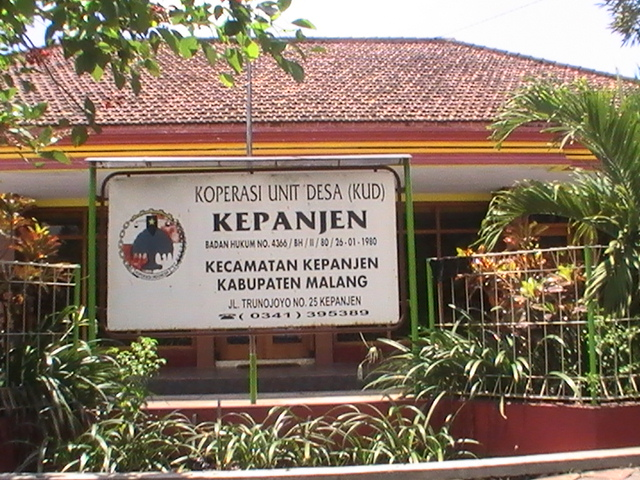
A Village Unit Cooperative (Koperasi Unit Desa/KUD) in Malang, East Java in 2010. (Wikimedia/Nur Cholis)
International experience offers another useful perspective. The International Cooperative Alliance’s 2025 global ranking of the world’s 300 largest cooperatives shows strong representation from sectors including agriculture and food, insurance, wholesale and retail, financial services, and industry and utilities. Mining does not feature among the leading sectors represented in that ranking. This does not mean that cooperatives cannot participate in mining. Rather, it suggests that mining is not the dominant model through which successful modern cooperatives have traditionally built their scale.
Indonesia’s own history also provides valuable lessons. Village Unit Cooperatives (Koperasi Unit Desa/KUD) was once developed with strong government support and an ambitious vision for rural economic development. Created in the early 1970s, KUD grew into more than 9,000 units that served as the state’s rural delivery channel, distributing subsidised fertiliser, procuring rice and channelling agricultural credit and they are widely credited with helping Indonesia reach rice self-sufficiency in 1984. Yet they were designed to implement government policy rather than act as independent agents, dominated by richer farmers and reliant on subsidies. When Presidential Instruction No. 18/1998 removed their protected status after the Asian financial crisis, KUD numbers fell by around a quarter within two years, and more than 5,400 units are now dormant.
Its experience demonstrates both the potential and the challenges of building large-scale cooperative institutions with substantial state involvement. One lesson stands out that cooperatives ultimately depend on their members. A cooperative can have government support, funding, programmes and ambitious business plans, but its long-term strength comes from whether members feel that the organisation belongs to them, understands their needs and creates tangible benefits for their communities. That lesson is particularly relevant as KMP continues to develop.
The discussion about mining should therefore not be framed simply as a choice between allowing or rejecting a new business opportunity. A more constructive question is: how can KMP expand its economic opportunities while remaining true to the principles that make a cooperative different from a company?
If a village has genuine mineral potential, there may be ways for its cooperative to participate responsibly. But such participation should be built around transparent governance, strong member involvement, professional technical expertise, environmental responsibility and a clear mechanism to ensure that economic benefits return to the community. At the same time, the original priorities of the KMP food security, healthcare, agricultural supply chains, logistics, access to finance and stronger local enterprises should remain firmly at the centre of its mission. The opportunity before KMP is therefore much bigger than mining.
It is an opportunity to demonstrate whether Indonesia can build a new generation of cooperatives that combine the strength of state support with genuine community ownership; modern business practices with cooperative values; and economic growth with social responsibility. The most important question is not simply how much mineral wealth a village possesses. It is whether the cooperative can ensure that whatever economic opportunities it pursues genuinely strengthen the people it was created to serve.
About The Author