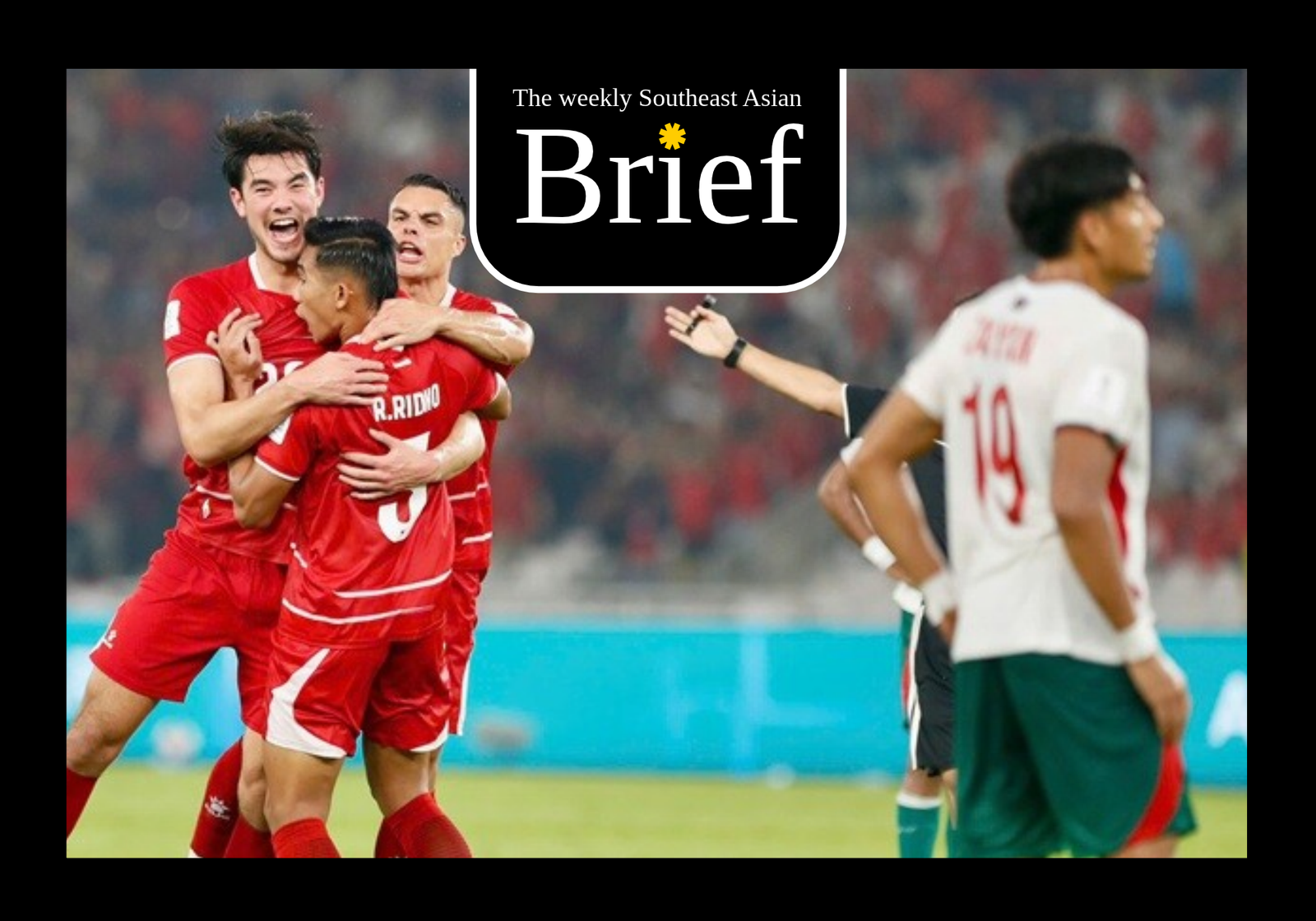
Indonesian players celebrate a goal against Bangladesh in their last group stage match that they won by 9-2. (FIFA ASEAN Cup 2026)
The Indonesian national team officially secured their final ticket in the 2026 FIFA ASEAN Cup after a 9-2 victory over Bangladesh at their home ground, the Gelora Bung Karno Stadium in Jakarta, on October 1.
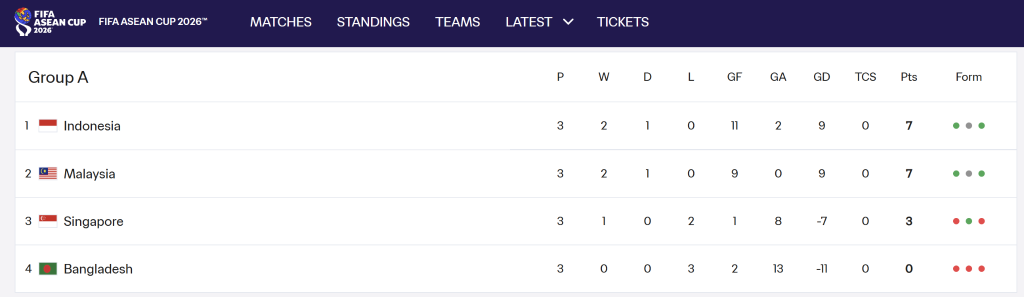
Indonesia and Malaysia were separated only by goals scored, a tiebreaker Indonesia won through Mitchell Baker’s 97th-minute strike against Bangladesh. (FIFA ASEAN Cup 2026)
Though the scoreline appeared decisive, it was precisely the ninth goal—struck by Mitchell Baker—during the seventh minute of injury time that clinched the coveted final spot for the Garuda (“Eagle”) squad. Only minutes earlier, Malaysia had momentarily eclipsed Indonesia at the summit of the group A standings—after routing Singapore 6-0, simultaneously, just miles away, at the Si Jalak Harupat Stadium in Bandung. Harimau Malaya (“Malayan Tigers”) will therefore compete for the bronze medal against Group B’s runner-up, Vietnam.
Waiting to face the Garuda squad in the final showdown scheduled for October 5 are Thailand’s Changsuek (“War Elephants”), who secured pole position in group B after defeating Vietnam’s Những Chiến binh Sao Vàng (“Golden Star Warriors”) by 2-0.
Notably, this is the inaugural edition of a regional football tournament organised directly under the world’s top football body, FIFA, which was first announced by FIFA President Gianni Infantino in October last year following the signing of the agreement during the 47th ASEAN Summit in Kuala Lumpur. It signifies a crucial milestone for a region boasting 10% of the global population—a demographic deeply enamoured with football, yet one that has historically struggled to reach the global stage.
With seven ASEAN Championship titles, Thailand is the historically undisputed “King of ASEAN football”. They are one of the exceptionally few ASEAN teams to reach the Final Round of the Asian Football Confederation (AFC) World Cup Qualifiers, becoming the bloc’s sole representative during the 2018 cycle.
This historic high was built through and through since at least 2007 when the country started investing heavily in their domestic league, supported by substantial private investment allocated for constructing state-of-the-art infrastructure.
In the second round of the 2026 AFC qualifiers—despite a final game 3-1 victory against Singapore—the Changsuek were heartbreakingly eliminated as identical goal statistics to China had FIFA looking at their head-to-head record, resulting in their rivals’ advancement.
Ramping up to take on Indonesia the stakes are high for the Thais to protect their legacy as the “kings” of the region.
Although the Garuda squad has never won the ASEAN Championship, they recently delivered a record-breaking performance that brought them all the way to the fourth and final round of the 2026 qualifiers. It was the farthest they had advanced since they became the first Asian nation to ever play at a World Cup in 1938, competing, however, under the colonial banner of the Dutch East Indies.
It was, of course, an all-time high and a heartbreak simultaneously; Indonesia succumbed to a narrow, single-goal defeat against Iraq in the fourth round qualifiers. They fell just one goal away from the chance to shatter their eight-decade-long wait to enter the World Cup. In this die-hard football-loving country, Indonesian fans were undoubtedly disconsolate.
There were mounting criticisms unleashed against Indonesia’s national football governing body (PSSI) for its erratic, rapid succession of high-profile managers. Notably, there has been a three-fold coaching change just in the past couple of years.
Indonesian fans had in recent years attributed the five-year tenure of South Korean coach Shin Tae-yong (STY), from January 2020 to 2025, as the architect of the Timnas’ golden generation. His success, most notably, navigated the Garua squad through the third round of the 2026 World Cup qualifiers, which the nations had never previously approached. The decision to not extend the contract with STY in 2025 left the country on a high note; marking an unprecedented peak in the World Cup qualifiers whilst simultaneously ushering in a new coach.
The PSSI subsequently escorted in a Dutch former football striker, Patrick Kluivert, with public sentiment noting his appointment was to bridge the cultural and communication gap with the national team’s massive wave of Dutch-born naturalised players. That alone speaks volumes about the controversial, recurring debate regarding the naturalisation strategy over local youth talent development—a dilemma that the neighbouring state of Malaysia has also confronted, prominently in last year’s scandal over allegations of “illegal” naturalised players.
Now the Garuda squad is operating under the direction of the Englishman, John Herdman. Having previously led Canada to the 2022 World Cup, Herdman was appointed by the PSSI at the start of the year specifically to build a long-term plan leading toward the 2030 World Cup cycle. The 2026 FIFA ASEAN Cup will therefore serve as his major litmus test.
It is analytically not useful to juxtapose these developing nations of Southeast Asia with the long-established and ever-well-resourced European football teams. Nevertheless, the hope has always been there among these “SEAblings” (a term combining “SEA” (Southeast Asia) and “siblings”) with their indomitable football fever, to see their respective countries competing at the World Cup.
Keeping in mind that even with an overwhelming sprawl of fans, the region’s core priority remains meeting the people’s daily survival needs, football in the region must find its own suitable pathway to the World Cup. Whether through naturalisation or infrastructure spending, both are viewed as accelerated instruments for a region that started “late” in ramping up athletes. Nonetheless, the long-term success and sustainability will not merely be a matter of skill or how many passionate supporters a country has; rather, it demands strong government support, especially in administration and sustained investment in youth development.
In the end, there is so much more possibility and momentum now than ever before for these die-hard football nations as they look ahead to the upcoming 2030 World Cup.
About The Author