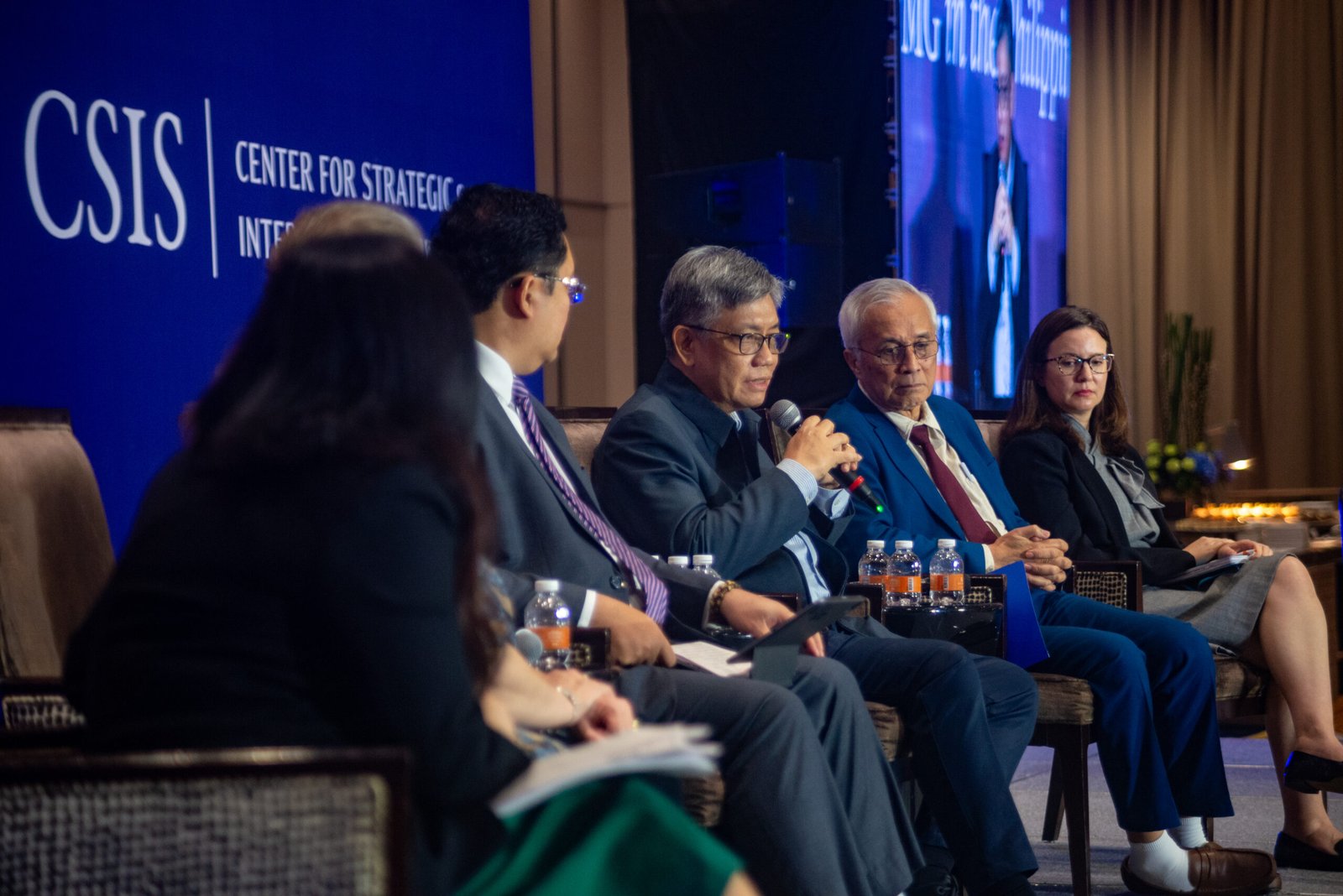
Alberto Dalusung III, Energy Transition Advisor at the ICSC, speaks during Panel 2, “Building Resilient Energy, Infrastructure and the Blue Ecosnomy,” at the Manila Strategy Forum, on September 9. (Amador Research Services)
“In today’s world, economic diplomacy is a national defence by another name,” Department of Foreign Affairs Secretary Theresa Lazaro affirmed during a keynote address at the 2026 Manila Strategy Forum on September 9.
The Secretary set the stage for one of the central themes discussed throughout the two-day conference; the Philippines’ backing for the US-led economic-security framework, Pax Silica.
For context, the Philippines joined the coalition on April 16, with the US claiming that Manila has greenlit a plan to establish a 4,000-acre (16 km2) artificial intelligence (AI) hub in the Luzon Economic Corridor. The projection is to transform the Philippines into the first AI-native economic security zone among the Pax Silica signatories.
Secretary Lazaro remains assured that the alliance can enable the Philippines to secure and “climb the global technology value chain,” explaining that the country “will not remain a mere exporter of raw materials or low-tier assembly”.
Yet, heightening concerns surrounding the Pax Silica proposal encompass complexities far beyond mere geopolitical considerations. Grassroot problems are chief among them; namely massive energy and water consumption, the guarantee of environmental regulatory compliance and the risk of indigenous displacement. These critical issues were explored during the panel sessions.

Erin Murphy, Managing Director for Asia at Redpoint Advisors, speaks during Panel 2, “Building Resilient Energy, Infrastructure, and the Blue Economy”. (Amador Research Services)
The collective stance was that the Pax Silica initiative must generate tangible benefits for the Filipinos.
Erin Murphy, Managing Director for Asia at Redpoint Advisors, reminded that this high-tech manufacturing investment is a double-edged sword, meaning it can either “take all the resources,” or, vice versa, “leverage them to substantially drive development”.
If the Philippines wants to really strengthen its value chain, “do not just be a contractor for someone else’s project,” she asserted.
Promotional narrations heavily focus on how the Philippines possess abundant critical mineral reserves and skilled talent, suggesting that the Pax SIlica projects will attract massive foreign direct investments (FDI) while generating high-skilled job opportunities. These are all indeed feasible to achieve, but, of course, hinge on non-negotiable prerequisites, with the government playing a pivotal role.

Josephine Romero, ASEAN BAC Senior Adviser and PCORP President, answers questions during Panel 6, “Building the Industries of the Future”. (Amador Research Services)
Alberto Dalusung III, Energy Transition Advisor at the Institute for Climate and Sustainable Cities (ICSC), argued that the Philippines actually “has the capacity to power all projects”. However, he reminded that for this capacity to materialise, the government is obligated to ensure sufficient energy (electricity) supply and stringent enforce environment compliance.
Crucially, Josephine Romero, ASEAN BAC Senior Adviser and PCORP President, stated that “the number one asset in the Philippines is talent”. She argued that “it is unfortunate that Filipinos are known for software and integrated circuit (IC) designs, because all of our neighbours are grabbing our people away”.
Therefore she asserted that a substantial amount of investment must not only be centred on building infrastructure, but also on “educating and training people”. This will enable them to run the high-end industries within the country, reverse the brain drain, and ultimately curtail foreign dependence.
About The Author