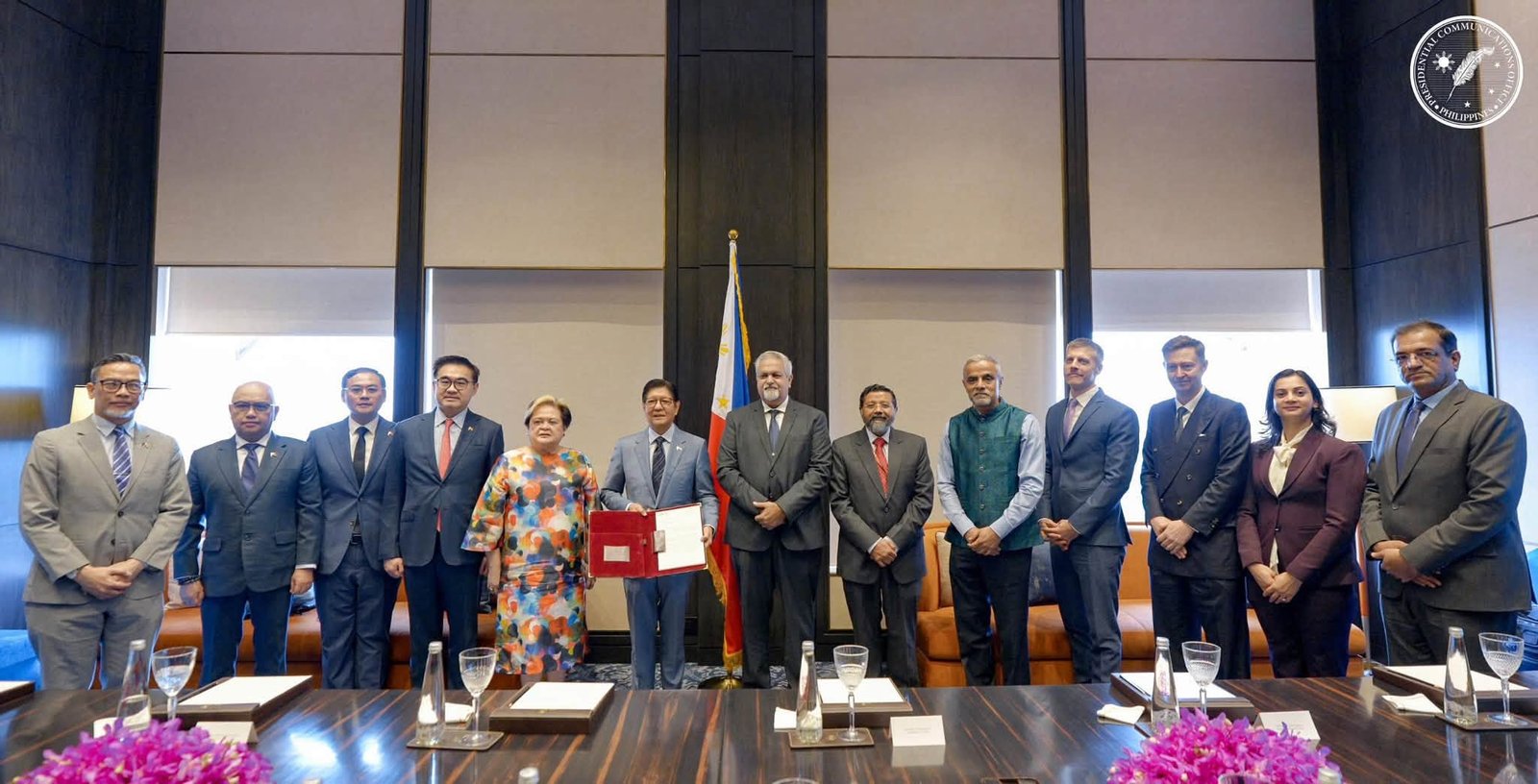
Officials pose during the Philippines’ meeting with the Coalition for Disaster Resilient Infrastructure. (Presidential Communications Office)
On September 12, Philippine President Ferdinand Marcos Jr. arrived in New Delhi, India for the 18th BRICS Summit, representing ASEAN as its 2026 chair while also advancing the Philippines’ infrastructure resilience agenda through membership in the Coalition for Disaster Resilient Infrastructure (CDRI).
President Marcos is expected to represent the Philippines’ ASEAN chairship priorities at the open session on September 13. These include peace and security, people empowerment and prosperity, alongside stronger disaster preparedness, climate action and responsible use of new technologies.
The government said the Philippines’ participation gives ASEAN an opportunity to engage with major emerging economies on trade, investment, regional security and climate resilience while maintaining ASEAN centrality. The President also said the Philippines would also call for fairer global governance and stronger disaster preparedness.
On the sidelines of the summit, President Marcos met officials from the CDRI, with the Philippines formally joining the grouping as its 71st member and the 2nd Southeast Asian country after Vietnam. The CDRI was launched by the Indian government in 2019 to support countries in strengthening infrastructure against disasters and climate-related risks.
Presidential Communications Office Acting Secretary Dave Gomez said membership would give the Philippines access to international expertise, technical knowledge and best practices on building infrastructure capable of withstanding disasters. He also added that it could provide access to financing for projects aimed at improving infrastructure resilience.
The Department of Public Works and Highways (DPWH) has been designated to represent the Philippines in the coalition. The participation supports the Philippine Development Plan 2023–2028, National Adaptation Plan 2023–2050 and National Disaster Risk Reduction and Management Plan 2020–2030.
The visit bridges the Philippines’ ASEAN chairship priorities with a domestic focus on infrastructure resilience. CDRI membership gives Manila a platform to draw on international expertise and financing as it strengthens roads, bridges, ports and other critical infrastructure. At the same time, raising disaster resilience at the BRICS summit allows the Philippines to connect a domestic development concern with wider ASEAN discussions on climate, preparedness and sustainable growth.
About The Author