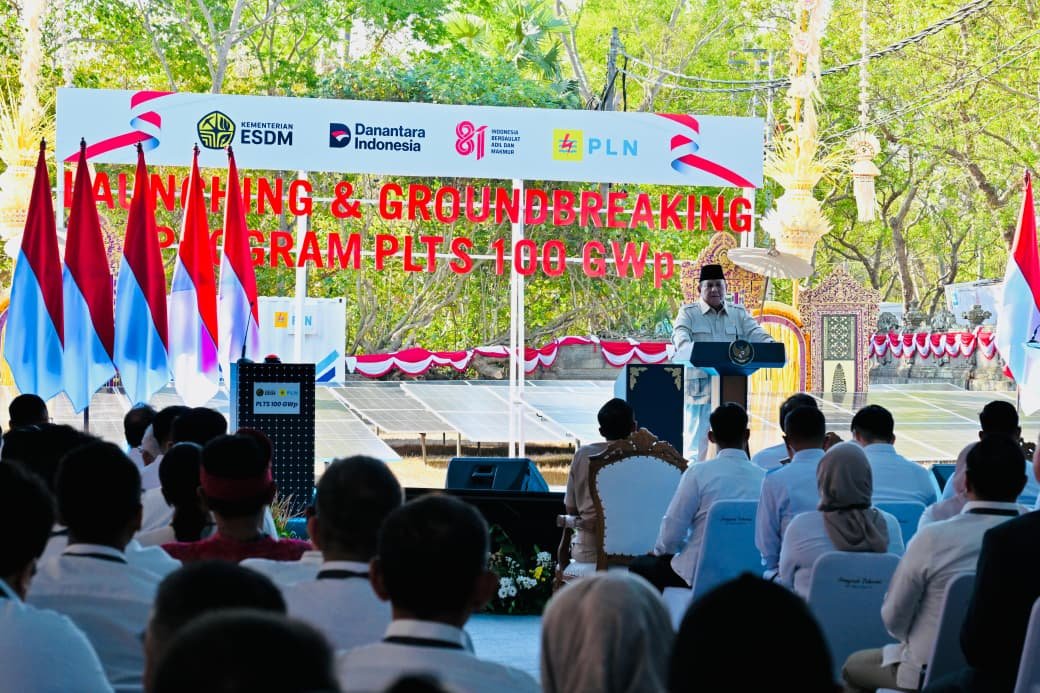
Indonesian President Prabowo Subianto officially launched Indonesia’s 100 GWp Solar Power Plant (PLTS) Programme and led the groundbreaking ceremony in Gilimanuk, Jembrana Regency, Bali, on August 25, 2026. (Sekretariat Kabinet RI)
Indonesia’s plan to develop 100 GWp of solar power has received backing from the Foreign Policy Community of Indonesia (FPCI), Indonesia’s largest foreign policy non-governmental organisation, following President Prabowo Subianto’s groundbreaking ceremony on August 25, 2026. FPCI said the event demonstrated the Government’s determination to place solar energy at the centre of Indonesia’s future electricity strategy.
Rather than focusing solely on additional generation capacity, the programme is designed to address several challenges across the energy sector. Solar installations supported by battery energy storage systems (BESS) are expected to contribute to diesel replacement, rural electrification, productive villages, grid development and electricity supply for industrial zones.
Implementation will involve senior officials from both the Government and state-owned enterprises. The team appointed by President Prabowo includes Coordinating Minister for Economic Affairs Airlangga Hartarto, Energy and Mineral Resources Minister Bahlil Lahadalia, Investment Minister and Danantara CEO Rosan Roeslani, PLN Presiden Director Darmawan Prasodjo and Pertamina President Director Simon Aloysius Mantiri.
The first stage will reportedly involve 14 projects with a combined capacity of 5.3 GWp. Energy and Mineral Resources Minister Bahlil Lahadalia also outlined the possibility of Government intervention when independent power producers (IPPs) cannot provide competitive offers, including the potential involvement of Danantara.
For FPCI founder and chairman Dr Dino Patti Djalal, the political momentum behind the initiative is promising, but legislation must now catch up. He argued that a firm regulatory foundation would be crucial to transforming the target into lasting implementation.
Clear rules, transparent procurement, defined institutional responsibilities and predictable financing, FPCI said, will ultimately determine whether the programme can deliver on its wider goals of strengthening energy access, domestic industry and Indonesia’s clean-energy transition.
About The Author