
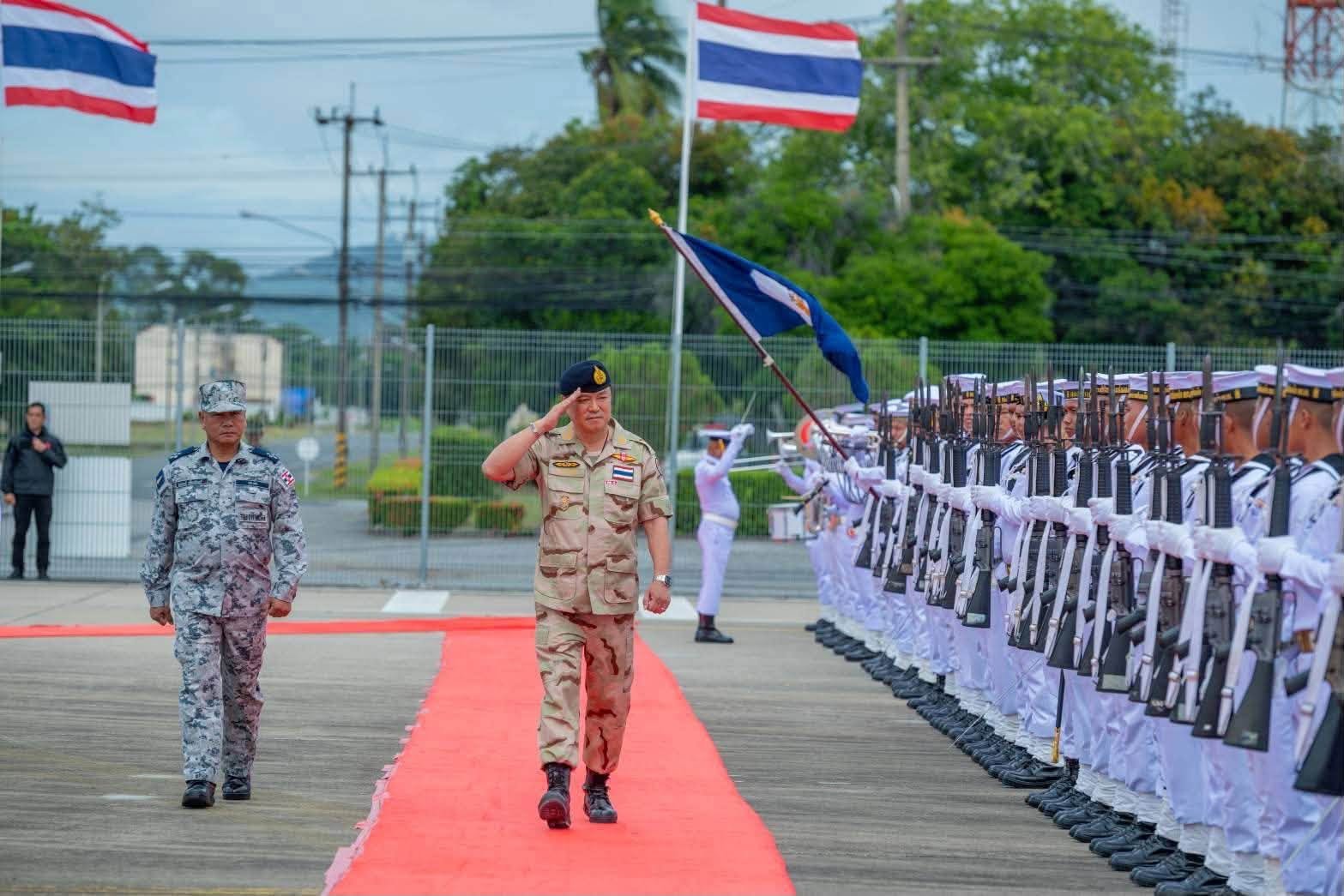
Prime Minister of Thailand Anutin Charnvirakul inspecting an honor guard during his visit to the Royal Thai Navy Aviation Division at U-Tapao in Chonburi province on August 27, 2026. (Royal Thai Navy)
On August 27, Thai Prime Minister and Minister of Interior Anutin Charnvirakul visited a Royal Thai Navy training exercise in the Upper Gulf of Thailand as the navy reviews its readiness for maritime and national security missions.
The inspection took place at the Royal Thai Navy Training Ground No. 15 in Sattahip, Chonburi province, and included the HTMS Chakri Naruebet and HTMS Bhumibol Adulyadej. Charnvirakul was briefed on troop preparations, force deployment and the navy’s wider readiness programme, with 2026 designated as the “Year of Combat Readiness of the Royal Thai Navy” by Thai Navy’s Commander-in-Chief, Admiral Pairote Fuangchan.
Thai Prime Minister Charnvirakul also observed the deployment of unmanned aerial vehicles (UAVs) and a demonstration of shore-based artillery support. The navy is developing the HTMS Chakri Naruebet as a “UXV Carrier”, intended to function as a command, control and support platform for unmanned systems conducting reconnaissance, surveillance, search and target designation missions.
Some of the UAVs used in the exercise were developed through the Royal Thai Navy’s own research and development programmes, drawing on operational experience to meet military requirements. The service said testing the systems in training conditions would support further improvements while contributing to greater domestic defence self-reliance.
The HTMS Bhumibol Adulyadej, a high-performance frigate and one of the navy’s main combat platforms, also demonstrated its surveillance, target identification, attack, command and control capabilities, as well as its ability to conduct joint operations with other naval and air units.
The exercise also highlighted the Maritime Domain Awareness (MDA) by linking information from ships, aircraft and unmanned systems to provide commanders with a shared picture of maritime activity and support faster decision-making, as well as the demonstration of its capacity to support disaster response through an Incident Command Centre (ICC) at the training ground, focusing on the use of military resources for both national defence and assistance during emergencies.
It reflects Thailand’s effort to combine conventional naval capabilities with unmanned systems and improved information-sharing, rather than the capabilities of individual platforms. Developing locally researched UAVs could support greater defence self-reliance, while stronger MDA and joint operations could improve the navy’s ability to respond to maritime and national emergencies. The emphasis on frigate capability also points to longer-term questions over fleet capacity and readiness as regional naval modernisation continues.
About The Author

One thought on “Thai PM Anutin Reviews Navy Readiness Amid Thailand’s Maritime Security Focus”