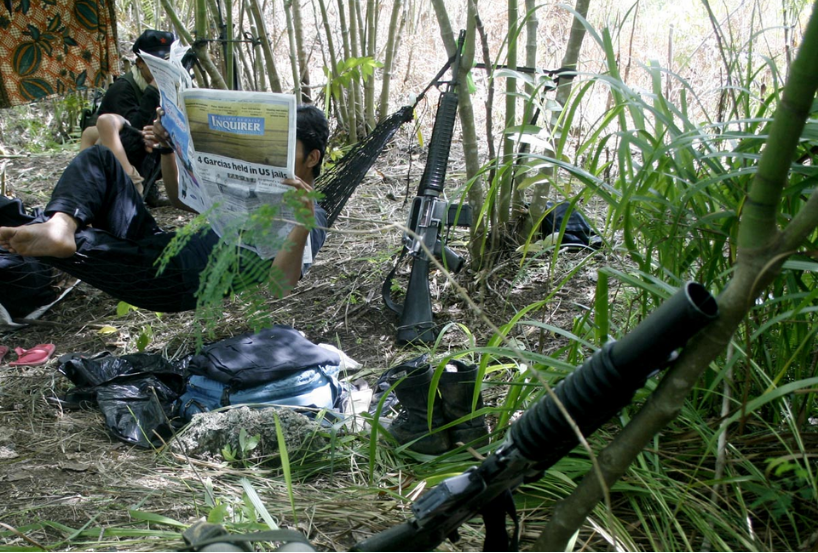
New People’s Army guerrillas under Leoncio Pitao, alias Kumander Parago, read newspapers at their base in Paquibato district, Davao City. (AKP Images/Keith Bacongco via Wikimedia)
Heavy crossfire between the 79th Infantry Battalion (79IB) under the Philippines Armed Forces and the communist New People’s Army (NPA) erupted on April 19 in Sitio Plaringding within the municipality of Toboso, Negros Occidental.
Pursuit operations led to eight clashes for almost 12 hours from 4 a.m. local time. This fighting incident left 19 NPA fighters killed.
As a result, the National Task Force to End Local Communist Armed Conflict (NTF-ELCAC) praised the brigade’s actions, saying they “demonstrate the firm resolve of the government to protect our people and secure communities long plagued by violence”.
This operation also killed Roger Fabillar, a high-ranking member of NPA, who is known as the hitman. Fabillar had been a fugitive for four years and carried a 1 million peso (16,623 US dollar) bounty for multiple murder cases. The 18 bodies of other fighters were transported to the nearest committal site in Escalante city.
This incident occurred shortly after a similar operation in Caraga, where the 30th Infantry “Fight On” Battalion successfully neutralised two NPA fighters and forced the leader of the group, Jun “Junjun” Requina Jr. to surrender.
The NPA has lingered in the Philippines’ political landscape for decades. As the paramilitary wing of the Communist Party of the Philippines (CPP), it has waged a Maoist ideology since its founding on March 29, 1969, making it one of the world’s longest-standing communist guerrilla groups.
The government formally designated it a Communist Terrorist Group (CTG) through the ratification of several key legal actions starting in 2017 and has since carried out a significant number of focused military operations in order to attenuate remaining communist terrorist groups (CTGs) led by the NTF-ELCAC.
The core NTF-ELCAC guideline uses the Whole-of-Nation approach, which unites government agencies and other civil society groups to achieve sustainable peace. Former anti-government fighters are also put through rehabilitation and aid programmes to help them integrate into society.
About The Author