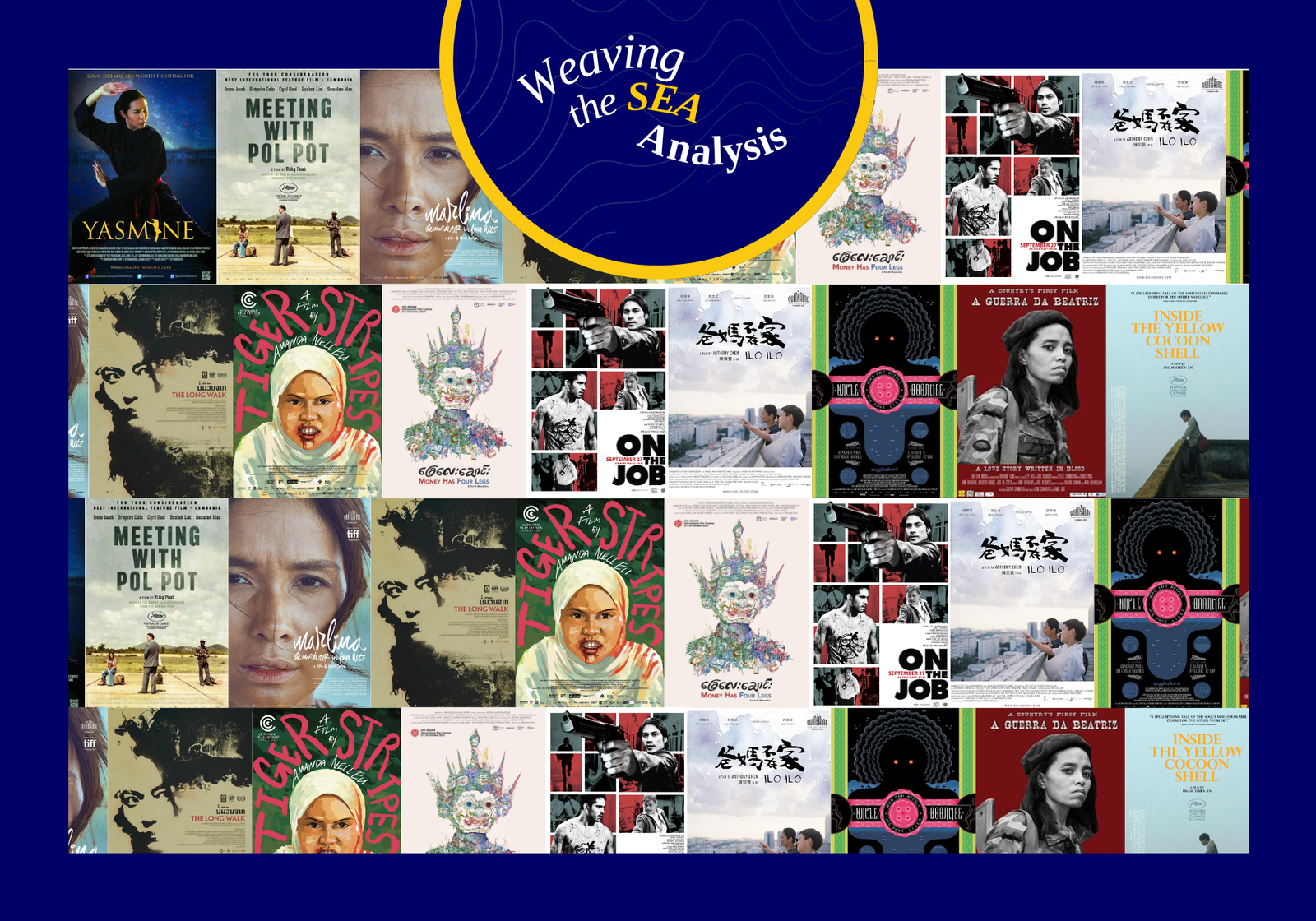
A collage of Southeast Asian films featured within this article.
As Southeast Asia increasingly becomes the centre of flashpoints between major global powers, the region is often discussed through the lens of geopolitics, economic growth, or regional diplomacy. But as we celebrate the 59th ASEAN Day—which marks the establishment of the regional bloc that unites 11 member states on August 8, 1967—we celebrate Southeast Asia through its cultural expressions. Beyond official statements and policy debates, the region’s complexities are perhaps best understood through the stories its people choose to tell. Cinema has become one of the most compelling mediums for examining how Southeast Asian societies grapple with history, identity, inequality, faith and the legacies of conflict and colonialism.
Across the region, filmmakers have documented moments of political upheaval, explored the tensions between tradition and modernity and brought local cultures to international audiences. Many of these works have received global recognition at major film festivals, reflecting not only their artistic merit but also their ability to illuminate issues that resonate far beyond national borders.
As ASEAN marks another year of regional cooperation, revisiting Southeast Asia through its cinema offers a different perspective on the region, one that complements headlines with lived experiences. The following films, each closely associated with a different Southeast Asian country, provide an entry point into the histories, cultures and social realities that continue to shape the region today. Together, they represent a Southeast Asia that is both remarkably diverse and connected by shared questions of memory, identity and change.
Brunei Darussalam
Yasmine (2014)
Yasmine follows a teenage girl determined to pursue the martial art of silat despite expectations that she prioritise more conventional paths. Through its coming-of-age narrative, the film explores family, tradition, gender roles and the negotiation between personal ambition and social responsibility in Bruneian society through its coming-of-age narrative. While Brunei has a comparatively small film industry, Yasmine represents an important milestone as one of the country’s first internationally recognised feature films.
Cambodia
ណាត់ជួបជាមួយ ប៉ុល ពត or Meeting with Pol Pot (2024)
Meeting with Pol Pot follows three French journalists invited to Democratic Kampuchea in 1978 to interview Khmer Rouge leader Pol Pot. Inspired by the experiences of American journalist Elizabeth Becker, the film explores the dangers of ideological fanaticism and the ethical dilemmas faced by those seeking the truth under repressive rule. Directed by Rithy Panh, the film continues Panh’s decades-long engagement with Cambodia’s traumatic past, demonstrating how the legacy of the Khmer Rouge remains crucial to the country’s collective memory and its ongoing search for historical accountability.
Indonesia
Marlina si Pembunuh Dalam Empat Babak or Marlina the Murderer in Four Acts (2017)
Set against the sweeping savannahs of Sumba, East Nusa Tenggara, Marlina the Murderer in Four Acts follows a widow who embarks on a journey to seek justice after surviving a violent assault. Beyond its striking cinematography, the film offers a nuanced portrait of rural Indonesia, where questions of gender, tradition, and justice intersect. By placing an Indonesian woman at the centre of a genre long associated with the American West, director Mouly Surya reimagines both the Western and Indonesia itself, presenting a country whose cultural diversity extends far beyond its urban centres.
Laos
ບໍ່ມີວັນຈາກ or The Long Walk (2019)
Directed by Mattie Do, The Long Walk follows an elderly man haunted by the ghost of a woman who died decades earlier in a remote Lao village. Blending science fiction, supernatural horror and Buddhist philosophy, the film imagines a near future where advanced technology exists alongside persistent rural poverty. This contrast reflects Laos’ ongoing development challenges, suggesting that economic growth and innovation do not necessarily eliminate inequality. Moreover, this film is both a landmark for the country’s cinema and a thoughtful meditation on memory, loss and the uneven realities of modernisation.
Malaysia
Tiger Stripes (2023)
Directed by Amanda Nell Eu, Tiger Stripes follows Zaffan, a twelve-year-old girl whose first experience of puberty triggers unsettling physical transformations that alienate her from her classmates and community. Blending coming-of-age drama with elements of body horror, the film uses the supernatural to examine adolescence, gender expectations and the pressures of conformity in contemporary Malaysian society. Drawing on local folklore and cultural beliefs, Amanda Nell Eu explores how young women navigate the intersection of tradition, religion, and modernity without reducing Malaysia to simplistic cultural stereotypes.
Myanmar
ခြေလေးချောင်း or Money Has Four Legs (2020)
Directed by Maung Sun, Money Has Four Legs follows Wai Bhone, an aspiring filmmaker attempting to complete a film while navigating censorship, financial hardship and the unpredictability of Myanmar’s film industry. Through sharp humour and satire, the story reflects broader frustrations with corruption, bureaucratic obstacles and creative restrictions that have shaped artistic life in Myanmar. Released shortly before the 2021 military coup, the film has since been viewed as an unintended snapshot of a society on the brink of profound political upheaval.
Philippines
On The Job (2013)
Directed by Erik Matti, On the Job follows prison inmates temporarily released by corrupt officials to carry out contract killings before quietly returning to their cells. Framed as a tense crime thriller, the film exposes the complex relationships between organised crime, political elites, law enforcement and the justice system in the Philippines. Rather than presenting corruption as the product of a few individuals, Erik Matti portrays it as a deeply embedded structure that shapes everyday governance and public life.
Singapore
Ilo Ilo (2013)
Directed by Anthony Chen, Ilo Ilo centres on a middle-class Singaporean family navigating the uncertainty of the 1997 Asian Financial Crisis. The arrival of Teresa, a Filipino domestic worker, gradually reshapes the family’s relationships, particularly her bond with the couple’s young son. Through this intimate domestic story, the film explores broader issues of migration, class, economic vulnerability and Singapore’s reliance on foreign labour, subjects that remain central to the city-state’s social fabric.
Thailand
ลุงบุญมีระลึกชาติ or Uncle Boonmee Who Can Recall His Past Lives (2010)
Directed by Apichatpong Weerasethakul, Uncle Boonmee Who Can Recall His Past Lives follows a man who spends his final days surrounded by both living relatives and the spirits of loved ones who have passed away. As memories, dreams and reincarnated lives intertwine, the film draws deeply from Buddhist philosophy and Thai folklore to explore mortality, memory and humanity’s relationship with nature. Apichatpong’s meditative storytelling reflects a distinctly Thai worldview in which the spiritual and material worlds coexist rather than exist in opposition.
Timor-Leste
A Guerra da Beatriz or Beatriz’s War (2013)
Beatriz’s War is the first feature film produced by Timor-Leste, directed by Luigi Acquisto and Bety Reis. Set during the Indonesian occupation, it follows Beatriz, a young woman who spends decades searching for her husband after he disappears during the conflict. Through her personal journey, the film explores the human cost of war, displacement, and the enduring struggle to rebuild lives in the aftermath of independence. Rather than focusing on military events alone, it foregrounds the resilience of ordinary Timorese communities and the role of women in preserving hope amid violence.
Vietnam
Bên trong vỏ kén vàng or Inside the Yellow Cocoon Shell (2023)
Directed by Phạm Thiên Ân, Inside the Yellow Cocoon Shell follows a man who returns to his rural hometown after the sudden death of his sister-in-law in Ho Chi Minh City, embarking on a journey that becomes both a physical search and a spiritual reckoning. Through long, contemplative takes, the film reflects on grief, faith, memory, and the tensions between Vietnam’s rapidly modernising cities and its deeply rooted rural traditions. Rather than presenting Vietnam through narratives of war, Phạm Thiên Ân offers a quieter exploration of identity and belonging in a society undergoing profound social transformation.
The success of these films marks a broader shift in global cinema. Increasingly, Southeast Asian filmmakers are moving beyond the role of representing their countries for international audiences. Instead, they are producing works that are deeply rooted in local realities while engaging with universal questions about power, identity, morality and belonging. Their stories resonate not because they explain Southeast Asia to the world, but because they trust audiences to meet the region on its own terms. If there is a common thread running through these films, it is not a single regional identity, but a shared commitment to telling authentic stories. As more of these works reach international audiences, they are expanding not only the boundaries of Southeast Asian cinema, but also the ways in which the region is imagined, discussed and understood. Happy ASEAN Day!
About The Author