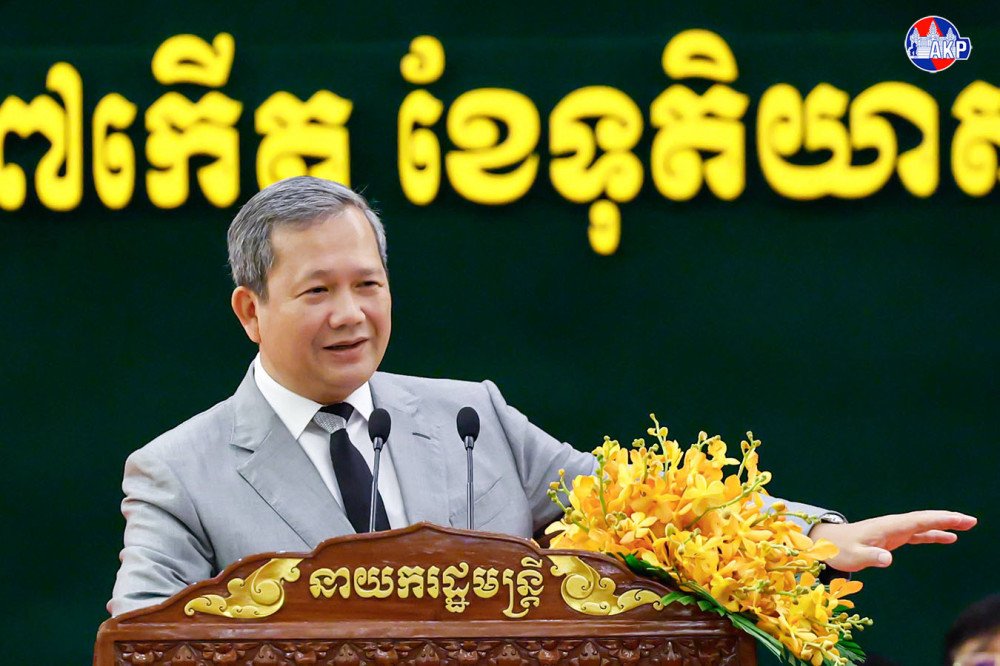
Cambodian Prime Minister Hun Manet addresses graduates at South-East Asia University in Siem Reap on July 21. (Agence Kampuchea Presse)
Cambodian Prime Minister (PM) Hun Manet has reaffirmed the country’s commitment to prepare for an artificial intelligence (AI) driven future, highlighting investment in human capital and international technological cooperation as one of the key priorities for Cambodia’s long-term development.
Speaking at the graduation ceremony of 1,500 students at Southeast Asia University in Siem Reap on July 21, PM Hun Manet said Cambodia must strengthen the skills and competitiveness of its workforce as AI continues to reshape the global economy.
“No country can live in isolation,” he said. “As we integrate into the global community, we must face increasing competition. Therefore, investing in human resources is a vital priority.”
Hun Manet said AI is no longer a technology of the future but one that is already transforming economies and societies, warning that countries which fail to prepare their workforce risk falling behind. He added that Cambodia must narrow the skills gap through continued investment in education, skills development and innovation.
The Cambodian PM also highlighted Cambodia’s participation as a founding member of the newly established World Artificial Intelligence Cooperation Organisation (WAICO), describing it as a platform for international collaboration rather than geopolitical competition.
His remarks came as Cambodia’s Minister of Post and Telecommunications, Chea Vandeth, attended the World Artificial Intelligence Conference (WAIC) in Shanghai, where he met representatives of leading technology companies to explore cooperation on AI and digital infrastructure from July 17 to 20.
Accompanied by technical experts and ministry officials, Minister Chea Vandeth toured the exhibition and held discussions with Huawei, ZTE, China Telecom and Alibaba on developments in AI hardware, cloud computing, specialised computing infrastructure, operating systems and AI development platforms.
The companies showcased next-generation AI technologies designed to meet growing global demand for advanced computing and digital services. Minister Chea Vandeth encouraged technical teams to strengthen collaboration and accelerate joint technological initiatives between Cambodia and its international partners.
Beyond individual initiatives in education and technology, Cambodia appears to be pursuing a broader strategy that integrates human capital development with digital transformation. By treating AI as part of its long-term economic agenda rather than as a stand-alone technology policy, the Cambodian government is seeking to strengthen both the skills of its workforce and its access to emerging technologies.
Building digital infrastructure without a skilled workforce risks limiting the benefits of AI adoption, while investing in education without access to advanced technologies could constrain Cambodia’s competitiveness as neighbouring ASEAN economies accelerate their own AI strategies.
About The Author