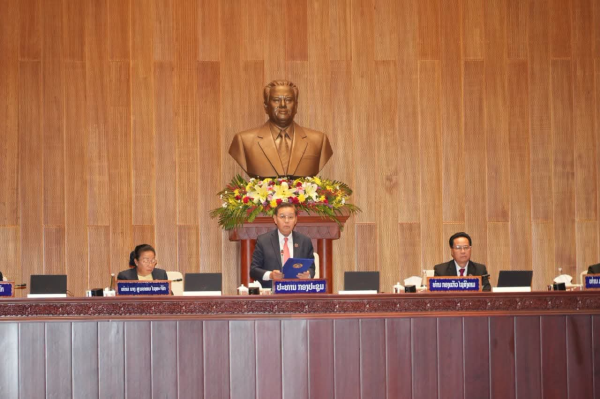
Lao official delivers closing remarks during the First Extraordinary Session of the 10th National Assembly in Vientiane on Friday. (Laos News Agency)
The First Extraordinary Session on the 10th Lao National Assembly concluded its five-day session from July 6 to 10 with adoption of the 2027-2030 National Agenda on Rural Development and Poverty Eradication, alongside the approval of adjacent fiscal measures by near-unanimous vote. The Agenda sets out what Vientiane intends to deliver to the countryside by 2030, while the two finance laws govern the framework that will have to pay for it.
The session is chaired by the Lao National Assembly President Saysomphone Phomvihane and attended by President Thongloun Sisoulith, Lao Prime Minister (PM) Sonexay Siphandone, state leaders, government members, ambassadors and representatives of international organisations.
Lao lawmakers reviewed the government’s report on implementation of the 2026 socio-economic development plan, the state budget and monetary policy for the first half of the year, as well as the priorities for the remaining six months.
The Lao National Assembly approved the government’s midyear socio-economic report (99.39%), the 2027-2030 National Agenda on Rural Development and Poverty Eradication (99.39%), the Law on the State Treasury (99.38%) and the amended Law on the State Budget (100%). Legislators also noted that the economy expanded by 5% in the first half of 2026, citing easing inflation and improved revenue collection driven by a modernised revenue system.Lao PM Sonexay and nine cabinet ministers also answered from lawmakers on issues within its respective portfolios, before receiving 153 public feedback through its 156 hotline, covering 208 issues that included electricity prices, deteriorating roads, illegal mining, inflation and drug-related problems.
Lao lawmakers urged the government to strengthen tax collection, intensify enforcement against illegal mining and forest encroachment, accelerate road rehabilitation and address other pressing public concerns. They also called for greater investment in education and healthcare, including measures to address shortages of teachers and healthcare workers and the implementation of the 6+3+3 education reform beginning in the 2028–2029 academic year.
Two of the four resolutions the Assembly passed dealt with public finance. The amended Law on the State Budget was the only item to pass unanimously, and it was adopted alongside a newly drafted Law on the State Treasury. In the same session, the government’s midyear report credited improved revenue collection to a modernised system, and lawmakers called for stronger tax enforcement, tighter action against illegal mining and forest encroachment and better management of state land concessions. Each of these points to central control over revenue and cash management. The Agenda commits Vientiane to extending electricity, clean water, telecommunications, healthcare and education deeper into the countryside by 2030, at a cost that has not been made public. Centralising the revenue it already collects is one way to pay for it.
About The Author