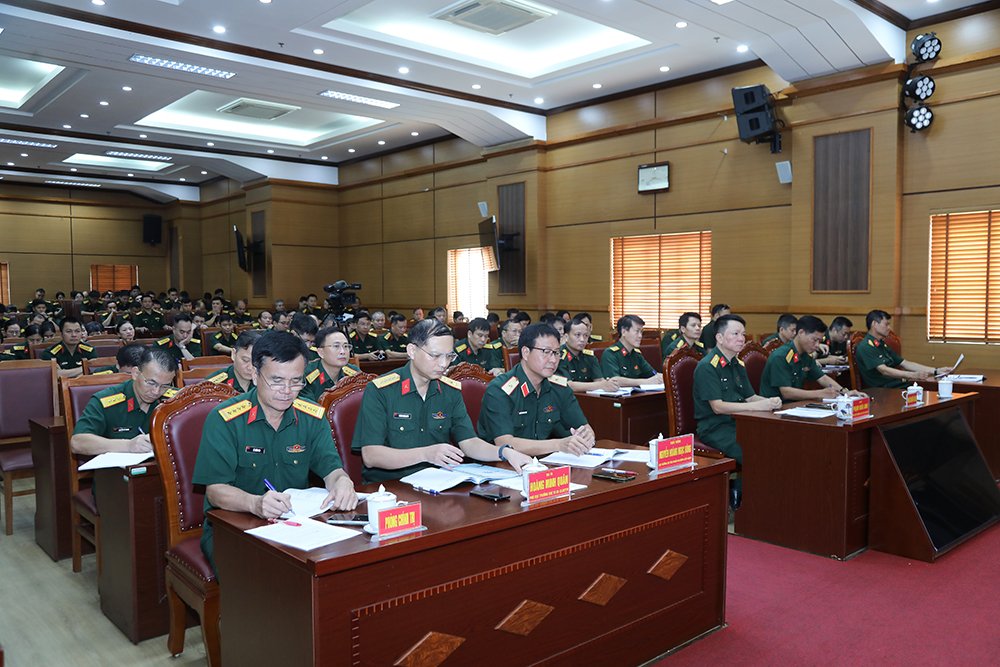
Officials attending the emulation movement to successfully fulfill annual military and national defense tasks and those for the period 2026-2030. (Ministry of National Defense of the Socialist Republic of Vietnam)
On July 15, Vietnam’s Department of Standards, Metrology and Quality under the General Staff of the Vietnam People’s Army (VPA) launched a five-year campaign to strengthen military standards and quality management, underpinning Hanoi’s push for a self-reliant defence industry by 2030 and its stated ambition to build and eventually export its own platforms.
The department said the initiative would improve research and strategic planning , while restructuring the armed forces’ standards and quality control network. It also plans to expand professional training and complete a digital database to support e-government and digital transformation within the Ministry of National Defence.
Officials said the campaign would prioritise scientific research, innovation and the adoption of digital technologies, as well as developing expertise in information technology, foreign languages and other technical fields. The programme also aims to improve administrative efficiency and support Vietnam’s wider defence modernisation objectives.
The launch came alongside with a review of the department’s 55-day anniversary campaign, during which officials said more than 60% of the department’s annual work plan had been completed. According to the department, achievements included drafting new regulations on military standards and quality management, certifying defence production and repair facilities, inspecting defence products and expanding oversight of military vessels and vehicles.
The campaign comes as Vietnam continues to modernise its armed forces through greater investment in defence technology, digital transformation and domestic industrial capability in a bid to create a self-reliant defence industry by 2030, one able to equip the VPA with domestically built systems. This would cut a dependence on foreign suppliers that has left Hanoi exposed, a goal pushing Hanoi to diversify procurement and expand output from state enterprises led by Viettel. Indigenous production still concentrates on the lower end, from small arms and ammunition to light naval craft, drones and radar. Meanwhile, officials have signalled that the aim is to move up to more complex platforms and even export them in the future.
Standards, metrology and certification are an essential part of this self-reliance push as a country cannot scale reliable defence production without a regime to test, certify and oversee them, and it cannot enter export markets at all without meeting standards that foreign buyers accept. That places the department’s work certifying production facilities and inspecting defence products closer to the centre of the modernisation drive than its administrative label suggests.
About The Author