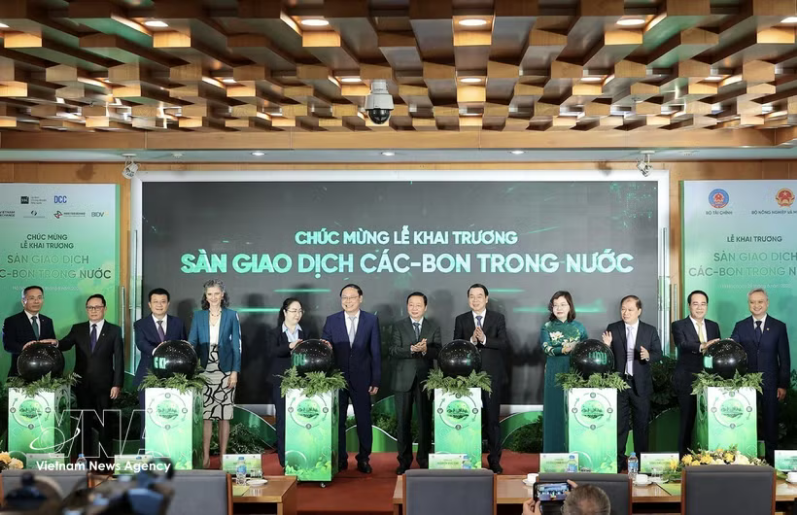
Delegates perform the ceremonial launch of Vietnam’s domestic carbon exchange at the Hanoi Stock Exchange in Hanoi on June 29. (Vietnam News Agency)
This initiative serves as a pilot phase that will run until 2028, before transforming to a full commercial operation in 2029. For the next couple of years, businesses participating will be exempt from exchange service fees under Decree No. 29/2026/ND-CP.
Reportedly, within the first fifteen minutes of the launch, the platform processed 400 tonnes of CO₂e worth 2,160 US dollar, pushing the spot price to 5.40 US dollar per tonne. By the closing bell, total volume cleared 1,200 tonnes for a total market turnover of 6,468 US dollars, though late-session trading pulled the final settlement price lower to 5.40 US dollar per tonne.
Speaking at the launch ceremony, HNX Chairman Nguyen Anh Phong explained that “the core objective of the exchange is to establish a flexible financial mechanism that helps enterprises optimise emission reduction costs while closely linking economic benefits with environmental protection responsibilities”.
Echoing the statement, Chairwoman of the State Securities Commission (SSC), Vu Thi Chan Phuong, stated that this advancement is only the first step in building a stable, transparent, efficient and sustainable carbon market. She urged stakeholders to analyse global best practices, upgrade the capabilities of intermediaries, brokerages and service providers, while steadily maturing the domestic market to meet international integration standards
What does this mean for business?
This newly formed infrastructure acts as the primary vehicle for achieving Vietnam’s statutory net-zero emissions target by 2050. Economically, the cap-and-trade mechanism will stimulate green growth by transforming carbon tracking into a tangible financial asset, motivating businesses to transition towards cleaner operations through accelerated technology adoption and digitalisation. Consequently, high-emitting sectors (such as thermal power, steel and cement) must now manage their GHG as strict corporate liabilities, requiring them to clear extra quotas on the market if they overshoot their limits.
Furthermore, this domestic framework protects Vietnamese supply chains from international green tariffs, such as the EU’s Carbon Border Adjustment Mechanism (CBAM), by establishing verified local carbon pricing. It enhances the competitiveness of exports in Western markets and aligns local suppliers with global net-zero mandates through the National Registry System.
Kala Advisory helps investors move on openings like these as Southeast Asia builds carbon markets and green-compliance infrastructure. Visit kala-advisory.com.
About The Author