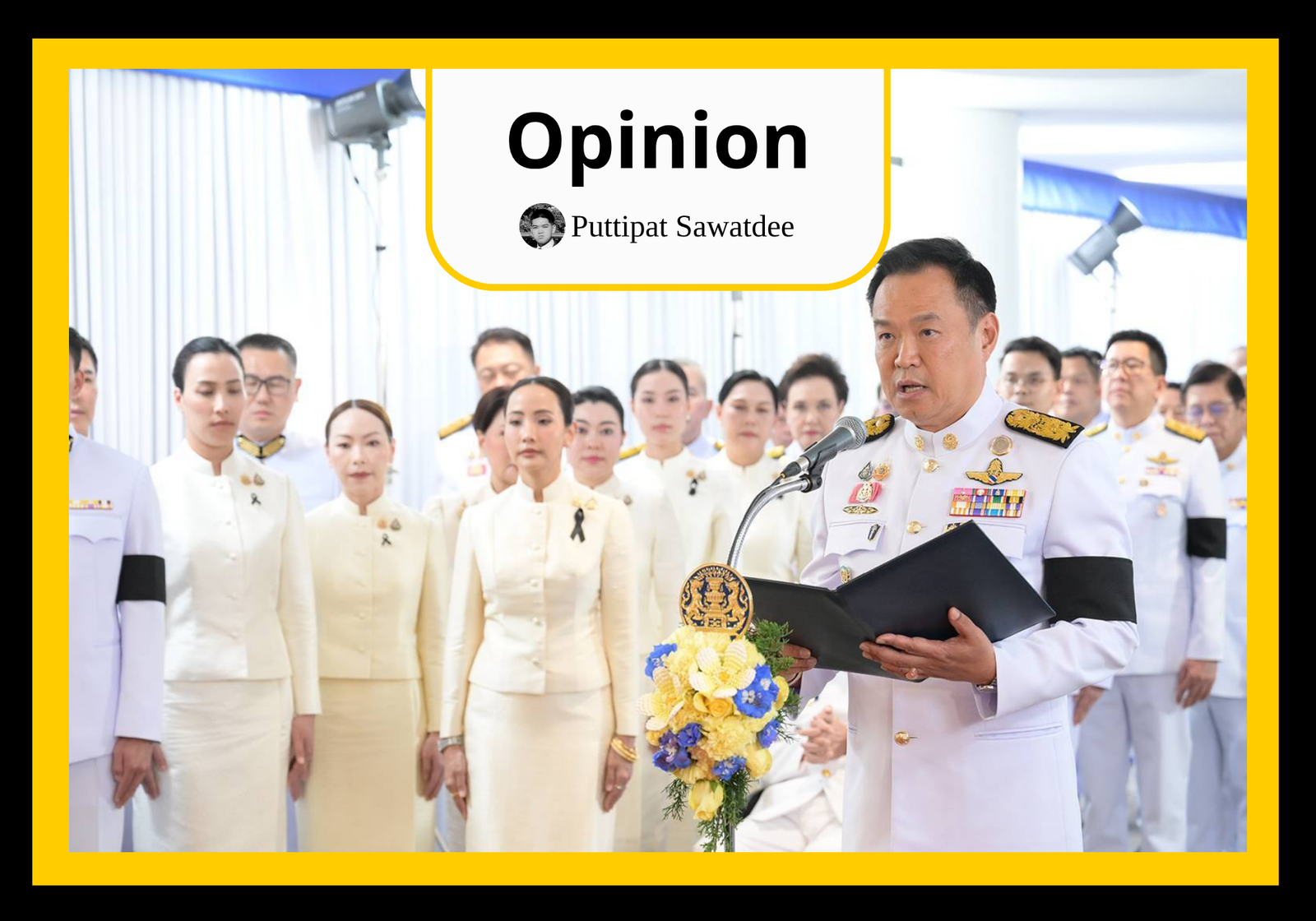
Thai PM Anutin Charnvirakul receiving the royal command of his appointment as the Prime Minister following his re-election on March 20, 2026. (Royal Thai Government)
Puttipat Sawatdee is an International Relations and Global Affairs student at Mahidol University. The views expressed are the author’s own and do not represent SEA Daily or that of another organisation.
An Overview to Thai Policymaking
Thailand has long relied on central economic planning to foster economic growth and address major socio-economic challenges. These policies range from the emergency measures implemented during the 1997 Asian financial crisis (known locally as TomYam Kung), to Thaksin Shinawatra’s ‘Thaksinomics’ reforms in its aftermath, to Prayut Chan-o-cha’s policies aimed at stabilising Thai economy during the COVID-19 pandemic and finally to Prime Minister (PM) Anutin Charnvirakul’s emerging economic agenda.
Anutinomics refers to the current PM’s economic agenda, a term inspired by Thaksinomics, that describes the economic frameworks introduced under Anutin’s administration. However, does his economic agenda represent a genuinely new economic framework as the term Anutinomics imply, or is it simply another variant of Thailand’s long-standing approach to economic policymaking? Anutin’s most significant economic initiatives might be able to answer this question, namely the newly formed Joint Public and Private Sector Committee for Economic Problem Solving (JPPCC) and the established Khon La Khrueng Plus programme.
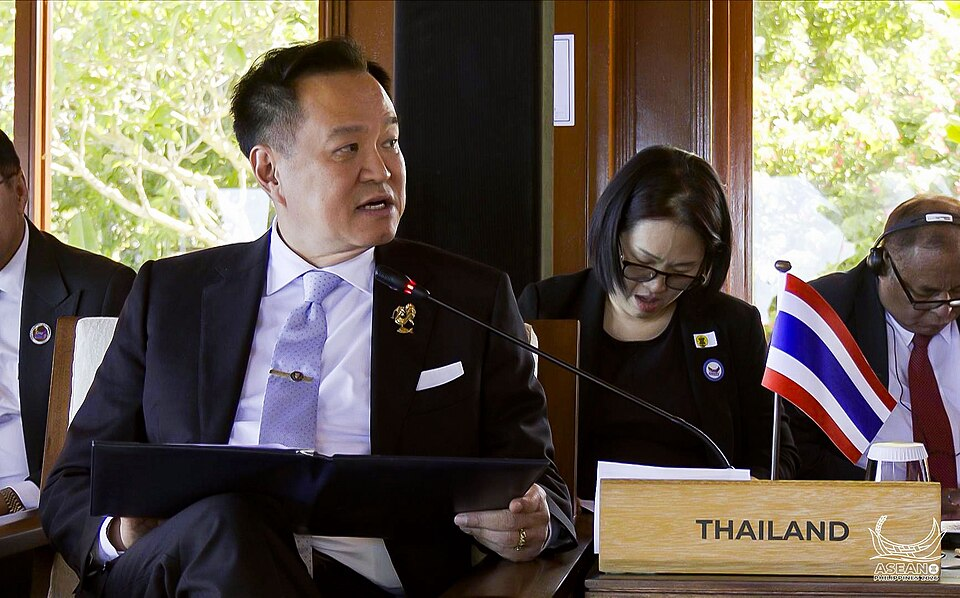
Prime Minister Anutin Charnvirakul during the 48th ASEAN summit in Cebu, the Philippines. (Philippine Presidential Communication Office)
Legacy of Past Economic Frameworks
Although Anutinomics emerged in the 2020s, its roots are based in Thai economic policymaking that dates before the 21st century. On July 2nd, 1997, following the Asian financial crisis, the Bank of Thailand (BoT) announced the float of the Thai baht and officially requested financial aid from the International Monetary Fund (IMF). The crisis began when Thailand’s baht was closely tied to the US dollar, prompting domestic borrowing of the US dollar at low interest rates, filling a massive real estate and stock market bubble with irresponsible foreign borrowing. When export growth slowed and global investors launched speculative attacks against the baht, the government exhausted its foreign reserves trying to defend the peg, which caused the float of the baht, leaving domestic businesses unable to pay back their dollar-denominated debts. Although Thailand attempted to maintain its economic framework by spending its foreign reserves, it ultimately failed, forcing the country to ask for a 17 billion US dollar financial support package from the IMF. This is widely considered as the turning point of Thai policy marking the birth of its contemporary economic policymaking, shaping future administrations’ approach.
Following the financial devastation caused by the TomYam Kung Crisis, telecommunications tycoon Thaksin Shinawatra was elected as the 23rd Prime Minister of Thailand in 2001. By that time, Thailand was economically devastated, with unemployment and devaluation rates rising to record highs due to which Thaksin was required to enact economic reforms. Now, these reforms were unique due to the unusual context since the country was required to open up to the global market while also prioritising its domestic citizens. This scenario led Thaksin to create the dual track policy, which involved the creation of domestic demand by satisfying the needs of all income groups, the dual track involved increasing trade between local regions or villages or the One Tambon One Product (OTOP) program, which focused on concentrated production of a specialty product of each Tambon (or village) boosting small local businesses, the dual track also covered entrepreneurs and businesspeople by creating a dedicated banking enterprise to relieve debts from the commercial banking system or provide low interest loans. These reforms were proven to be highly effective, creating global demand for Thai crops such as rice or rubber, allowing Thailand to surpass economic predictions by not only paying its debt to the IMF by 2003 (2 years earlier than predictions) but also maintaining a gross domestic product (GDP) of 5.3% in 2003, an increase from 1.9% in 2001. But although Thaksin’s administration was cut short in a coup d’etat in 2006, his approach, as he claimed himself “was followed by almost every subsequent government for its high flexibility, even if they put different names on it.”
In 2014, another military intervention occurred, with General Prayut Chan-o-Cha stepping up as the new PM. His main challenge was not a person, but a global disaster that affected all trade and dynamics in the world: the COVID-19 pandemic. At that time, Prayut was required to boost local consumerism while enforcing quarantine, keeping a delicate balance between public health and socio-economic conditions. This prompted the creation of several domestic based policies that fostered local trade despite international constraints. From these situations, the original Khon La Khrueng programme, which was a government initiative enacted to boost domestic consumption and by subsidising part of the purchases done at local businesses. The initiative was introduced in October 2020, which enticed both consumers and businesses to engage with each other by subsidising 50% of the purchases between registered citizens and partner businesses. These policies not only aim to pull Thailand back from the effects of the COVID-19 pandemic but also to prepare the country to return to normality, leaving a major legacy that would be inherited into the current administration.
It was against this backdrop that current PM Anutin Charnvirakul was elected on September 5, 2025 after former PM Paetongtarn Shinawatra’s resignation. Similar to his predecessors, Anutin inherited an economy facing multiple domestic and international challenges. While reducing the cost of living became one of his administration’s main priorities, external developments such as the Hormuz Strait conflict and the Thai-Cambodian tensions further complicated Thailand’s economic outlook. These circumstances required the government to formulate a new economic response. However, the more important question is whether Anutin’s response represents a genuinely new economic framework or simply another continuation of Thailand’s long-standing tradition of economic policymaking.
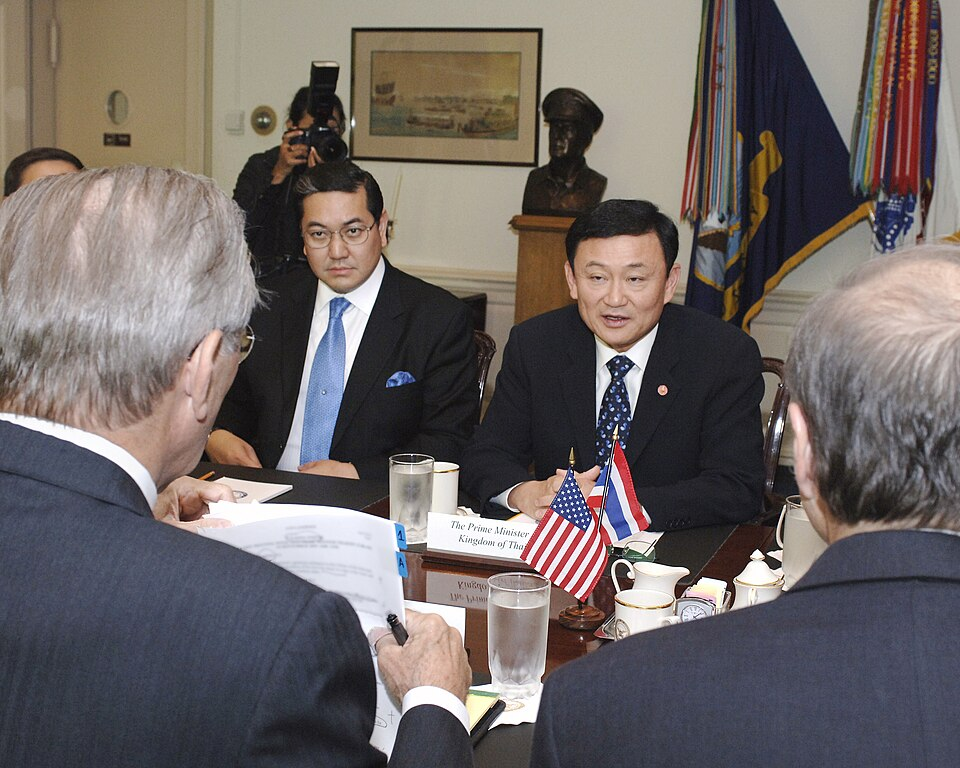
Former Prime Minister Thaksin Shinawatra (right) meets with Secretary of Defense Donald Rumsfeld (foreground left) in the Pentagon. (US Department of Defense)
Inheritance or Innovation?
Anutinomics focuses on reducing grassroots burdens and driving high-value economic restructuring, using the Khon La Krueng Plus (Half-and-Half Plus) programme as a foundational tool to expand financial access and onboard citizens into the digital economy. This digital launchpad is supported by strict SME protections, modernised capital markets and a global “Team Thailand” trade strategy that favours domestic products and diversifies international market risks. But apart from the economic challenges, Anutin also faces major unique scenarios, which includes significant border tensions with Cambodia since last year and the Strait of Hormuz conflict that risks a collapse on fuel prices.
Central to Anutinomics was the Joint Public and Private Sector Committee for Economic Problem Solving (JPPCC), which was created on June 16 with the goal of ensuring proper alignment between government economic policies and the private sector, while promoting and supporting such cooperation. The comparison begins with the classification of the JPPCC, which can be considered an economic cabinet plus, involving a distribution of responsibilities between public and private actors, unlike traditional economic cabinets, which are formed exclusively by public entities. Despite its recent introduction, the concept that underlines the JPPCC is not entirely new, a similar public-private dynamic existed during the Thaksinomics era, where several members of Thaksin’s cabinets possessed extensive business backgrounds across major industries. Specifically, in his second cabinet of October 2002, this public-private overlap was evident in: (1) telecommunications, via the PMs family and former Commerce Minister Adisai Potharamik; (2) automobiles, through former Transport Minister Suriya Jungrungruangkit; (3) entertainment, via former Interior Minister Pracha Maleenont; (4) agro-business, with Charoen Pokphand group’s former son-in-law and former Commerce Minister Wathana Muangsuk; (5) construction, involving former Industry Minister Somsak Thepsuthin and former Labour Minister Suwat Liptapallop; and (6) real estate, through former Public Health Minister Sudarat Keyuraphan and former Foreign Affairs Minister Surakiat Sathienthai. While the institutional structures differ, both approaches demonstrate an attempt to incorporate private-sector expertise into economic policymaking. This suggests that Anutin, together with Finance Minister Ekniti Nitithanprapas, may be adopting a similar philosophy of government-business cooperation, although through a more formal institutional arrangement that explicitly includes private-sector actors. There is no definitive way to determine whether this represents an intentional iteration of Thaksin’s CEO-style approach unless confirmed by Anutin or Ekniti themselves. Nevertheless, the structural similarities with Thaksin’s framework remain significant enough to suggest policy continuity rather than a complete institutional innovation.
On the other hand, Prayut’s Khon La Khrueng Programme was effectively revived under the new name of Khon La Khrueng Plus (or Half-Half Plus). This new policy works in the same pattern as the original programme but with a different approach by providing a 60 % subsidy for every purchase between partnered consumers and businesses and a slight difference between the scenarios on which they were implemented and the a difference of cap amount per day, with taxpayers paying 2,400 Thai baht (72,07 US dollar) while non taxpayers pay 2,000 Thai baht (60,06 US dollar). Although Khon La Khrueng Plus introduces several administrative refinements, including differentiated subsidy allocations and an expanded emphasis on digital financial inclusion, its core policy mechanism remains fundamentally unchanged. The programme continues to rely on government co-payment subsidies to stimulate domestic consumption and support local businesses. Consequently, Khon La Khrueng Plus appears to represent an evolution of the original programme rather than a fundamentally new economic policy.
It is thus evident that past legacies still significantly influence today’s Anutinomics. The structure of the JPPCC’s membership is similar to the composition of the cabinets during the Thaksinomics era, with distinguished members possessing concurrent backgrounds in the private sector. Likewise, the current Khon La Khrueng Plus programme represents a more sophisticated version of the original programme implemented under Prayut. With these comparisons, we can observe that Anutinomics is another sub-strand of Thai economic policymaking due to the clear influence of past economic frameworks on its policies. But although Anutinomics clearly inherits major elements from previous administrations, its emphasis on digital financial inclusion and the formalisation of public-private coordination demonstrates that policy continuity does not necessarily exclude incremental innovation. Ultimately, the long-term success of Anutinomics will not depend on whether it introduces entirely new policies, but on whether these inherited frameworks remain suitable for Thailand’s rapidly changing economic environment. This will nevertheless still be up for guessing as Anutin’s term has just started.

The Khong La Khrueng Plus Program, now providing a 60 % subsidy for consumers. (Thai Help Thai Plus)
About The Author