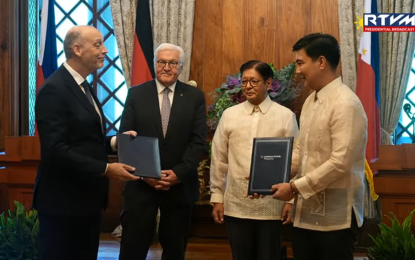
German President Frank-Walter Steinmeier and Philippine President Ferdinand Marcos Jr. attend the signing of an aviation agreement. (Philippines News Agency)
The aviation partnership deal was signed on June 16 at Manila’s Malacañan Palace, during German President Frank-Walter Steinmeier’s state visit to the Philippines. Philippine President and ASEAN Chair Ferdinand Marcos Jr. was also present to witness the exchange between the Bases Conversion and Development Authority (BCDA), the Luzon International Premier Airport Development Corporation and Lufthansa Technik Philippines (LTP).
Both sides agreed to develop a 157,000-square-meter site within the Clark airport complex, which will expand the aerodrome’s capacity to serve large aircraft.
Reportedly, operations will commence in 2028. This advancement is expected to drive Clark airport’s ambition to become Southeast Asia’s key aerospace hub and, subsequently, attract further capital and create job opportunities. As noted by LTP Chief Executive Officer (CEO) Holger Beck, “our sites in Manila and Clark will complement each other as two strong pillars of our growth and mark an exciting new chapter for LTP”.
BCDA President and CEO Joshua Bingcang stated that “Lufthansa Technik’s decision to expand in Clark is a strong endorsement of the Philippines, our workforce and the strategic advantages of Clark as an investment destination”.
Echoing this sentiment, Philippine Secretary of the Department of Finance Frederick Go affirmed that the investment manifests “growing international confidence in the Philippines’ economy and workforce”.
For context, Clark airport was formerly a US military base in the Philippines, initially built to facilitate Washington’s air force capabilities across the Asia-Pacific. Analysts remarked that the investment made by Berlin is a vivid illustration of how economics has become a new geopolitical tool.
What does this mean for business?
Optimism remains high as Germany stands as the Philippines’ largest business partner within the European Union (EU), with LTP operating as one of Manila’s premier aircraft maintenance powerhouses.This positive outlook is further reinforced by the fact that this year, Manila is ranked among the top ten fastest-growing aviation markets globally, with projected year-on-year (YoY) growth exceeding 4% over the next three decades, a momentum heavily fueled by a booming middle class.
The Clark airport expansion will yield 1,200 high-skill positions and carries immense potential to attract secondary aerospace investors. Nevertheless, a heavy obligation falls upon the government to upskill the local workforce to meet market demand, while resolving current political fragmentation within the Senate to avoid signaling policy uncertainty to foreign capital. Furthermore, with the local currency facing pressure from the ongoing Strait of Hormuz crisis, a rigorous strategic master plan is vital to safeguard the global competitiveness of the Philippine aviation industry.
Kala Advisory helps investors move on openings like these as Southeast Asia builds out new aerospace and industrial hubs. Visit kala-advisory.com.
About The Author